
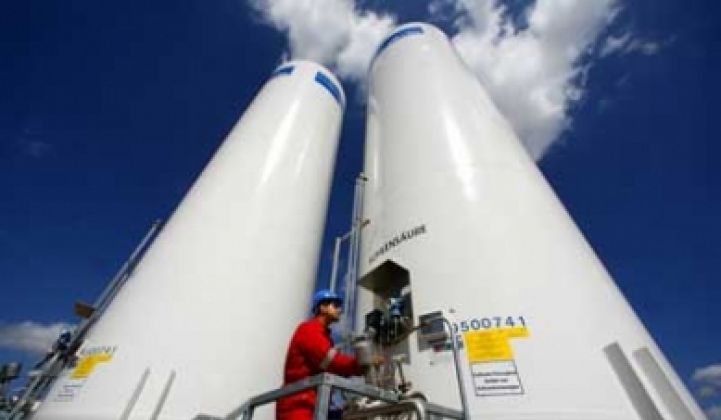
How do you combat a necessary evil on a budget? That's the dilemma with carbon capture. Scientists, policy makers and energy companies all agree that carbon dioxide from coal burning plants needs to be kept out of the atmosphere. The problem is how to do it without running up expenses that will make China, India, the United States and even Europe retreat behind years of prototype trials.
Thus far, carbon capture and sequestration (CCS) has been concerned with research and very little about actually putting the technology to real use. In Part I: Carbon Storage, the Money and the Market, we examined the history of carbon capture. In Part II: Carbon Economics, we dug into the forces driving the carbon market. In Part III: New Ideas in Carbon Capture, we profiled various companies making their mark in CCS. In this final installment, we'll examine the policies that are helping and hindering carbon capture and sequestration.
Part IV: Carbon Policies
The Policy Debate
Should the use of fossil fuels be prolonged, rather than focus on renewable energies such as solar and wind power? There are also doubts about how well the different technologies for storing and capturing carbon will work in the long run. Carbon taxes and cap-and-trade, would also have to be implemented in more countries. The debate will be an intense one.
Gas and wind power are growing fast. And solar power is seen as one of the strongest candidates to become one of the most common energy source in the future. CCS would not bring any climate benefits to the table compared to those energy sources. But there is much at stake and the clean coal technology would, if done correctly and on a large scale, make it possible to make the transition from fossil fuel to renewable energy more of a slide than a jump.
The companies that put CO2 in the ground today might not exist in the future, which is why it is important to create both regulations and standards that could survive over time. It's also a very important factor for companies investing in the technology. They need to know who's going to be responsible if something happens. It is possible that there will be some kind of fund for managing those responsibilities. For every ton of CO2 one injects in the ground one would need to contribute a certain amount to the fund. If something goes wrong there will need to be financial resources available to deal with it.
When it comes to developing the technology and putting it to use, the Intergovernmental Panel on Climate Change (IPCC) has developed a set of guidelines. The guidelines regulate how to inventory green house gases in every sector. And in 2006 the IPCC updated the guidelines with a plan for how to deal with CCS.
The Cost vs. the Future
The business of CCS is not a "two guys in garage" kind of industry. You need a lot of money and a lot of research. So there's no big startup industry connected to it.
"The projects are huge, a couple of billion dollars to build a plant. The insurance industry has developed insurance for this kind of industry. But it's very unlike solar energy where there's a huge potential if you come up with the most efficient solar cell," said Sally Benson, Director of the Global Climate & Energy Project (GCEP) at Stanford University.
But it could be beneficial to have more of a startup-mentality going into capture technology. The notion of carbon capture was not even heard about 15 years ago even though there were people doing research within the field. And it's also a question of humans surviving on the planet earth, which one might think could be worth a reasonable amount of money.




 41
41
 15
15
 9
9