
[pagebreak:CarbonCaptureItsPossibleSolutionsPartI]
How do you combat a necessary evil on a budget? That's the dilemma with carbon capture. Scientists, policy makers and energy companies all agree that carbon dioxide from coal burning plants needs to be kept out of the atmosphere. The problem is how to do it without running up expenses that will make China, India, the United States and even Europe retreat behind years of prototype trials.
Thus far, carbon capture and sequestration (CCS) has been concerned with research and very little about actually putting the technology to real use. Below we look at some of the issues and possible solutions.
Part I: Carbon Storage, the Money and the Market
Where Does It Come From?
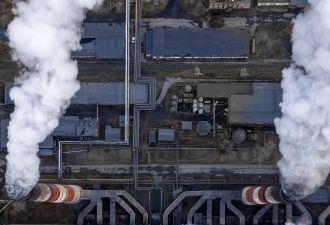
Although people like Charles Dickens have been complaining about the environmental effects of coal for over 150 years, it is still a big part of our energy consumption. Coal accounts for 49 percent of the electricity in the U.S., and 22 percent of all of the energy in the U.S. It's second only to petroleum.
Solar, wind, geothermal and wave power produce power with very low carbon emissions even after the emissions from equipment construction is calculated. Those technologies, though, only account for 12 percent of the renewable energy produced in the U.S. and renewables only account for 7 percent of the overall energy pie. Put another way, solar, wind, wave and geo are 0.8 percent of the U.S.'s energy.
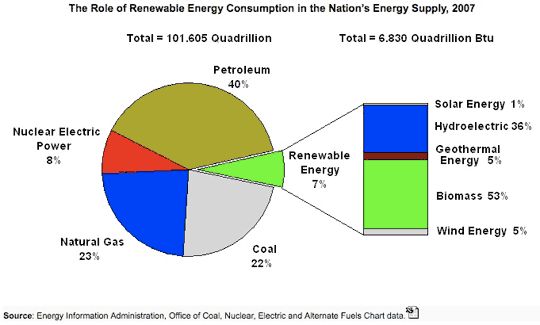
Source: DOE
"The reality is that in the U.S., half of our electricity comes from coal. And China and India are largely dependent on coal. People are using it. So my point of view is instead of saying that we shouldn't burn coal, let's instead find a way to make coal as environmentally acceptable as possible," said Stanford University research professor Sally Benson, Director of the Global Climate & Energy Project (GCEP) at Stanford.
"And the big emphasis of our work is trying to find ways of reducing CO2 emissions from that. It's just necessary. One can't play god. And people are not going to let go of electricity services," said Benson.
[pagebreak:Carbon Capture Cont'd]
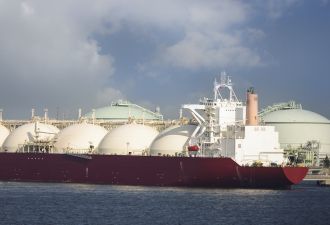
Much of the discussion regarding CCS focuses on coal, however, natural gas is also a problem – though it's not as big a problem, said Benson. Twenty-five percent of our emissions are from an industry that requires very hot processes, like melting and purifying materials using very high temperatures. Presently, no good substitute for these processes exists.
"Sequestration has the potential to help the transition for those kind of processes, which we rely on and that are important, and also for natural gas. Places like Italy and California have a very high reliance on natural gas for energy supply. But emissions for natural gas are not acceptable either. If we converted all of our emissions to natural gas, the emissions would still be way too high," said Benson.
Cars, of course, emit carbon emissions as well, but it's tough to put an industrial scrubber on a tailpipe. Nonetheless, electric cars, cleaner diesels and improved mileage will cut down emissions.
Coal Dust on the Highway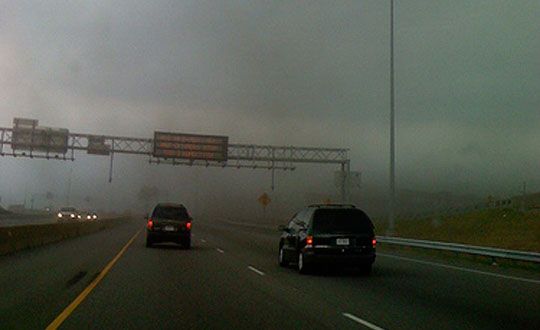
Source: Candescense
How Do You Separate CO2?
The technology for separating CO2 from emissions is really not the problem. Storing it permanently is. The most common storage process involves using a liquid solvent to bind with the CO2. The emission gases are then collected, chilled and mixed with the solvent, which captures the CO2 in a chemical reaction. By changing into a more solid state the CO2 can be separated from other gases. It later gets reheated, which makes the solvent and the CO2 divide. The CO2 then goes into storage while the solvent can be reused.
Other methods of scrubbing include: absorbents, selectively permeable membranes and cooling down the flue gases to force CO2 to condense. Scientists are looking at other ways of scrubbing that would be more efficient.
On a more positive note, capturing gases and keeping them out of the atmosphere has worked before. Remember acid rain? After regulations passed, major manufacturers invested in scrubbers, which got rid of a huge amount of sulfuric gas.
[pagebreak:Carbon Capture Cont'd]
How Much Needs to Be Stored?
Lots, and it needs to be stored for thousands of years. The UN Intergovernmental Panel on Global Change (IPCC) estimates that 10 percent to 50 percent of the emissions reductions goals for 2100 could come from CCS. Humans emit about 27 gigatons of CO2 every year.
There are, of course, risks. The companies that today would pump the CO2 in the ground may very well cease to exist in a few hundred years. According to the IPCC, it's very probable that 99 percent of the stored CO2 would remain stored within the first 100 years after injection. But the question about global responsibilities and carbon taxes is yet to be solved.
The Coal Utilization Research Council (CURC) notes that there is a portfolio of options and different coals may require different solutions. They also emphasize that retrofit solutions will be more costly than new plant solutions due to space limitations, and relatively low initial power plant efficiencies.
Locations
There are three different locations where CO2 could be stored: oil and gas reservoirs, deep saline formations, and coal beds that can't be mined. In each case, CO2 is stored by injecting it in dense form into rock formations below the surface of the earth. This method is already used in the oil and gas exploration and production industry for, among others, enhanced oil recovery. And the technology for exploring oil and gas reservoirs today could be used for finding storage sites for CO2 in the future.
The possibility of injecting CO2 in geological formations such as basalts, oil and gas shales, salt caverns and abandoned mines are all seen as niche opportunities to this day and would need more research to investigate their potential.
Diagram of a CO2 Storage Facility
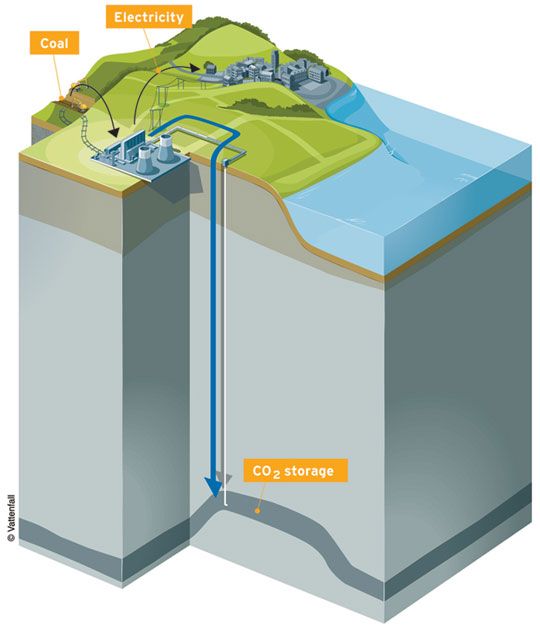
Source: Vattenfall
Continue to Part II: Carbon Economics.




 41
41
 15
15
 9
9