
[pagebreak:CarbonCaptureItsPossibleSolutionsPartIII]
How do you combat a necessary evil on a budget? That's the dilemma with carbon capture. Scientists, policy makers and energy companies all agree that carbon dioxide from coal burning plants needs to be kept out of the atmosphere. The problem is how to do it without running up expenses that will make China, India, the United States and even Europe retreat behind years of prototype trials.
Thus far, carbon capture and sequestration (CCS) has been concerned with research and very little about actually putting the technology to real use. In Part I: Carbon Storage, the Money and the Market, we examined the history of carbon capture. In Part II: Carbon Economics, we dug into the forces driving the carbon market. Below we'll look at some of the new ideas in carbon capture.
Part III: New Ideas in Carbon Capture
Storage Through Careful Burning
Rather than store CO2 underground, some companies claim they can sequester carbon in the power plant where it is generated depending on how the coal is handled. The process complements underground storage.
A. Pre-Combustion Treatment
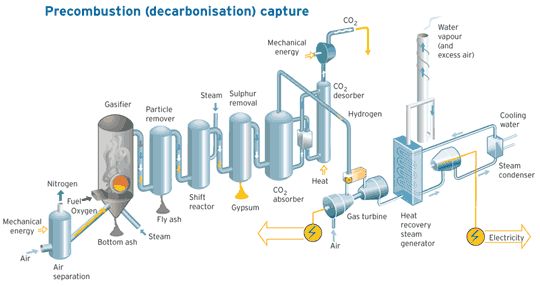
Even before coal gets burned, it can be treated so there is less to capture and store. The CO2 removed in this stage of the process needs to be stored, but it's easier, say advocates, to capture and store CO2 early in the process than when it comes out of a smokestack.
Source: Vattenfall
One of the leading pre-treatment companies is CoalTek. The firm reduces the moisture content in coal to optimize plant efficiency and make the coal "cleaner" before combustion.
Novomer, a competitor to CoalTek, is a green chemistry company using carbon dioxide as an ingredient for a chemical process that produces uniform polymers, plastics and other chemicals. Its goal is to turn these materials into green environmentally friendly materials. Dow Chemical Company is another actor in this field. And there is also Microcoal, which process cleans up coal pre-combustion by basically microwaving it.
B. Old-Style Gasification
If you talk to Siemens or GE, they will tell you they've been doing CCS with integrated gasification combined cycle plants (IGCC). In a nutshell, the process turns coal into synthetic gas and removes impurities before combustion.
The gas is used to power a combined cycle gas turbine where the waste heat of the turbine is powering a steam turbine system.
C. New-Style Gasification
Great Point Energy says it has a technique for converting coal and biomass into pipeline-grade natural gas while also allowing capture and sequestration of the carbon dioxide.
"We can take coal out of the ground and put it in a natural-gas pipeline for less than the cost of new natural-gas drilling and exploration activities," said CEO Andrew Perlman, to MIT Technology Review.
The base of the technology is a recyclable catalyst that lowers the level of heat that is required for the gasification process and also transforms the coal into methane from its gasified state.
D. Underground Mining
Laurus Energy doesn't want to dig coal up. It wants to burn it underground. Borrowing technology originally developed in the former Soviet Union, the Houston-based company wants to popularize a technique for using coal as a form of energy that it says will be both comparatively environmentally friendly and economical. Scotland is conducting similar experiments.
An underground coal gasification project is more or less like coal mining without a mine. Instead of an open pit you dig wells in the ground reaching down to the coal resources. Then you inject oxygen and saline water turning the coal into gas.
The clean synthetic gas produced from the underground coal resources can be used for pretty much the same purposes as natural gas: power generation, gas for home heating, hydrogen, methanol and transportation fuels. It can also be used for pre-combustion carbon dioxide capture.
The method of underground coal gasification poses no risk to shallow fresh groundwater since the depths are below 1,000 meters, says the Alberta Energy Research Institute (AERI). And being underground it's more environmental friendly compared to traditional coal mining or coal gasification methods, but of course not near as clean as solar or wind power.
[pagebreak:Carbon Capture Cont'd]
Capture Without a Cave
Several companies are proposing ways to capture carbon without the geological engineering and policy headaches that come with underground storage. Some of the leading ideas include:
A. Mineralization
Carbon dioxide can be stored by turning it into stable carbonate mineral. This is made through a chemical process that actually speeds up a natural process that changes the CO2 gas into a solid mass. When it's done in nature the CO2 turns into limestone. When higher temperatures or pre-treatment of the minerals speeds up the process, the result is CO2 in solid form, not dependent on sealed storage space below ground or sea level. Though the technology is estimated to use much more energy than a regular power plant.
Carbon Sciences has a system for converting CO2 into calcium carbonate (CaCO3). Calcium carbonates can sell for $1,000 a ton and the paper industry, which started substituting it for wood chips in the 1980s, buys 80 percent of it. Converting gases into a solid requires energy and money, but the energy usage and cost are offset because the calcium carbonate won't have to be mined from the ground.
The process of mineralization can also be used in building products. CalStar is a company that takes advantage of this technology when making bricks for buildings. Instead of burning clay, CalStar takes fly ash, the particulate matter that ordinarily leaves smokestacks to enter the atmosphere, add some extra chemicals and make bricks. Rather than requiring high temperature cooking, the chemicals sort of congeal into a solid, hard mass. The CalStar process will reduce the energy content in bricks by over 90 percent, according to CalStar.
Another actor in this field is Skyonic. Its SkyMine process is a post-combustion technology that fits with large CO2 emitters like coal, natural gas or oil fired power plants. The process is said to remove CO2 from conditioned at-temperature flue gas and store it as stable sodium bicarbonate (industrial clean baking soda). It also returns the flue gas to the plants stack for release.
B. Algae
CO2 can be turned into food for algae, which then can be used to make biofuel. Algae are also fast-growing and harness sunlight and CO2. Some researchers believe they can use the stored energy within the algae and convert into fuels such as biodiesel and ethanol. Also, proteins produced by algae could be used for animal feed.
The method has not been tested on a big scale. However, startups like SequesCO claim it is possible.
C. Untouched Rain Forests
Rain forests act as a carbon sink when it comes to taking care of greenhouse gases, and there is more carbon stored in the world's forests than in all remaining oil reserves in the world. That shows the importance of keeping the forests alive. Young, actively growing forests consumes more CO2 than it releases and could be used for lowering the effects of CO2 emissions.
Forestation carbon credits are already for sale on auctions and carbon markets conducted by WorldEnergy and others.
Countries in the Rainforest Coalition, like Papua New Guinea, Brazil and Costa Rica, are somewhat dependent on the destruction of the forests for their economic growth. In the same time, the rest of the world is dependent on the preservation of the forests' natural wealth. The Rainforest Coalition recognizes this and their solution is putting a price on the action of not harvesting the forests and controlling the logging.
"The objective, is to align the interests of rain forested developing nations with industrial nations – with the latter offering markets for carbon off-sets and forest products," said Sir Michael Somare, the Prime Minister of Papua New Guinea, in an interview with The Independent. "If we, the rain forested nations, reduce our greenhouse gas emissions, we should be compensated for these reductions, as are industrialized nations. It's that simple."
D. CO2 Into Fuel
Carbon Sciences says it has the technology to transform CO2 into basic fuel building blocks. It converts CO2 into hydrocarbons (methane, ethane and propane), which can be used for gasoline and jet fuel.
It is a biocatalyst process, which means that both microbes and chemical catalysts are involved. The biocatalysts "destabilize" the carbon dioxide. Water is injected as part of the process. The end result is a number of carbon-hydrogen molecules, which become precursors to fuel. The hydrogen atoms released from the water molecules do not have to be converted into freestanding hydrogen molecules in the company's process. The biological part of the process is key because CO2 is a stable molecule; cracking or destabilizing it requires quite a bit of energy with traditional processes.
Carbon Sciences isn't the first company to think of something like this. LanzaTech, a Khosla Ventures company, wants to make ethanol from CO2. Japan's Mitsui is also trying to turn carbon dioxide into methanol, another liquid fuel.
Also, Scientists in Singapore say they've found a way to turn carbon dioxide into methanol, using less energy and lower temperatures than previous processes. The new process uses N-heterocyclic carbenes (NHCs) as an organocatalyst, then adds hydrosilicane – a combination of silica and hydrogen – and water to make methanol, according to a study published in the journal Angewandte Chemie International Edition.
But don't hold your breath. "There is a good reason CO2 is the end product of combustion. It is a low energy molecule," said Steve Koonin, the former BP chief scientist who is now in the Department of Energy." Getting rid of CO2 by burying it underground may be the best option.
[pagebreak:Carbon Capture Cont'd]
E. Membranes
Parc, among others, are working on catalytic membranes that would soak up carbon dioxide from a plant, similar to how a catalytic converter gobbles up fumes in car engines. Scientists envision fields of gossamer, similar to the running fence erected by the artist Christo years ago, surrounding power plants. The sheets could then be replaced and buried. Like many others, the technology is still in development.
F. Treaty Time: Ocean storage
Another way of storing CO2 could be to inject it directly into the ocean at depths greater than 1,000 miles. While it's a new technology, it would also likely be preceded by international agreements. It is estimated to then become isolated from the atmosphere for centuries and would subsequently go into the global carbon cycle. The injecting would be done via pipelines or ships.
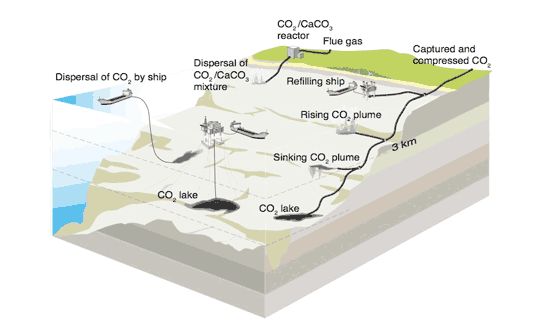
Ocean storage methods.
Source: IPCC
The Risks and Threats
CO2 could change the ocean chemistry around the area where it has been injected. If hundreds of GtCO2 were injected it could even change the balance of the whole ocean. Adding CO2 could also harm marine organisms leading to reduced rates of calcification, reproduction, growth of the oxygen supply and increased mortality.
The Costs
The cost of injecting CO2 into the ocean (not counting transporting it to shore) is estimated at $5 to $30 per gigaton of CO2 by the IPCC. For short distances it will be cheaper to transport it via pipeline and for longer distances by ships. Recent scientific reports from Lawrence Berkeley Lab also cast doubts on how well ocean sequestration would work.
G. Plankton
The open ocean is where most of the natural CO2 gets removed from the atmosphere. Natural phytoplankton do it naturally. Climos is one of the companies that thinks it can use this knowledge and improve the efficiency of the natural phytoplankton production to lower the effect of human CO2 emissions. It has done small-scale experiments since 1993 and developed its Ocean Iron Fertilization method. According to Climos, the addition of iron can stimulate large blooms of phytoplankton, but the methods are still in its research phase.
The idea is to provide iron for the iron-limited regions of the ocean. This will make the phytoplankton grow faster and in the same time lock away carbon. This is called the biologic pump and it puts carbon in the deep ocean as sediment and dissolved bicarbonates.
This technique, though, is highly controversial.
Continue to Part IV: Carbon Policies.




 41
41
 15
15
 9
9