
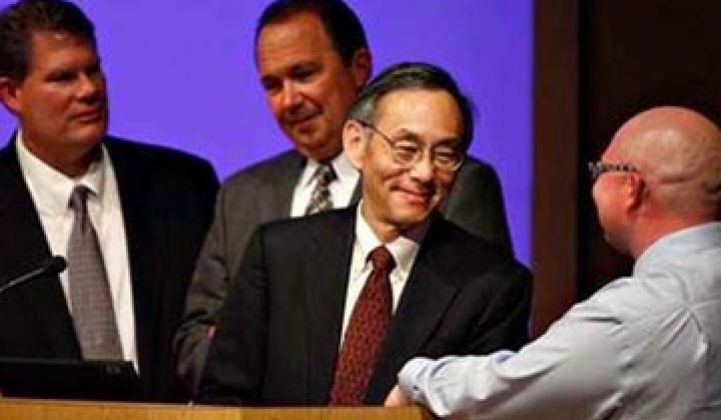
Washington, D.C.--ARPA-E, the advanced projects division inside the Department of Energy, will hand out $100 million to accelerate research to promote building technologies like energy efficient air conditioners and concepts for the grid like "soft magnetics, high voltage switches, and reliable, high-density charge storage" that can store and/or deliver megawatt hours worth of power quickly as part of a second round of grants.
The funding announcement kicked off the ARPA-E Energy Innovation Summit taking place in Washington this week. ARPA-E, modeled after the Internet-creating agency called DARPA inside the Department of Defense, was founded last year to seed next-next-generation projects. Last October, it gave out $151 million in grants to among others, start-ups working on direct solar fuel (liquid fuel from carbon dioxide and sunlight) as well as novel storage technologies. The grants average around $4 million. ARPA-E will have a grant budget of $400 million.
We wrote yesterday about a concept that PARC will show off at the conference -- an air conditioner powered by sound waves. It could cut energy consumption in the U.S. by 13%, according to PARC.
ARPA-E will likely be a favored agency as long as Steve Chu remains Secretary of Energy. For years, Chu, who came out of Bell Labs, championed the idea of funding for advanced research. ARPA-E is run by Arun Majumdar, a former UC Berkeley professor who worked with Chu. What concepts might these two favor? It's hard to predict, but both worked at Lawrence Berkeley Lab, where energy efficiency for buildings was a primary topic of research. Majumdar also conducted research that led to the formation of waste heat start-up Alphabet Energy. Chu has also been a proponent of synthetic biology: genetically engineering microbes to produce synthetic fossil fuels or industrial chemicals. Amyris, which may file to go public soon, was fostered at Berkeley.
Rick Thompson and David Leeds from Greentech Media are at the conference. Here are their notes from the speeches of Chu and Majumdar.
Chu:
--"Most of the dramatic progress in science occurred during golden moments of time and space," Chu said. "How do we nurture these golden moments for energy innovation?"
Chu's advice for building a lab? Hire great people: protégés, not assistants. Lesson two: maximize your chance for making a great discovery by developing and using new technology. In the pursuit to ever-shorter wavelengths and higher resolution radar, Charlie Townes invented the MASER -- intellectual precursor to the LASER. Clinton Davisson joined Bell Labs in 1917 to work on vacuum tubes. William Shockley joins in 1936 to work on vacuum tubes and soon moved to the newly formed solid-state research group. In the 40s, he headed up the team that developed the first transistor.
--Other Bell highlights: the Weinberg-Salam-Glashow theory unifying electromagnetic and weak nuclear forces. Bell Labs was structured to promote communication. Seventeen scientists were awarded Nobel Prizes.
--The talk ends with a flash vision of Earth from Apollo 8 and a bleak lunar landscape: "There is nowhere else to go"
Majumdar:
--"Starting a new agency is not easy; it takes a village."
--DARPA was created in 1958 in response to the launch of Sputnik because it was felt that the U.S. was losing ground in terms of technological leadership. Today, we have another "Sputnik moment."
The three main issues we face today are energy security, greenhouse gas emissions, and achieving a global technological lead. The U.S. also uses more energy and emits more carbon dioxide per capita than other nations.
"Business as usual means that we are sitting on the Titanic heading for the iceberg," he said.
--This will be a big business opportunity, too. The U.S. only has a very small slice of the solar panel and lithium battery market.
-Technological game-changers for the last century included: artificial fertilizers, the green revolution, polio vaccinations, antibiotics, airplanes, electrification, nuclear energy, transistors, integrated circuits, fiber optics, wireless communications, and the Internet. All of that innovation took place in a 100-year time frame, although some of the inventions were bunched up in a few decades. It wasn't a smooth path of inspiration.
Now imagine all of this happening in a 20-year time-span -- that is exactly what energy needs.
--Some of the areas ARPA-E will concentrate on include batteries for transportation and storage. Battery packs for electric cars now cost around $15,000. That needs to drop to $10,000 within a few years.
--Carbon capture is another area where ARPA-E will direct research. It now costs $70-$100 to capture a ton of carbon dioxide. Majumdar also likes direct solar fuels.
--We still have the best R&D infrastructure in the world and the best ecosystem for developing businesses. The goal is once again to turn scientists into rock stars. History made heroes out of the Manhattan project researchers, after all.


 41
41
 15
15
 9
9