• Wednesday, May 13, 2009 Latest Update: 10:32AM

Greentech Solar

An Ikea for Solar?

Armageddon Energy has a solar system-in-a-box that removes a lot of the pain and expense from installing solar systems.

It's a solar system, but Armageddon Energy's system is built like something you'd find at Ikea called a "Snarvik."

Armageddon Energy has devised a framing system and a lightweight solar panel that, effectively, can go straight from a few cardboard boxes to your roof. It's sort of like assembling furniture from Ikea for your living room.

A single solar "clover" from Armageddon consists of a triangular frame, a micro-inverter and three lightweight silicon hexagonal solar panels. A single can put out 400 watts. A few Tab As into Slot Bs and it's complete. Three of the systems on one roof can provide a house with a kilowatt of power, says Armageddon CEO Mark Goldman.

The clovers still have to be secured to the roof, angled toward the sun and plugged into the electrical system – which works best when handled by professionals – but much of the grunt work associated with conventional solar systems is already done. As a result of pre-fabbing, the cost of an Armageddon system will be lower, Goldman asserted.

A household system built around its clovers will deliver power for $6 a watt when the company starts shipping them in commercial volumes a little over a year from now, he said. (Beta systems will cost about $10 a watt.) At $6, that's $1 less per watt than conventional household systems today, once it gets into manufacturing.

"The total is six grand [for a clover] but the target is less than that," he said. Setting up a clover "takes a few minutes," he added.

The clovers are also lightweight. A single hexagonal solar panel weighs around 10 to 12 pounds. A conventional silicon solar panel might weigh 40 pounds. Lower weight means cheaper shipping, lower carbon taxes (where applicable) and a more rapid install.

Solar appliances like Armageddon's clover constitute a fringe of a sliver of the solar market today, but interest is growing. Unlike standard solar modules, solar appliances are complete systems and tend to be differentiated by how they are packaged and the functions they perform, rather than any particular nuance in the solar cell itself. Chromasun, for instance, has devised a rooftop device that creates electricity to PV cells but also provides heat (via solar thermal collectors) to compressors in a building's air conditioner system. SDFs has an all-in-one solar thermal/PV panel/skylight device.

Ideally, solar appliances will more tightly fit customer needs, reduce resistance to adoption, and cut the costs of installation, while at the same time reducing a manufacturer's risk to declining module prices. A BMW, after all, is from a functional standpoint just a car, says Goldman.

 "That's when you put on your marketing hat," he adds.

And installation costs could stand some trimming. Installation still accounts for around 30 percent to nearly 50 percent of the cost of a solar system. Over the past three decades, the vast majority of research in the industry has focused on increasing the efficiency of solar cells and reducing the amount of raw material required for solar cells.

The hexagonal panels weigh less than conventional panels because the cells are encased in a Teflon coating from DuPont rather than glass. A thin-film coating will likely raise eyebrows among installers and consumers. Testing is underway. Goldman projects that the coatings will last for 20 years, but initially it will likely only offer a ten-year warranty.

And what is with the hexagonal shape? It is more efficient. They examined several shapes. Circles tend to be strong, but contain a lot of wasted space. Rectangles are, by their nature, off-balance. Hexagons are inherently strong and efficient. Hexagonal solar panels means the company can also use triangular racks, and triangles tend to be fairly stable.

One of the company's investors, ironically, is a great grandson of Buckminster Fuller, who championed hexagons and three-wheeled vehicles.

" 'You don't have to sell me on hexagons,' he said," Goldman recalled.

But Armageddon isn't imminent. The company, however, only recently completed its first prototypes and is working on a larger beta round of devices for further testing.

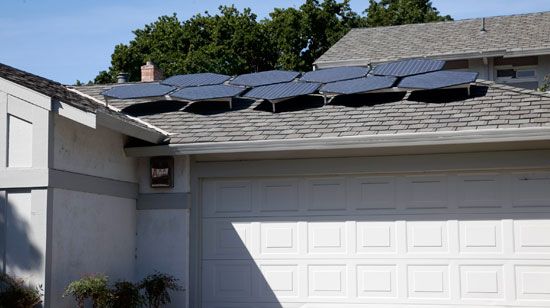
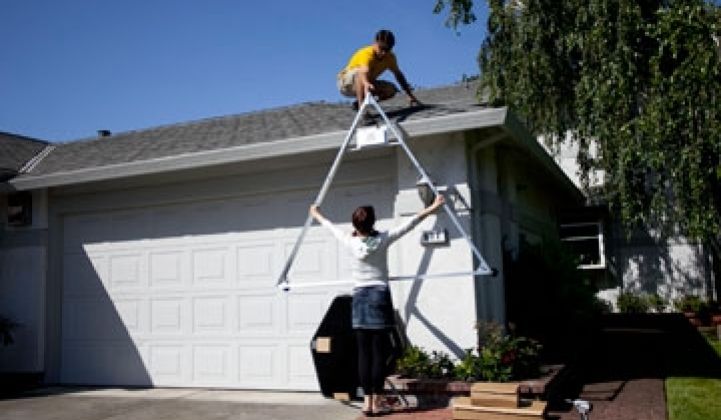
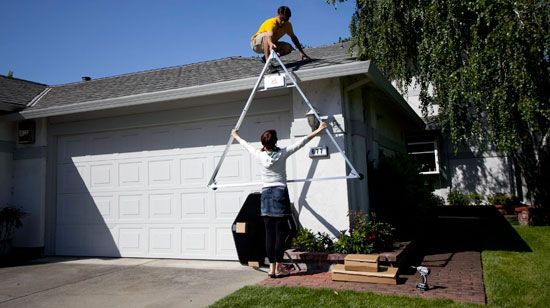
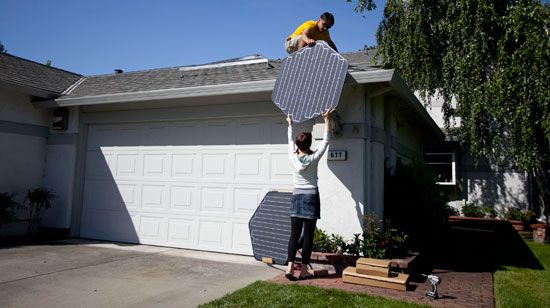
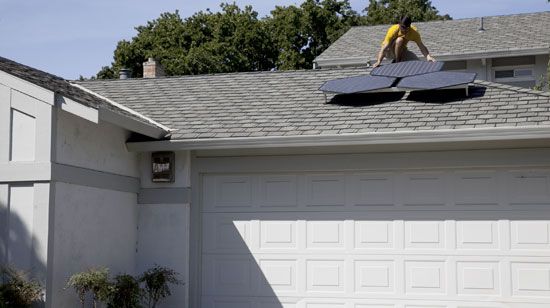
The photo gallery below shows, respectively, hexagonal panels going up on a roof, the triangular rack, a single clover and a 1-kilowatt system.
Join industry leaders and influencers at Greentech Media's Concentrating Solar Technologies & Markets at Intersolar in Munich, Germany on May 29.
Comments [18]

  • Peter A 05/13/09 12:38 PM

    I think I said it before (or was it a different forum?). We are not too far from being able to walk into Home Depot and buy a DIY solar kit starting at $299. Solar scales linearly (unlike wind) and with mass manufacturing of panels in China the cost will continue to decline. Ten years from now, most houses in America will have solar panels and many of them will have advanced high-capacity storage as well (it’s on its way). We’re not going to get off the grid, but much to the dismay of the big utilities, Intel, CISCO and Google, the so-called “smart grid” won’t be the Matrix that they’re dreaming of. Energy independence begins at home.

    Reply
      • Bruce Kujawa 05/18/09 9:28 AM

        Let’s keep moving in this positive direction. Since I live in Florida, solar energy should be a major source of our power needs!

  • Dave Brooks 05/13/09 2:31 PM

    What the heck is a Snarvik? Even Google is stumped.

    Signed, “confused”

    Reply
      • Michael Kanellos 05/13/09 3:18 PM

        It is the kind of name you’d expect on a product at IKEA. LIke the Alsvik single handled faucet. My dream job would be to name stuff at Ikea.

  • Mark A in Illinois 05/13/09 6:19 PM

    On a tangential note.  The sun shadow on the garage door barley moves over the 3 or so pics above.  This husband and wife DIY team is really fast! 

    But seriously the comment of Peter A is good.  The electric utilities get the highest prices and sell the most juice in July and August when the sun shines brightest.  Peak summer load is exactly that but 1KW on every residential roof in America could make a real dent .

    Reply
  • Meredith M 05/15/09 2:17 PM

    Check out Ready Solar (http://www.readysolar.com).  They have a product already on the market.

    Reply
      • sodajerk 05/19/09 11:30 PM

        Their website is worthless

  • sodajerk 05/19/09 11:27 PM

    I like the idea of IKEA selling solar. I bought my first compact fluorescent bulb there in 2004 and it’s still humming along.

    Reply
      • Steve Pluvia 05/20/09 9:46 AM

        Costco is selling a modular PV system for $5/watt right now.

  • rooferguy 05/20/09 7:56 PM

    Steve - I haven’t seen it in my Costco (I just buy my ladders there).  Do you have a URL or more information about the product in Costco?  Is it Ready Solar?

    Reply
  • DouglasDiner 05/21/09 8:01 PM

    This looks awesome. not the most aesthetically pleasing solar system on the market, but looks pretty interesting…none the less. I for one am going to take a look at it, at least. I love the fact that it is so simple to set up. That’s a big selling point, as far as I am concerned. bamboo clothes

    Reply
      • Hayds 06/2/09 3:37 AM

        Looks great. Will this be available in South Africa? Would it also work on a flat roof? I would like to keep it out of view of people walking past the house. Being outside, it is easy for this product to be stolen of the roof. If i could leave it flat on the flat garage roof, no-body would be able to see it.

  • dougout 07/14/09 7:17 PM

    Akeena Solar (akeena.com) beat Armageddon in having easy-to-install panels, both in physical integration (panels more or less “snap” together), and in micro-inverters (which make the electrics easy and safer for DIY). Akeena’s panels which they call Andalay are patented (US patent 7406800).

    Reply
  • FreeCleanSolar.com 07/16/09 10:56 PM

    Props to armageddon for advancing with an innovative product.  But that name is a bit off-putting. 

    The DIY market for residential solar panels will likely account for 15% of the total U.S. market once it becomes more mainstream.  The majority of homeowners will want and need a professional, certified solar installer to design a system, turn off the power, get up on the roof, run conduit, test the system and re-connect the power… without being electrocuted.

    If you want to do something about this today, then visit a site like FreeCleanSolar.com to search a nationwide network of 500 local solar installers. You can also find information about state solar rebates, federal tax credits, solar financing, system costs and the benefits of going solar.  The bottom line is that many homeowners and business owners can afford solar power today.

    Reply
  • Robert 08/24/09 9:43 PM

    Nowadays everyone is moving into green tech. I’m still waiting for our Ikea to start selling this solar system-in-a-box.. although i doubt if we ever get one because of our government politics…hybrid suv

    Reply
  • Zfficiency 11/11/09 7:41 PM

    How do you connect it to your house electric system? What about the Utility interface?

    Reply
  • rooferguy 11/12/09 7:54 PM

    You fill out 50+ pages of utility, city and state paperwork, hire an electrician for the wiring, then make appointments with your local building department for an inspection and utility for a meter change-out….

    Or you go to Home Depot and buy an adapter and plug it right into a wall.

    What do you think people will do?

    Reply
.