

[pagebreak:AGreenBuildingMarketOverview]
If you want to get a sense of the scale of the opportunity in green building, look around.
If you're reading this while inside a U.S. office building, there is an 85 percent chance you're under or near a fluorescent tube bulb. General Electric and Westinghouse began selling them in 1938. They were a big hit, along with the television and an IBM typewriter, at the World's Fair a year later.
Modern drywall? 1916. Joseph Aspdin invented Portland cement, which is still the world standard today, in 1824. The cement is made by crushing rock and cooking it to 2,700 degrees Fahrenheit. With the right tools, the Flintstones could have figured that one out. Electric air conditioning? Willis Carrier invented it in 1902. And you can thank Albert Butz for the devising the thermostat in 1885.
And if you think about it, you could probably take care of your cooling and lighting needs if you could only open your office window.
It's that handsome combination of IOU (inefficient, old and ubiquitous) technology, the potential for inexpensive solutions and the "wow" factor that green design techniques lend buildings like the California Academy of Sciences that lay at the heart of the market. Building hasn't been as popular with VCs as solar or biofuels -- but many believe we are on the verge of a two-decade boom in retrofits and new types of construction. (It's why we are holding our Green Building Summit next week on June 11.)
Besides, if the economics won't drive it, legislation will. In California, new homes will likely have to meet net-zero energy standards by 2020 and commercial buildings will have to hit it by 2030. An estimated $21.65 billion is baked into the American Recovery and Reinvestment Act. And to get grants in other parts of the program, applicants have to show they are "shovel ready."
But it's also a more complex market with more moving parts than solar or biofuels. We've broken it down into five segments.
1. Construction and Design
If you talk to contractors and architects, they claim that most energy savings can be accomplished through proper design and construction. While that point can be debated, green construction has clearly become commercially attractive. Various studies report that LEED-certified or LEED-like buildings generate higher rentals and property values. Employers claim environmental construction reduces sick days and serves as a recruiting tool. A much-touted retrofit of the Empire State Building dropped energy consumption by 38 percent.
In China, A skyscraper being erected in Shanghai will have municipal parks on most floors while buildings by upscale developer Shui On Land can rent for 1.5 times that of competing properties, according to sources. Retrofitting or building green also does not necessarily add costs.

Source: Department of Energy
Limbach Energy Solutions, a large HVAC contractor in Pittsburgh, has begun to take a program developed in Ohio for cash-flow neutral energy retrofits. In the commercial market, large builders like Webcor and Weitz already gain a substantial portion of their revenue from LEED. A few startups like Project Frog, which builds energy efficient schools, have also emerged.
The consumer space has moved slower than commercial or government. Prior to the economic downturn, mass home builders such as Lennar reported fairly strong sales of homes equipped with solar panels. Since then, it's been tough to sell homes. Michelle Kaufmann Designs, one of the early modular homebuilders, recently went under while others such as Living Homes and Zeta Communities are in startup mode.
[pagebreak:Green Building Overview Cont'd]
2. Building Materials
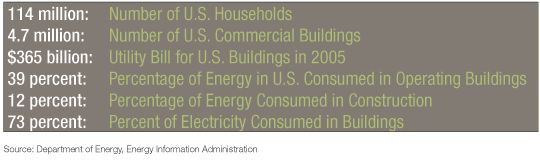
Building materials comprise bricks, cement, drywall, carpets, furniture, wood flooring, windows, insulation, etc. Approximately 12 percent of the energy in the U.S. gets consumed in construction and preparing building materials, according to the DOE. The idea here is to produce products, like thermal windows, that reduce energy consumption, or cut the energy and natural resources used in manufacturing them.
Serious Materials – which specializes in drywall and windows – essentially kicked off what has become an expanding pool for startups. Some names to watch: Timber Holdings (wood); Integrity Block, Serious Materials and Arrx (concrete forms); Microposite (siding); Aspen Aerogels (insulation); Icynene (spray-foam insulation); Ecore and Lehigh Technologies (rubber); Sage Electrochromics and Photosolar (windows); and Enocean (creates kinetic power to replace wires). Element Partners, Navitas Capital and Foundation Capital have some of the more interesting portfolios.
Despite the interest, however, these companies face a daunting, uphill challenge. Contractors are notoriously conservative and cheap. If green building materials cost more, they won't adopt them.
Another challenge: getting out of development. Hycrete has incorporated its material into structures but many companies remain in the lab.
3. Hardware and Software
When asked at a recent event what his favorite green company was, Wired.com's Alexis Madrigal said it was Autodesk. Unusual, yes, but it makes sense the more you think about it. To reduce energy consumption or the fossil-fuel based materials in a product, you have to start with design. Simulation tools from Autodesk, Bentley Systems and others can examine a building's performance under various environmental conditions as well as gauge the effect of putting the ovens in a kitchen close to lobby air conditioning vents. A few companies in stealth mode are expected to soon unveil design applications for net zero energy homes.
The other big hardware and software market is in tools for managing heater/air conditioner HVAC, lighting systems, landscape sprinklers and other internal systems. Although heating/air conditioning systems have been linked to remote management systems produced by Johnson Controls and Honeywell for years, a new generation of tools from companies like Cimetrics and Tririga claim they can control thermostats more dynamically. Optimum Energy and EPS, meanwhile, specialize in controlling air conditioner chillers and industrial equipment, respectively.
Lighting is almost completely ignorant – only around 10 percent of lights are controlled on IT networks. Watch out for companies such as Adura Technologies, HID Laboratories and Lumenergi.
4. Appliances
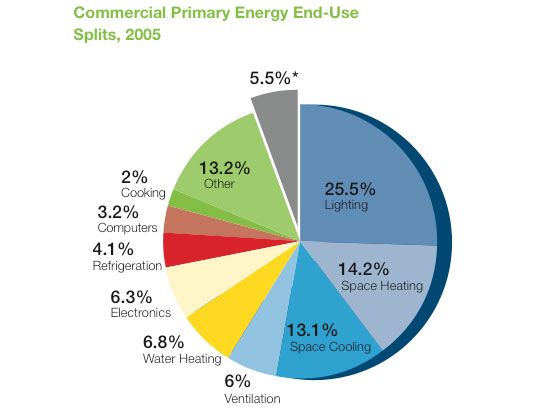
Appliances are otherwise known as HVAC and lights. Lighting has been perhaps the most active market in terms of VC activity and for good reason: Light bulbs are the last major vestige of the vacuum tube era. The incandescent bulb celebrates its 130th anniversary this year. VCs put $86.5 million into lighting in 2007 and $185 million in 2008. Some notable companies: Renaissance Lighting BridgeLux, NiLA, Kaai, Soraa, Luminus Devices, Nuventix and D.Light (LED lamps and components); Eden Park Illumination, Novaled and Ceelight (flat architectural lights); Luxim and Topanga (plasma lights); Vu1 (cathode lights); Lumiette (thin fluorescent); Energy Focus (interior fiber optics); and Sunlight Direct (piped sunlight).
There are also low-tech solutions. Kawneer, the architectural products group at Alcoa, sells windows with integrated light shelves. A light shelf is a white board that reflects sunlight inside. It can cut light power bills by 12 percent.
In HVAC, look at: Chromasun (solar air conditioners); Ice Energy and Calmac (ice cooling); Groundsource Geothermal AC Research (pre-cooling air); and Octus Energy (condensation cooling).
Source: U.S. Department of Energy
5. Energy Generation
Solar and small wind have been around for a number of years. The next big trend will be to make these more unobtrusive. Several CIGS vendors promise to release building-integrated photovoltaics. Armageddon Energy, meanwhile, has come up with easy-to-assemble photovoltaic systems for homes.

Join industry leaders and influencers at Greentech Media's Green Building Summit in Menlo Park, Calif., June 11.



 41
41
 15
15
 9
9