
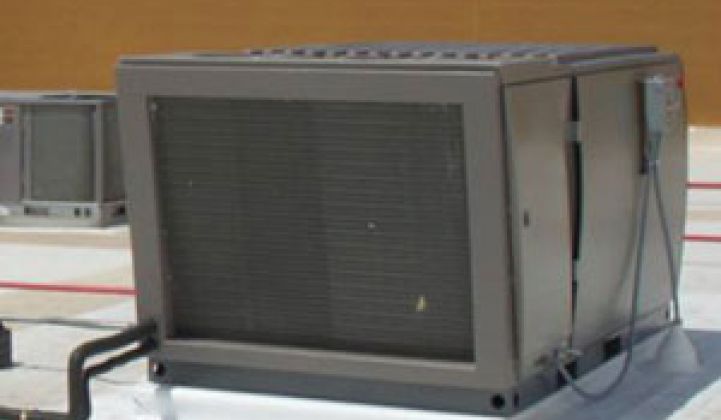
Air conditioning management.
In most circumstances, it's not the kind of job that attracts groupies. Nonetheless, the subject will begin to occupy a greater portion of the energy debate as energy efficiency and green buildings expand. Building operations consume 39 percent of the energy in the U.S. and HVAC gobbles up a big part of that. Air con and ventilation account for 15 percent of the energy used in commercial buildings, while heating accounts for 36 percent. Air conditioning represents about 16 percent of the electricity consumed in homes. The percentage of homes with air conditioning rose from 27 percent in 1980 to 55 percent in 2001.
Worse, the air conditioners come on during the hottest days in the year en masse, when power is at its peak price and brown-danger looms. Secretary of Energy Steve Chu, in his previous assignment at Lawrence Berkeley Labs, oversaw one of the premier research centers for building management.
Although companies such as Johnson Controls and Honeywell have continually improved the efficiency of their products, the design and operation of buildings, the aged install base and other factors leave a lot of room for improvement.
The following is a guide to startups and others trying to crank down the high cost of cooling.
1. AC Research: Formerly known as Viridis Earth, AC Research has effectively devised a computer-controlled misting system for residential air conditioners. The product essentially sprays water vapor into the air around an air conditioner, the same way misters at outdoor cafes keep patrons cool. The goal of the system is to keep the air around the air conditioner around 80 degrees, which in turns leaves less for the air conditioner to chill. The trick is getting the sensors and control systems to work together, says founder Tuyen Vo. Vo came up with the idea after the 2001 blackout. He learned about cooling when working with cryogenic pumps at a semiconductor maker.
Pre-cooling can save a home in a hot region around $500. AC will conduct trials with two utilities later this year.
2. Octus Energy: The company is trying to commercialize a technology out of UC Davis called WicKool that collects the condensate (i.e., water drops) extracted from the cool air flows created by an air conditioner and uses that to pre-cool incoming air. Octus Energy's design also lets building managers get rid of a condensation ejection system. It's a passive system but can improve air conditioner efficiency by 3 percent to 5 percent. It's been tested at a Walmart and Target in the Sacramento, Calif. area. WicKool may license to other companies.
3. Smart Cool Systems: Smart Cool Systems has algorithms that optimize the compressor in commercial or residential air conditioners, the component that can account for up to 70 percent of the power consumed by some systems. More than 26,000 of its energy saving modules have been installed. Smart Cool Systems has been around for nearly 20 years and is still small.
4. Chromasun: Chromasun has developed a solar air conditioner from Ausra co-founder Peter Le Lievre (see Ausra Co-Founder Returns With Solar Air Conditioner). Solar air conditioner? Heat is captured with a rooftop device similar to a solar thermal power plant. The heat is then used, instead of natural gas, to boil a refrigerant in a solution in a sealed chamber. Through heat exchangers and manipulating the pressure inside the sealed chambers, the refrigerant is re-condensed into a low-temperature liquid and employed create cold air. The evaporation-condensation cycle goes as long as the sun provides enough heat.
Fifty percent of the demand for power during peak periods in California and 70 percent of the power in Dubai can be attributed to air conditioners, according to Le Lievre. Peak power typically comes when air conditioners are cranking their hardest.
"Ninety-five percent of that can be tackled by a solar thermal air conditioner on the roof," he said. "The biggest market is for peak AC."
5. Ice Energy: This one is best understood without technical talk. Ice Energy's Ice Bear makes ice at night, when power is cheap. The stored energy (i.e., chilly vapor) then runs the air conditioner at night. Remember sticking your head in the fridge on sunny days and breathing? Similar principle. The company says its systems collectively have performed for two million hours in the field and that it is currently bidding on twenty utility projects.
6. GroundSource Geothermal: Sandblasting with steel. GroundSource Geothermal has devised a way to drill holes for geothermal cooling systems with steel sand, rather than a drill bit. The drilling unit, which relies in part by ideas from some of the same people who brought you the hot rock geothermal technology at Los Alamos National Labs, can also take advance acoustic readings of soil to improve drilling efficiency. The technology is also being improved so you can drill through the foundation of your house. it can also be used for heating and cooling.
While Lord Kelvin first studied ground temperatures, Robert Webber invented the first shallow geo heat pumps. Throughout most of the U.S., the temperature of the ground about five feet below the surface remains roughly constant throughout the year: 45 degrees to 50 degrees Fahrenheit in the northern parts of the country and 50 degrees to 70 degrees in the south.
7. PhotoSolar, Sage Electrochromics: Technically, PhotoSolar and Sage Electrochromics are not air conditioner companies, but they keep heat from entering buildings, which reduces the strain on the air conditioner. Denmark's PhotoSolar has a film that keeps out 50 percent of solar radiation. Sage has windows that dynamically change tint with daylight: after several years of development Sage is moving toward a wider commercial release.
In this same vein, more things you can add to the list are LED and energy efficient lighting companies like Bridgelux (less waste heat – less air conditioner work), contractors selling white roofs (heat reflectors), data center efficiency experts, and industrial waste heat specialists like Recycled Energy Development.
8. Maglev compressors: This isn't a company name, we're just listing the concept. The same technology that allows high-speed trains to float in Japan is now being used to run compressors. "They are really incredible compressors," said David Leathers, a VP at Limbach, one of the country's larger engineering contractual firms. (Limbach has done work for the both the Detroit Lions and the NRDC, which will not be playing each other in the playoffs.)
9. Optimum Energy: The company thinks in tons. It has created software that dynamically adjusts the activity of water chillers in large buildings. Optimum Energy says it can cut the energy required for a ton of water in a large building's chiller system down to 0.5 kilowatts (see Better Cold Water Through Software). Older buildings can consume 1.4 kilowatts. Even LEED platinum buildings can consume 0.7 kilowatts, said founder Nathan Rothman, CEO. The software adjusts the activity of the chiller by looking at occupancy data, temperature, etc.
10. Cimetrics: Instead of controlling the water, Cimetrics controls what goes on inside your building. It monitors thermostats, carbon monoxide sensors and other systems. It then matches the performance of the HVAC system against a simulation that determines how it should be performing.
"It is like data mining for buildings," says CEO James Lee, who says the way Americans heat and cool buildings is "absolutely ridiculous."
11. Comverge, EnerNoc and other demand response companies: Although you've heard about the smart home, those smart meters and other wireless devices right now are primarily connected to the heating and air conditioning system.
And bonus number zero. Nothing. This is perhaps the ultimate system for reducing air con power. In some areas such as Seattle and Northern California, architects like Perkins + Will are just leaving out the air conditioners. It cuts power and gives developers a nice bonus of LEED points. This can be supplemented with air side economizers that draw in scrubbed ambient air. (These devices can also be used to cool data centers in cold climates like Ireland.)

Join industry leaders and influencers at Greentech Media's Green Building Summit in Menlo Park, Calif., June 11.

 41
41
 15
15
 9
9