
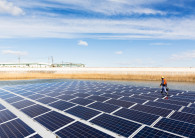

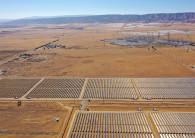
Seambiotic, located in Ashkelon, Israel, uses eight raceway/paddle-wheel open-ponds for algae cultivation, fed by C02 flue-gas from a nearby Israeli Electric Corporation power plant. The company employs genetic optimization and has teamed up with Inventure Chemical to turn the algae into fuel.
And now it has a new CEO. Daniel Chinn is replacing founder and previous CEO Amnon Bechar who will now assume the position of COO. Mr. Chinn is a GP at Israel Seed Partners and has a background in M&A and law.
The last algae company helmed by a VC in a management switch was GreenFuels led by IT-guru Bob Metcalfe. GreenFuels was the proud winner of the Frost & Sullivan Technology Innovation of the Year Award and oxidizer of $70 million in VC. May they Rest in Peace.
Like most algae farmers, Seambiotic expects to harvest the algae for nutraceuticals and biofuel. The CO2 from a nearby power plant as feedstock makes some sense. I remain curious about where they're going to get a constant large supply of water and nutrients in a water-challenged, resource-starved nation.
Summer 2009 saw an enormous amount of activity in algal biofuels. Some called it "The Summer of Algae." I'll have to settle for calling it the "Summer of Algae Hype" until a company actually produces algae-based biofuels in volume at a price close to "pump-parity."
Recent announcements have included:
More on algae's future as a biofuel feedstock to come.
Yes, But How Will This Impact the Price of My Sushi?
South Korea will invest $275 million over the next decade to grow seaweed forests off its coast and increase the country's ability to produce biomass energy. The biomass would be used to produce a target of 400 million gallons of ethanol per year by 2020 or roughly 10 percent of the country’s petroleum-based fuel usage.
Most of the algae farming and algae investments in the U.S. and Europe are focused on microalgae. Seaweed, which is already sustainably farmed in Asia and is a multi-billion dollar market, is considered macroalgae.
$418 Per Gallon
According to Biofuels Digest, Professor George Poste of Arizona State University, a member of the Defense Science Board of Department of Defense, and an adviser to Burrill & Company, a VC firm, claimed that the cost of providing fossil fuels to the military in Iraq is $418 per gallon. He believes that the Department of Defense is ready to invest in biofuels research to control the cost of fuels for troops in “forward areas.”
$777M for Energy Frontier Research Centers (EFRCs)
The White House announced that the U.S. DOE Office of Science will invest $777 million in 46 new Energy Frontier Research Centers (EFRCs) over the next five years.
Supported by funds from President Obama’s American Recovery and Reinvestment Act, the EFRCs will bring together groups of leading scientists to address fundamental issues in fields ranging from solar energy and electricity storage to materials sciences, biofuels, advanced nuclear systems, and carbon capture and sequestration.
Demand Response Factoid
The cost of generating electricity during peak-demand periods can be up to 10 times more expensive than during other periods, and 100 hours of peak demand (about one percent of the hours in a year) can account for as much as 20 percent of annual electricity expenditures.
The GTM Research blog provides brief and frequent market analysis provided by the GTM Research team of analysts. It covers everything from analyst perspectives on greentech market events, insights into existing and future research, posts based on select analyst briefings and vendor meetings, and insights from conferences and other industry events.