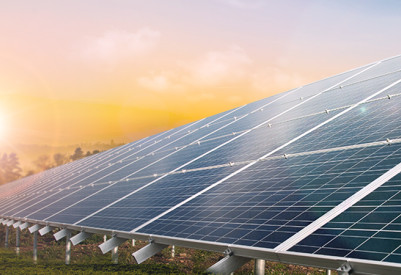
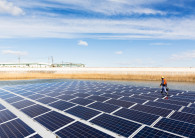


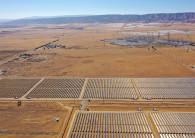
This is Applied Materials' SunFab line. Note that standing next to the equipment are standard-size adults, not Oompaloompas.

I was lucky enough to join a group of cleantech investors at Applied Materials today for a presentation and a tour of Applied's facilities as part of the Cleantech SIG Group. It was an animated group of VC and corporate venture investors that included DFJ, Rockport, Globespan, Venrock, Siemens, Battery, Vantage Point and more.

Randhir Thakur, the Sr. VP and GM of the Display and SunFab Solar Group presented. Note that Display and SunFab are included in one business group. That's because there is is a strong commonality in display and solar glass handling, thin film deposition, and in Applied's hopes – cost curves. 

There has been tremendous performance and cost improvement in flat panel displays. The potential exists for those price-performance curves to be mirrored by a-Si solar panels.

Applied Materials is already the leader in fabrication tools for semiconductor manufacturing. They also provide tools for c-Si solar. But the true pioneering solar activity at Applied is their effort and sales in fabrication tools for building large size amorphous silicon solar panels in single, double and triple junction flavors.

The double junction a-Si cells have efficiencies in the 8% range with lab results in the 10 percent range. That's low compared to c-Si, CdTe and CIGS.

Applied has already furnished fourteen Sun Fab factories to a number of firms including Moser Baer in India, Signet Solar in Germany, Taiwan's G.E.T., firms in China and even Abu Dhabi's Masdar.  Nine of those factories are producing panels, six are in volume production.  None are in the US though, much to Thomas Friedman's chagrin.

Cameras were not allowed on the tour so I can't provide photos of the equipment – but this is the domain of the huge.  The current Sun Fab glass size (Gen 8.5) is 5.7 square meters and a full size Signet Solar panel puts out more than 340 Watts. (A 10% efficiency panel would put out more than 500W).  We got a chance to see the Gen 10 glass size, now used for flat panel TV displays and it is seriously massive.  Made by Corning and currently supplied to Sharp for FPDs, Gen 10 glass is 2.85 meters x 3.05 meters.

You can imagine the scale of the tools needed to handle and transport this size panel. Think big overhead cranes, large conveyors and suction cups. You can also imagine the mess when the glass shatters. We wore safety glasses. And booties. Applied, of course is an expert at handling these Brobdingnagian elements. Flat panel display glass is 0.7 mm thick, solar glass is 3.2 mm thick.  Interestingly, at these sizes, there are standing wave phenomena in the plasma deposition field that can vary the thickness of the deposited material and this needs to be monitored and compensated for. 

Despite the relative low efficiencies, the sheer size of the frameless panels has the potential to reduce balance of system cost in metal, cables, mounting equipment, and labor. Although, the full panel size and efficiency does limit deployment to solar farms only. 

Applied Material's blog here.  More photos of the Applied Materials facility below.

* * *

Returning for a moment to Thomas Friedman's chagrin. Friedman took a similar tour of Applied last week and in an op-ed column in Tuesday's New York Times lamented the lack of a Sun Fab plant producing PV in the U.S. and the necessity of importing PV panels from China, equating that to importing Mideast oil. Which is a lazy parallel on his part.

Stop lamenting Thomas – right in your editorial you quoted Applied's CEO, Mike Splinter saying, "In the last 12 months, it has brought us $1.3 billion in revenues." And Applied is an American firm. 

Once again, you're simplifying the issue. You cite the German solar miracle – but meanwhile a substantial portion of their magic Feed-in-Tariff gets sent to China. Note that more jobs are created in the installation of panels than in the manufacture of panels in an increasingly automated production process.

Also not being considered by the editorial page at the NYT is the fact that solar factories are actually being built in the U.S. SunTech and SunPower for example.  More domestic PV manufacturing activity is cited by Shyam Mehta in his recent U.S. Manufacturing report. 

And Friedman, do some research.

* * *