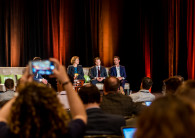
First of all, a congrats to the guys at Greentown Labs for their grand opening last night; the event was a great success.  I wrote about them and their role a while back, and I still am very impressed with how they're bringing a collaborative -- and cheap! -- approach to getting things actually built and implemented, without taking tens of millions of dollars of venture capital to do so.  The startups at Greentown Labs are applying a "guerrilla cleantech" model to what they're doing that really undermines the "cleantech is always capital-intensive" argument I've been hearing a lot of these days from my fellow cleantech investors. So cheers to the guys and gals at Greentown Labs on their big official launch, and also my thanks to them for arranging for Mayor Menino to be the opening act for my speech. (I kid, I kid; the Mayor and his green team, such as Galen Nelson of the BRA, have been terrific supporters of Boston cleantech over the past few years. They've really made a difference.)

But on to the other big news of the day:  The announcement of the Cleantech Syndicate.

When we launched Black Coral Capital a couple of years back, we started reaching out to our fellow family offices, just to learn who was active and who wasn't in cleantech, and to learn from what had already been done.  Our thinking was that since we were going to be doing some investing via models other than 'cleantech venture capital,' we would need to identify like-minded co-investors from outside the VC community.  And while we expected to find cleantech investors in the family office world, the level of activity and latent interest surprised us nonetheless. So many very quiet single and multi-family offices have an interest in investing in the sector, but have limited bandwidth (the one thing family offices appear to have in common is that we're all chronically understaffed) to actively seek out dealflow, and poor connections to others like them (the "quiet" factor again) for diligence-sharing and co-investing.  So by default, many of these family offices were just following along after the VCs, investing in deals the VCs had invested in. Or just being angel-type investors. Or avoiding cleantech VC altogether and focusing just on project finance. Or, frankly, any of a million other things -- it's a loosely-defined category for sure.

My colleague Christian Zabbal here at Black Coral Capital, and Ward McNally of McNally Capital, started talking about bringing together family offices with strong existing activity in cleantech private equity.  This initial inspiration quickly turned into the idea of a formalized group of leading families, dedicated to collaborating in the sector, across cleantech private equity categories.  It's an amazing group, with deep resources dedicated to the sector, deep domain expertise in a number of critical areas, and some early collaborations already underway, so hats off to Christian and Ward and the others who've played a key role in getting this effort up and off the ground.

Family offices are going to play a key role in the next wave of cleantech investing.  I alluded to this in my presentation about cleantech in 2015 a while back. It's amazing to me, when I speak with my fellow cleantech venture investors out there, to discover that all of us are still trying to figure out first principles about how we should do what we do.  Pretty core assumptions are being re-examined, and very basic lessons are still being learned, by a lot of us. And this is after more than a decade of "cleantech" investing.  

The challenge for VCs is figuring out which venture capital models apply to various cleantech sectors, and which cleantech sectors and investments just aren't a fit for venture capital at all.  My sense is that cleantech VCs are concluding that there are large swaths of the cleantech market (though note, certainly not the entirety of it) that just aren't applicable to venture capital models, whether "capital-efficient" or "capital-intensive" or otherwise. Yet that's not to say that these non-VC investments aren't attractive investments, viewed through another lens.  Innovations in business models, instead of proprietary tech.  Investments in implementation, instead of innovation.  Investments in long-term tech development efforts, instead of "growth stage".  These and others are all examples of where many VCs have concluded they can't play.  But if the 'Cleantech Revolution' is ever to become a reality, these are critical market needs, and thus that suggests they'll be attractive investment areas -- at least at some point.

Family offices typically don't have nearly as many restrictions as venture capital firms and other institutional investors.  We often don't have defined fund lifespans, which eases the pressure to find relatively quick exits.  We may not need an exit at all, but instead can back long-term company growth that will yield ongoing cash flow to owners.  We often won't have VC-type IRR targets, but instead are looking for alpha -- sometimes that will mean VC-type targets and VC-style investing, but it can also include lower-return, lower-risk investments like project finance.  And we can wear multiple hats and play hybrid roles.  

Family offices have always had this kind of flexibility -- and it's desperately needed in the cleantech sector right now.  But without a network of like-minded investors, the challenges of deal sourcing and co-investing with limited team bandwidth has often pushed family offices into the existing institutional investor boxes.  

But that's why the Syndicate is, to me, a very exciting development.  It turns the question on its head.  The question is no longer, 'What parts of cleantech are applicable to the established venture capital and project finance models?' 

Now we get to ask, 'What are the right investing models for cleantech private equity?' We don't have all the answers yet. But it's very exciting, and fun, to have like-minded partners with which to tackle this question.