
It’s still tough to squeeze economy and electric into the same sentence.
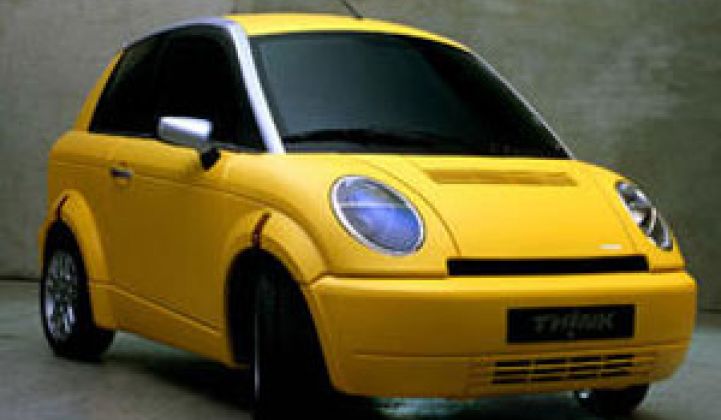
Norwegian car manufacturer Think has begun to sell its first car, the City. The City, a compact vehicle made for urban customers, can go 180 kilometers (112 miles) on a charge and hit a top speed of 100 kilometers an hour (62.5 miles per hour). Buyers can also choose between a sodium- or lithium-ion battery pack.
The car is available only in Norway but will head to Denmark in the first quarter.
"We have just started taking delivery on our first cars. And we have sold a few cars. But there has been a lot of test driving, so I’m sure we going to sell a lot of Thinks the next year,” wrote Petter Hummel at RohneSelmer, the Norwegian car dealer authorized to carry the City.” I have received emails and phone calls from other countries like Sweden, Denmark, Finland, Germany, England, Spain and the Canary Islands. And they want to buy this car and some would like to sell them too."
The diminutive City, however, is still priced more like an Acura than a Nissan Micra thanks to the battery. The base price of the car is 200,000 Norwegian Kroner ($28,690). Consumers then have to lease a battery for 1,275 NOK a month ($183). If a consumer kept the car for seven years, that would result in $15,372 in battery costs.
Together, that comes to $44,062. The price of the battery includes 300 NOK in taxes a month. Take that out and the price comes to $40,450. At those prices, you could almost buy two new Honda Accords for the price of a single City.
The price tag underscores the cost/benefit dilemma that electric car manufacturers will face over the next few years. Public opinion polls have shown that the public wants the U.S. to find alternatives to gas and oil. Hybrids, which partly drive on electric power, have helped Toyota leap to the top of the automot ive market.
Big companies are jumping on the trend. Nissan is coming out with all-electric town cars in Japan and the U.S. in 2010 and will follow with a broader array of models.
"We are aiming for EV leadership, which means we need to cover the market," said Minoru Shinohara, senior vice president of the technology development department at Nissan, in an interview with Greentech Media last month. "Which means we need to prepare several vehicles."
Nonetheless, price is still a big issue when it comes to car sales. Toyota execs admit that their all-electric RAV 4 garnered lots of customer interest when it tried all-electrics back in the 1990s, but it was tough to close a sale because of the price and limited driving range.
And gas, even at $4 a gallon, is cheap compared to the price of batteries. You could buy an Accord and get $20,000 worth of gas for the same price as a City. At $4 a gallon, that’s 5,000 gallons. Accords get about 25 miles per gallon, blending highway and city driving. Thus, with the Accord you’d have enough gas to go 125,000 miles, which is about 10 years worth of driving.
Batteries are actually one of the slowest high-tech products to evolve. The amount of power a battery can store doubles about every 10 years, according to most estimates. That's more than five times what it takes for computer chips to double in performance. The number of charge-recharge cycles a battery can endure increase at a faster rate, but it still stakes time.
Car execs also admit that getting consumers accustomed to the idea of a car with a limited range will be an educational process.
So does that mean all-electrics will squeezed to a niche be economics? Not necessarily. Government policy will likely help Think and other electric-car makers. Japan, several states in the U.S. and several European countries have or are implementing tax breaks for plug-in car owners that could cover a substantial portion of the cost of electric cars. Finland, for instance, passed laws that reduced the tax on low-carbon emitting cars to 10 percent of the car’s value. High-carbon cars come with a 40 percent tax. Some cities like London are also giving parking credits to plug-in car owners.
The City arrives to market after a few delays. Back at the Cleantech Forum in San Francisco in early 2007, the company said it would start shipping cars to customers in Norway and the U.K. in the fall of that year and to U.S. customers in 2008. In July 2007, it raised $60 million in VC funds. Before that, Think had raised $25 million.
The City went on sale this month at RohneSelmer. After the expansion into Denmark in the first quarter, the company will look at ways to move across Europe. U.S. plans are not clear at the moment.
Think also hired a new CEO, Ford veteran Richard Canny, late last month. The car grew out of an electric-car project in Scandinavia. Ford bought it in the '90s and then subsequently transferred it to Think.



 41
41
 15
15
 9
9