• Thursday, May 29, 2008 Latest Update: 4:39AM

Greentech Solar

Thin-Film Solar Has Bright Future

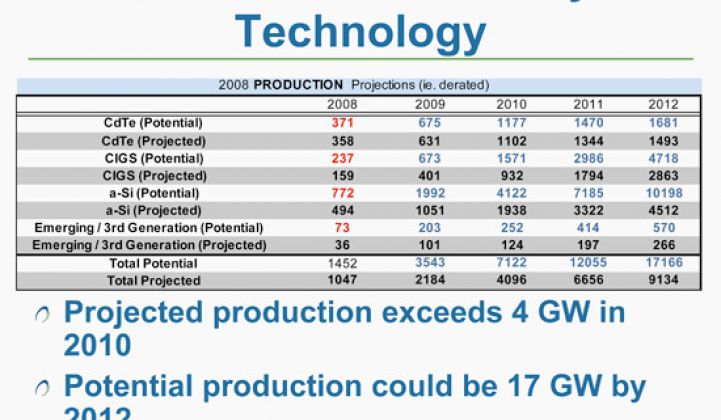
The Prometheus Institute expects thin solar technology will reach 9 gigawatts in four years, according to preliminary numbers presented at a Greentech Media conference this week.

At a Greentech Media conference Wednesday, Travis Bradford, president of the Prometheus Institute, forecasted that thin-film solar production will grow from 1 gigawatt this year to more than 9 gigawatts in 2012.

 “We project increased penetration of all technologies – cadmium telluride, copper indium gallium diselenide and amorphous silicon – above even our aggressive forecasts in 2007,” said Bradford.

Cadmium-telluride films, led by First Solar (NSDQ: FSLR), make up the largest portion of the thin-film market, he said, adding that he expects the company’s costs to drop from less than $1.25 per watt to less than $1 per watt by 2009.

However, those costs could be subject to the price of glass, which in turn depends on energy prices, he said. The cost of telluride, which is a mining byproduct of zinc, also has increased, he said. 

“Cadmium telluride is the current leader,” he said. “There are some difficulties. But First Solar will continue to do well.”

According to Bradford, the big story of next year is likely to be copper-indium-gallium-diselenide – also known as CIGS – technologies.

Even though none of these companies have yet produced CIGS films in significant volumes, he said the technologies have potential.

“Many of these [technologies] are ready to go,” he said. “In some cases, it takes as much of a third of the capital less than First Solar to build a plant. … We think CIGS will be the big story on 2009 because we know how many companies are putting in multi megawatts of CIGS in 2009. We are convinced. Just like polysilicon was the big story of 2007 and First Solar is the big story of 2008, we believe in 2009 the big story will really be CIGS.”

Global Solar,Nanosolar, HelioVolt Corp. and Miasolé all have announced plans to expand production of CIGS in the last few months. 

Meanwhile, Prometheus, which is a Greentech Media partner, expects amorphous-silicon films – such as those made by Applied Materials and Oerlikon – to stumble slightly in 2008 and 2009, as technologies get debugged and verified, before taking off in 2010, he said. 

By 2012, the institute forecasts that amorphous silicon will make up the largest chunk of the thin-film pie with 4.5 gigawatts of production, with CIGS coming in second at more than 2.6 gigawatts.

The institute also named what it expects will be the top thin-film producers in 2012, starting with First Solar, Miasolé and Sharp.

“There are so many technologies, even if we’re wrong in one bucket, in one technology, there are a lot of different ways to hit 4 gigawatts in 2010 and our projections in 2012,” Bradford said.
Comments [12]

  • mike nolan 10/7/08 2:05 PM

    Steve, here are some facts…land is leased for approximately $300-$1,000 per acre for a PV utility grade solar farms.  I’ve looked at $1 land deals offered by municipalities…lots of strings attached.  It ends up costing more than $1…details, details, details.  It costs approx $1 million a mile for transmission lines and millions more if you have to install a substation.  The land is put under a lease option, usually 3-5 years.  The developer pays a nominal yearly fee to keep the option.  The land leases are signed for 20-30 years. A developer doesn’t have to execute the lease until a PPA (power purchase agreement) is signed, the project is approved and financing is in place.  At which time the development begins.  Lets say a 30 MW solar farm costs $120 mil…$80 million in GC work and $40 million in materials.  Power is purchased between $.15 and $.20 a KW.  So, land isn?t a major cost for the overall project.

    Reply
  • Steve Pluvia 05/29/08 6:03 AM

    The Prometheus Institute just proved why they are the leading analyst in the solar sector.  Their forecast on thin film is DEAD on.  A stark contrast to yesterday’s forecasts from Stephen O’Rourke, managing director for Deutsche Bank Securities which proved Deutsche Bank is scraping the bottom of the talent pool barrel.

    Reply
  • Fake Name 05/29/08 7:10 AM

    I disagree, the space limitations of rooftops mean there will always be a place for hi-efficiency (eg- traditional silicon) installations.  And as the silicon supply shortage shakes out prices in this market will fall quickly.  Bad news for suppliers, but good news for the market.

    Reply
  • Steve Pluvia 05/29/08 8:03 AM

    I think you have 2 fatal erors in you assumptions: 

    1.  Space limited, small footprint installs will offer a “niche” market for hi-efficiency c-si.  Remember, 95% of the current PV market is c-Si.  That means 95% of the market that can no longer cost compete with low-cost thin film will suddenly be fighting to sell into a niche market of small footprint rooftops [which is a bad install idea to begin with as customers should be able to easily access panels for cleaning].

    2.  Small footprint rooftop installs that can ONLY use hi efficiency PV are a teeny-tiny segment of the PV market.  Low-cost free-field installations using grid parity priced PV [i.e. thin film] is the primary market; this segment will drive huge demand in the grid parity priced thin film market. 

    As a manufacturer do you want to produce product for a buyer who buys multiple 1-2mw systems, or a residential buyer who buys one 2-5kw system?

    As a buyer, do you buy grid parity PV [thin film] or PV that requires a 25yr payoff schedule, when lower cost PV is available?

    No Brainer.  c-SI is looking at rough times ahead; Thin film PV is set to explode.

    Reply
  • Fake Name 05/29/08 9:14 AM

    What about the shift (which Prometheus and everyone else points to) in the supply-demand dynamic of silicon.  There is a glut of silicon coming, whether it’s in late ‘08, ‘09 or even 2010.  This will significantly drive down the price of silicon PV.

    Reply
  • Steve Pluvia 05/29/08 9:34 AM

    Yes, there’s a glut of poly coming.  No, substantially lower poly prices won’t make c-Si PV cheaper than thin film [CdTe, AMAT PV Plants; CIGS]

    “There is a glut of silicon coming, whether it’s in late ‘08, ‘09 or even 2010. This will significantly drive down the price of silicon PV.”

    Reply
  • Jack Bertuzzi 05/29/08 9:39 AM

    All of you are wrong. First of all, space is always a constraint whether you?re talking about a house or a multiple acre solar farm. Land costs money and the larger the installation the more construction, soiling, and maintenance costs there are. Thin film has a lower manufacturing cost but when you factor in those other costs it becomes less of a difference. Add that to a supply glut of silicon and a PV shake out, and you probably have these two technologies almost at parody. Thin film may eat in to the overall solar market share a little, but this will not really matter as you see both technologies costs come down and the overall market cap grow larger and larger. The bottleneck for both technologies will always be in upstream manufacturing capacity which will always be cyclical in nature.

    Reply
  • Steve Pluvia 05/29/08 10:16 AM

    There are an abundance of sites where land for a 2mw thin film free-field PV plant can be leased for $1—your argument land costs are prohibited holds no water.  In emerging countries suitable sites cost less than $1.

    Thin film install costs are not necessarily higher than c-SI.  Take the AMAT Gen 8.5 garage door size modules [380w ea]; (1) panel install costs 1/2 that of 2 c-SI panels in terms of connections and labor.  Install costs for this thin-film product are actually lower than c-Si.

    PV cost/watt and install costs drive product demand and establish which technology will be highly profitable vs marginally profitable. 

    Anyone who thinks a drop in Poly prices will bring thin film and c-Si cost/watt to parity has never run a cost analysis on PV production costs.


    Reply
  • Fake Name 05/29/08 11:11 AM

    Steve you are forgetting about the challenge of transmission.  Cheap land is great, but it is generally located a long way from where the power is needed.  Transmission lines are incredibly expensive, and getting approval to and right of ways to build them is even more expensive (and time consuming).  Cheap land is not enough.

    Reply
  • Fake Name 05/29/08 11:13 AM

    Steve you are forgetting about the challenge of transmission.  Cheap land is great, but it is generally located a long way from where the power is needed.  Transmission lines are incredibly expensive, and getting approval to and right of ways to build them is even more expensive (and time consuming).  Cheap land is not enough.

    Reply
  • Norrin Radd 05/29/08 11:28 AM

    Pluvia reveals his utter ignorance of real world requirements for solar farms.  His assertion that “suitable” sites can be leased for a $1 and that thin film’s low cost will trump high efficiency silicon except in “niche” applications indicate a woeful lack of industry experience.  Clearly he’s a desk jockey, spreadsheet-fetishist, day-trader.  He should talk to installers, integrators, and financiers to get an idea of what’s really being deployed.  And his personal attacks on O’Rourke are just uncalled for.  Thin film is brilliant technology and it has it’s place but wafered silicon will dominate for the next 5-10 years.  I would rather not feed this troll but his vapidity is just too compelling.

    Reply
  • Steve Pluvia 05/30/08 4:45 AM

    $1 LEASE OR ZERO COST FOR LAND

    1.  Land Owner Installs on land that can’t be used or developed—ZERO LAND COST

    2.  $1 Lease from municipality for roof-top space un-usable land in parks, municipal facilities, garages, car parks—ZERO TO $1 LAND COST

    ZERO LONG TRANSMISSION LINES

    Reply
.