
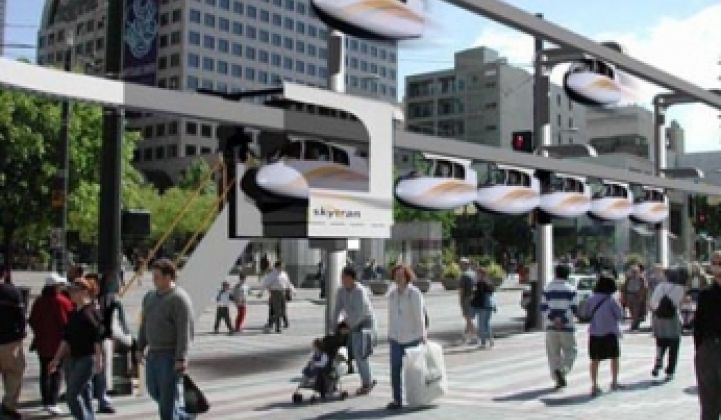
These vehicles won't consume much power, emit fumes, get stuck in traffic, or slam into head-on collisions with other vehicles.
Oh, and they will whiz about approximately eight to fifteen feet above the heads of pedestrians.
The SkyTran system, being developed by a startup called Unimodal, is at the same time one of more seemingly outlandish – and most compelling – ideas in green transportation I've seen in a while. SkyTran would consist of two-person pods suspended on a cable propelled by magnetic fields.
For a mental picture, think of a magnetic levitation (maglev) trains cross-bred with that thing that shuffles around shirts in a dry cleaner.
The first lines would be along heavy-duty transportation corridors, i.e., delivering passengers from central downtown stations to the airport, or inside the redesigned city of the future. Over time, the lines could be extended to individual homes with parallel tracks for exits. The cable required to propel the vehicle and hold them in the air is only about 18 inches wide and two feet wide, said John Cole, Unimodal's COO.
"You could install it on standard utility poles. It would require the same gauge [of pole] that would hold up a traffic light," he said.
Once it connects to homes or buildings, SkyTran effectively becomes a "physical instantiation of the Internet", shuttling small packets on interconnected pipes, he said. Customers would buy a service, not a pod.
"It gives you the speed and convenience of a car with the capacity of mass transit," said Cole.
So far, Unimodal has created a very small prototype. In about 18 months, it wants to show off a working device on a 1,000 foot loop at Nasa/Ames in Mountain View, California, where SkyTran is now located. The company has also been talking to officials in Marin, San Francisco and at CalTrans.
They key to the system is in the inherent nature of magnetic transportation. The power pushing the vehicle forward does not come from a motor or bank of batteries in the car. It comes from the track and/or cable. Thus, the vehicles can be fairly light and cheap to build; lightweight also means greater energy efficiency. The final SkyTran cars might only weight 1,000 pounds, or about the same as the weight of the battery pack in the Tesla Roadster. (Interestingly, weight is already becoming a third fuel for car makers like Bright Automotive.) By being slimmed down, the SkyTran cars could get to 60 miles an hour on 7.5 kilowatts.
"The problem with cars is that it makes no sense to carry your energy source," said Cole."The only thing this vehicle is is the shell for the passengers."
But aren't maglev trains expensive? Yes. Classic magnetic levitation transportation-the Maglev trains in Europe and Japan – cost around $100 million to $200 million a mile. Maglevs, however, use electromagnets. SkyTran would use permanent magnets wrapped in a coil.
"The vehicle [SkyTran] surfs on a passive magnetic field," he said.
Ideally, a system could be put in place for $10 million a mile, he asserted. That would include the cable, the pole, portal stations (passengers have to walk up staircases to get to the cars) and cars.
Cities would have to get aerial easements, but the easements for the suspension poles would likely be covered by existing easements for sidewalks and other municipal services.
At that price, it would be cheaper than freeways ($30 million to $100 million a mile) or light rail ($40 million to $150 million a mile.)
But how about the practical issues, like accidents? Passengers don't control it. The cars travel on their own at speeds from 10 miles an hour to well over 100 miles an hour. North-South lines and East-West lines are at different elevations with the lowest any car comes to the ground at around eight feet. Tracks would be uni-directional, which would eliminate right turn/left turn collisions.
Is anything completely safe? No, but it beats driving. "The most dangerous place to be is the street," he said.
But wouldn't a proliferation of small cars in the sky increase, rather than decrease congestion? Wouldn't buses or vehicles that can carry dozens of passengers make more sense? It's counter intuitive but small vehicles on a wire do better, he claimed. If you had SkyTran pods on a cable one-half of a second behind each other, you could shuttle 14,000 people an hour. A freeway does 12,000. It goes back to the internet-small packets can move faster.
And SkyTran can do something other forms of transpiration can't: ease traffic on the streets.



 41
41
 15
15
 9
9