The State of U.S. Biodiesel: Up the Creek Without a Paddle?

It seems like yesterday biodiesel was the rage of the biofuels movement.  How have times changed.

The State of U.S. Biodiesel: Up the Creek Without a Paddle?

Biodiesel is a renewable fuel that serves as an alternative to petroleum diesel. Although it can be used as a source of heating oil, its primary use is as a blend with diesel in trucks and automobiles. There are a variety of feedstocks that can produce biodiesel. First-generation feedstocks include animal fats, recycled cooking oils, and vegetable oils like rapeseed, soy, and palm oil. Biodiesel is produced through a simple refinery process called transesterification that uses catalysts to convert either vegetable oil or fats into methyl esters (86%) and a byproduct called glycerin (9%), which is used by the pharmaceutical, cosmetics, and soap industries.

On an environmental basis, biodiesel has a number of compelling attributes, as it produces approximately 78% less CO2 than traditional diesel, with reductions of 58% for particulate matter and 60-90% for other GHGs. NOx emissions actually increase 10% compared to diesel, yet there are simple methods that can be used to ameliorate the NOx. In general, biodiesel is better suited to overcome many of the upstream and downstream infrastructure issues that plague ethanol. For example, biodiesel can use all the same storage containers and pipelines that are currently used with traditional diesel. Low blends of biodiesel can be used in any diesel engine without modifications, though high blends require some engine adaption. However, most biodiesel fuels have a higher cloud point than diesel, meaning that special care must be taken in cold-weather climates when storing, transporting, or blending biodiesel. Biodiesel performs similarly relative to diesel on a BTU basis (8% lower than diesel), with higher cetane and fuel density levels.

Although biodiesel has many positive attributes, it is not immune from the criticisms leveled at first-generation ethanol, specifically the "food vs. fuel" debate. Biodiesel production uses at least 10% of the U.S. soybean crop and 60% of European rapeseed oil for what amounts to a relatively limited impact on the overall diesel market. That is, global biodiesel was 4.1 billion gallons in 2008 -- about 1.5% of the 265 billion gallons of diesel consumed in that year.

The last 18 months have been a very difficult stretch for U.S. biodiesel producers.

Subsidized U.S. biodiesel flooded the EU market in recent years, resulting in estimated U.S. exports of 550 million gallons in 2008 -- accounting for approximately 19% of total E.U. biodiesel consumption in 2008. In 2009, the EU responded with an anti-subsidy tariff (€237/MT, which translates to $0.78 per gallon) and an anti- dumping duty (€208.20 per MT -- $0.68 per gallon) that essentially locked out U.S. producers from Europe. 

Call this strike one.

Then, on January 1st, 2010, the U.S. Congress let the $1 per gallon tax credit for biodiesel producers expire. 

Why are subsidies so important to biodiesel producers?

Let's assume that 7.2 pounds of feedstock is required to produce a gallon of biodiesel.  The current spot price of soybean oil is $0.38lb, which translates to $2.74/gal.  If you add $0.81 per gallon in capital, energy, and operational costs (net of any sales of glycerin), we find that the levelized cost to produce a gallon of unsubsidized soy-based biodiesel is $3.55/gal.  As of February 15, 2010, the U.S. national retail price for diesel is $2.76/gal -- illustrating why U.S. biodiesel is estimated to be running at 15% of capacity.

Strike two.

In recent weeks, Senators Max Baucas (D-Mo) and Charles Grassley (R-IA) have attempted retroactively to reinstate the $1/gal tax credit via the Jobs Bill that passed the Senate.  The original $85B bill contained the tax credit.  However, in recent weeks, Congress has miraculously discovered fiscal restraint and as such, has nixed the biodiesel credits.

Proponents of the industry, like the National Biodiesel Board, point out that 25,000 jobs were lost in 2009 in the biodiesel industry and at least that many could be lost in 2010 if the biodiesel credit is not restored.

Critics counter that implementing the biodiesel credit is a very expensive way to save/create jobs.  For example, a 30MGY facility would receive approximately $30M in subsidies to save about 30 jobs (at $1M per job).  This compares to a $100M construction project for roads and bridges that support 1750-2000 jobs ($57K per job).

Strike two and a half (foul tip).

One saving grace for the industry could be the recently updated Renewable Fuel Standards (see EPA Issues Renewable Fuel Standards: What it Means for 1st and 2nd Generation Biofuels).  U.S. refiners are required to purchase at least 650 million gallons of biomass-based diesel in 2010.

Yet, it is not entirely clear whether these RFS mandates will be sufficient to avert the collapse of the industry. In an industry with production capacity close to 3 billion gallons, limitations on its ability to export to the largest global market, and without the subsidies to compete against diesel in the domestic market, it is likely that we will see a wave of companies in permanent bankruptcy.
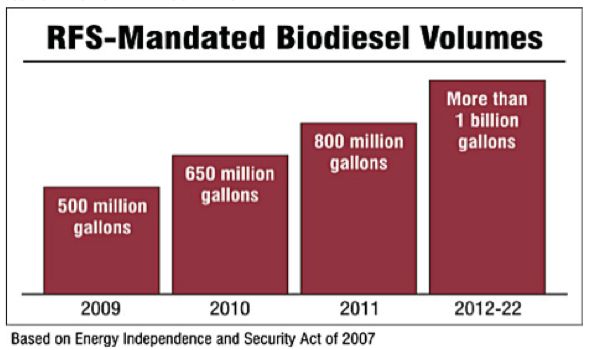
Biodiesel Mandates via Renewable Fuel Standards


10 Comments

  • Curt Felix 02/24/10 5:02 PM

    Well written except for two basic factual errors: 1) a pound of soy produces 6/7 of a pound of food for every 1/7 of a pound of fuel.  If soy is grown for fuel, we consume more fuel than food and the food portion of soy would flood the market lowering food prices dramatically. 2) Although old EPA data showed NOx increases, when newer engines are used especially the common rail and TDI types now proliferating, NOx is the same or better and the engines can be further optimized to reduce NOx. 3) Jobs, Jobs, Jobs The calculation of $1M per job is a ridiculous comparison since it compares a captial intensive industry biodiesel to a labor intensive business road building.  If you were to calculate all the new jobs created from a smart grid, or drill baby drill (electricity and oil being capital intensive businesses) the numbers would be substantially worse.  Moreover,  soley focussing on jobs, without looking at the impact of reducing exports and the multiplier effect of trading imported petroleum for domestic, the energy security costs associated with imported oil and the global insecurity costs of having continous sources of new funding for Al Qada, not to mention the human health care costs in cancer and emphysema from continued combustion of petroleum, misses some of the even more significant high points for biodiesel.

    Reply
      • Jon Smith 02/24/10 5:19 PM

        Well written Curt, and here’s more on the subject:  .http://www.biodiesel.org/resources/sustainability/pdfs/Economic Contirbution.pdf

  • randydutton 02/24/10 5:29 PM

    Biodiesel from food is “Not Too Big To Fail”.  It was a foolish concept from the start to promote a food based 1st gen fuel with major technical problems.  Subisidizing production only saps the overall cost to taxpayers and the US economy.  Sure, it helped some political special interest groups but overall it cost America. 

    America doesn’t have a shortage of domestic petroleum, it has a leadership shortage.  http://www.naruc.org/News/default.cfm?pr=183

    Trying to justify biofuel as a savior of the climate was false science.  CO2 never was the problem.

    Reply
  • Doug DiLillo 02/24/10 5:45 PM

    Concerning strike two, if you look at the fact that biodiesel is blended in low quantities, there isn’t a huge impact on the price of fuel, even without the subsidy. Taks as example, $2.00/gallon wholesale cost for petrodiesel and $4.00/gallon wholesale cost for biodiesel.  At a 5% blend, the cost for the blended gallon is only $2.10.  Hardly enough of a difference to make an argument to kill biodiesel, especially when all the benefits are factored in.  Let’s also not forget, $4.00 a gallon wholesale petrodiesel is likely (again) in the not too distant future ....

    Reply
  • glenn2ns 02/24/10 11:07 PM

    Josh, I didn’t see any mention of jatropha curcus (pictured in story photo) as a 2nd generation feed stock, which has a slightly toxic nature (casin), and therefore is free of the food displacement issues.  In sub tropical climates it grows remarkably quick.  Last I knew an a mechnical harvestor was seen as an alternative to hugely intense labor requirements to herald in this WEED as the 800 lb. gorilla for biodiesel feedstocks.  Derives from latin/central america, and was exported to far east as a wind block for other crops (15’ tall untrimmed).

    An alternative to transesterification is gasification with Fischer Tropsch as a downstream process to produce your fuel of choice.  What’s nice about gasification is that so much more of the fodder (seed casings, leaves, trimmings, etc) which have BTU content convert to fuel and remove much of the costly processing steps - chop the biomass once or twice and throw it in the hopper.  This is vastly less complex than standard enzyme processing.

    Randy, even if CO2 doesn’t hold center stage in your perspective, their is little support for a continued energy policy buying 1 Billion barrels of oil a day from Saudi Arabia alone.  Energy independence is a manta that resonates in every quarter.  National Security, trade deficits, and domestic employment are prime motivators and are going to take a big bite out of petro fortunes.

    Nice job GTM/Kagan

    Reply
  • sukamadek 02/25/10 2:22 PM

    The fact that Biodiesel would cost today $3.55/gallon (which is a “Pre-tax value”) the real price comparison would be $4.35/gal once road-use taxes are applied. If biodiesel can exist without tax credits and mandates it is a solution. if not it is welfare. Another thing $.38/lb soy oil would go a lot higher if this tax-credit is reinstated.

    Reply
  • Subsidy Eye 02/25/10 7:02 PM

    Very informative article. Thank you! Sukamadek is right: the proper price comparison is either both fuels before tax, or both fuels after tax. I hope you’re right, Joshua, that Congress has miraculously discovered fiscal restraint and has nixed the biodiesel credits for good.

    Reply
  • Subsidy Eye 02/26/10 4:44 PM

    By the way, in the title of the article the word before “Creek” should start with “sh” not “th”.

    Reply
  • Little Red Riding Hood 05/19/10 12:18 PM

    Comparing BF jobs to construction jobs is valid as a waste indicator.  Much of the 57,000/job money goes back to the coffers in the form of income tax, whereas much of the 1000000 BF job cost never makes it back to the US gov coffers… as that’ goes to tax credits, accelerated depreciation and foreign produced steel.  I don’t know anyone in BF that makes 1m/yr,  so I figure on the average no more tax dollars return from 1 job in BF than from 1 construction job, but the cost was 20 X.  And ... the fact that I can drive on the roads and bridges = infinitely more benefits for me.

    Reply
Need an avatar? Get one here: Gravatar