
[pagebreak:The Smart Home, Part II]
Software vs. Hardware: The Google Factor
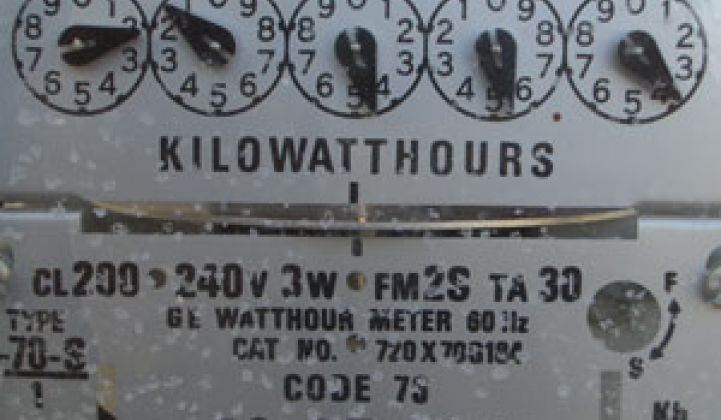
Lots of companies are making displays, thermostats and other plastic-and-silicon devices to bring homeowners information about how much power they're using and how to save (see The Smart Home, Part I).
Does it work? Apparently so. Early tests – such as a 6,600 household test conducted in Oklahoma City indicate that consumers will change their behavior when they are more aware of peak rates, average consumption rates and other factors. Industry advocates have long said that information can curb consumption by 5 percent to 15 percent.
"There is price elasticity for electricity. If you send people information, they will act on it," said Eric Dresselhuys, vice president and co-founder of Silver Spring Networks, which participated in the Oklahoma trials.
Until recently, that world has been dominated by startups, but that changed in a big way in February, when Google announced it was launching a new platform called PowerMeter to bring home energy usage to homeowners (see Google Gets Into Home Energy Management).
While Google hasn't made PowerMeter available to the public yet or said which utilities and companies it would work with to get the data it needs, its big step into home energy management has caused waves in the industry.
How the startups seeking to provide in-home energy monitoring software will adapt to Google's entry is yet to be determined. So far, most smart grid companies are praising the search giant for promoting energy monitoring – and noting that they're open to forming partnerships.
Adrian Tuck, CEO of Tendril, said his company is actively investigating ways to partner with Google's PowerMeter efforts. He may have an inside track – he was the only startup CEO invited to speak at a Google-General Electric smart grid briefing in Washington D.C. on Feb. 17.
But Ben Schuman, analyst with Pacific Crest Securities, pointed out that Tendril's plan to license its software to third parties is "a pretty Google-ish business model." (See Tendril Targets Meter Makers.) The fact that Google is promising to make PowerMeter free for homeowners who want to use it, and to make it technical specifications open to others who want to design software around it, could make it an even bigger threat.
Another home energy monitoring software maker that might be looking at Google as a partner or a competitor is Greenbox, the San Bruno, Calif.-based startup founded by the creators and designers behind Flash. Greenbox, which makes software to manage data from smart thermostats, appliances and household devices, tested out its Web-based home energy usage dashboard with customers in a pilot project with Oklahoma Gas & Electric and Silver Spring Networks.
4Home is another home energy software developer with partnerships to back it up. It has a deal with smart meter maker Sensus to develop home area network solutions, and its 4Home Energy system shown off at the Consumer Electronic Show in Las Vegas in January links its software to energy devices and technology from?smart meter company Echelon, SMC Networks and Radio Thermostat.
Others are looking at software that's backed up by hardware – and yet others have shifted from a hardware-centric approach to focusing more purely on software.
Agilewaves, for example, has created a Web-based "Resource Monitoring" system that monitors electric, gas and water usage in real time from a variety of third-party sources and links them through an integration panel located at the building. That is likely to be more expensive than handling data remotely. So far the company has been focusing on apartments, and is working on a pilot project with the U.S. Department of Housing and Urban Development. (It's also a supporter of power-line communications, which may be better suited to apartment housing, though it promises to work with wireless as well.) Agilewaves in some ways is emphasizing brainpower. The company's executives hail from NASA and it often stresses the dynamic capabilities and behavioral science baked into the software.
PowerMand, in a similar fashion, promises a hardware-software combination Web-based system to control home "demand response," systems that can power down or turn off air conditioners, refrigerators and other devices when utilities are facing overload. PowerMand is also part of the Intel Mafia, the ever-growing swath of startups headed up by a former blue shirt. CEO Dan Russell spent years in the motherboard and software groups at Intel.
Gridpoint, on the other hand, has moved from hardware to software. The 2003 startup began by making products that monitor electricity use in buildings and integrate electricity produced by solar power and other renewable sources into grid-usable power. But it shifted to a software focus with its SmartGrid platform, which promises to link "nodes," which talk to smart thermostats, lights and appliances within a house, to a utility's operations center.
Fueled with one of the larger investments in a smart grid startup ($120 million in September, on top of $105 million at the start of the year), Gridpoint is part of Xcel Energy's SmartGridCity initiative in Boulder, Colo., where it showed off an experimental SmartHome in September. Its ambitions stretch beyond the home – last year it teamed up with Duke Energy to test how plug-in electric cars interacted with the grid, and then bought electric car-charging management software developer V2Green for an undisclosed sum.
Positive Energy provides similar services – Web-based information to consumers, demand response services – but in a distinctly different manner. It works with utilities to send consumers information on their power consumption inside their bills.
All these companies will likely be considering different options for getting home energy data to the homeowner – and the utility might not be the only source. After all, if homeowners install equipment that can measure the energy being used by appliances, wall sockets and thermostats, do they need the utility?
In Google's case, "We're working with multiple partners, and looking at a number of ways to get the data, both from the utility directly and at home," Michael Terrell, program manager for Google's non-profit wing Google.org, said.
Even so, smart meters are likely to continue to be a major source of data for home energy monitoring – particularly because, unlike homeowner-installed systems, they will be coming to millions of households on the utilities' dime.
[pagebreak:Smart Home, Part II: Continued]
Bridging the Gap
As utilities move forward with their smart meter deployments, they've turned to a set of companies that offer enhanced communication services that link those meters to utility networks – and perhaps to home networks as well.
Three companies – Silver Spring Networks, Trilliant and SmartSynch – stand out for Canaccord Adams equity research managing director John Quealy as companies that "have very clear pathways to interface inside the home."
Silver Spring Networks has received a lot of attention with its Internet protocol (IP)-based communication network, broadcast over an RF mesh system, which is now being deployed by utilities including Pacific Gas & Electric Co., Florida Power & Light, American Electric Power and others. The Redwood City-based company said in December it had $500 million in utility contracts and expected that to grow to $1 billion.
It's also drawn attention from the money it has raised – most recently a $75 million investment led by Silicon Valley powerhouse VC firm Kleiner Perkins Caufield & Byers (see Silver Spring Grabs $75M). It promises the ability to communicate across an array of communications, including RF mesh, WiMax and next-generation cellular.
In home area networking, Silver Spring has a "technology alliance program" that includes many home energy-monitoring companies, including Tendril, Greenbox, Control4, Energate, Radio Thermostat and, most recently, Onzo.
Trilliant is another company putting the communication smarts inside smart meters and home area network systems. The Redwood City, Calif.-based company is more than 20 years old, but reformed in 2004 to concentrate on the smart grid space. It landed $40 million from MissionPoint Partners and Zouk Ventures in August.
Trilliant has deals with about 200 utilities, among the largest with Ontario, Canada utility Hydro One, where they've hooked up about 750,000 homes so far. The company builds a "multi-tiered network" that uses a beefed-up version of the 802.15.4 wireless standard – which the ZigBee protocol uses for in-home equipment – as its primary home-to-utility concentrator point communications technology, according to Eric Miller, Trilliant's chief solutions officer.
As for the home area network field, Trilliant is involved in a pilot project for Louisville Gas and Electric, where they've hooked up about 2,000 homes with pilot home power monitoring systems made by Aztech Associates, smart thermostats made by Energate, and load control switches made by Entec, Miller said.
SmartSynch is using a different means of communication – the existing cellular networks of AT&T and others. The Jackson, Miss.-based company has business with more than 100 utilities, mostly in industrial and commercial smart metering.
On the home area network front, SmartSynch is involved in a pilot project to test its ability to provide smart meter communications to home devices, CEO Stephen Johnston said, though he wouldn't provide details.
Smart Appliances, Home Automation
Once the home area network is in place, there's little doubt that the big boys of home appliances will be on its heels, said John Quealy, managing director of equity research at Canaccord Adams.
Whirlpool was a partner in PNNL's GridWise project, he noted, and other major "white box" manufacturers are also moving ahead with smart appliance plans.
General Electric, for one, intends to introduce a line of "Energy Management Enabled Appliances" in the first quarter of this year, and plans to test them out with Louisville Gas and Electric Co.
Lighting giant Phillips is also getting into the game. The Amsterdam-based company has a partnership with Lawrence Berkeley National Laboratory to jointly research building energy efficiency, with wireless-enabled lighting as a first objective. Products could be coming out this year.
And a consortium that includes Sony, Panasonic, Samsung and Philips has agreed to use ZigBee for remote controls for next-generation TVs and other consumer electronics – and observers say some of them are eyeing energy monitoring and control capabilities in their new devices as well (see Will Utilities Control Your TV?).
Of course, the idea of a "smart home" with Internet-enabled appliances has been around for more than a decade without catching on with consumers. But a utility-sponsored network that can give homeowners ways to save energy might just be the way to spark their interest.
That's according to a market survey released at the Consumer Electronics Show in Las Vegas last month. Funded by a consortium including Whirlpool, Cisco Systems, Hewlett-Packard Company, Microsoft Corporation, Procter & Gamble and the Z-Wave Alliance, the survey found that energy monitoring was one area that seemed to resonate with consumers otherwise interested in the idea of – but not excited about paying for – smart appliances.
But if utilities can succeed in putting home area networks in place, there's little reason why every company making power-using stuff for the home won't jump on board, Quealy said.
"You've got to think that people are focusing on lower energy consumption products" in general, he said. "If it communicates, all the better. It's not an expensive add-on feature."
"In terms of other devices, it comes down to Whirlpool coming down to buying a chipset" from providers like Ember and Freescale Semiconductor for ZigBee-enabled communications, he said. "We've heard of consumer electronics providers out of Asia looking for ZigBee chips for that 2010 timeframe."
"Then you've got Honeywell and Johnson Controls," mainstays in the building automation field that are likely to become more aggressive in the home area network field, Quealy said. Other such giants include Siemens and Schneider Electric.

Join industry leaders and influencers at Greentech Media's Green Building Summit in Menlo Park, Calif., June 11.





 41
41
 15
15
 9
9