Swapping CIGS for Silicon

AQT plans to launch production of its thin-film cells that will look like conventional silicon cells but at much cheaper price, its CEO says.

Applied Quantum Technology (AQT) has lined up a customer who plans to assemble AQT's solar cells of copper, indium, gallium, sulfur and selenium into panels for an installation in Mexico. 

Unlike competitors who use similar compounds, AQT will be rolling out cells in the familiar square shape of conventional crystalline silicon cells.

Santa Clara, Calif.-based AQT plans to announce its first customer, a Chinese company with a factory in the United States, in a few weeks, CEO Michael Bartholomeusz told Greentech Media.

The company, founded in July 2007, plans to set up production next year and begin shipping to the customer in the second half of 2010, said Bartholomeusz, who declined to say more about the customer or project.

AQT would have an initial factory capacity to produce 15 to 20 megawatts of solar cells per year. The company also is considering building a factory in China.

The startup began its technology development by fabricating the simpler copper, indium and sulfide (CIS) cells. Some companies, such as Sulfurcell in Germany, are making CIS cells.

Bartholomeusz said CIS cells typically can't achiever the same high efficiency as cells that use copper, indium, gallium and selenium (CIGS), which is the alloy used by startups such as Nanosolar, MiaSolé and Solyndra. But AQT isn't ready to move from CIS to CIGS yet, said Bartholomeusz. So the company will be rolling out cells with both sulfur and selenium next year, followed by CIGS cells, he said. Germany-based Johanna Solar Technology also makes cells with all five semiconductors – it takes copper, indium and gallium and put them through gases containing sulfur and selenium to form the desired cell structure.

AQT is employing a more unusual strategy than many of other CIGS companies.

While its peers such as Nanosolar, MiaSolé and Solyndra are producing cells and then turning them into panels for sale, AQT wants to be a cell provider only. Not only that, AQT plans to produce CIGS cells in the same shape and dimensions as conventional crystalline silicon solar cells.

This approach would enable the company to market its product to makers of crystalline silicon solar panels, which dominate the market today. Crystalline silicon solar panel makers could easily tweak their equipment to use AQT's cells, Bartholomeusz said.

This way, the company can skirt some of the manufacturing and marketing challenges faced by other CIGS companies, Bartholomeusz said.

"Competitors want to build their own freeways. We are simply building an onramp and launch into an incumbent's freeway," he said. "We don't have to re-invent the wheels from the time-to-market standpoint."

Why would silicon companies opt to buy AQT's solar cells, especially when the costs of crystalline silicon cells have fallen about 40 percent over the past year for large manufacturers such as Q-Cells in Germany?

AQT aims to sell its cells at a good discount. The company says it already can offer prices that are 10 percent to 15 percent lower than multicrystalline silicon cells, Bartholomeusz said. The company expects to produce cells at 60 cents per watt when its first production line is in full swing.

The savings would be greater, up to 40 percent, in several years when AQT boosts production and cuts its manufacturing costs, he added. Manufacturer's prices for crystalline silicon cells have been reported anywhere between  $1.25 per watt and $1.50 per watt these days.

By around 2014, solar panel makers could produce their products at around 50 cents per watt by using AQT cells, Bartholomeusz said. By that time, AQT also expects to have 1 gigawatt of cell production capacity.

Selling solar cells at lower prices is key for any developers of thin-film technologies – which use little or no silicon. In fact, the selling point of thin film technologies, in general, is their abilities to manufacture in high volumes at low costs. But delivering on that has proved difficult to many.

Major crystalline silicon cell makers say they can produce cells with efficiencies in the mid to high teens. The world's largest thin-film maker, Tempe, Ariz.-based First Solar, makes cells at near mid-teen efficiency. But it claims to be able to make them at a much cheaper cost – at 85 cents per watt.

First Solar has set the bar for other thin-film makers, who must try to beat it or at least stay not far behind.

AQT already has produced prototype cells with 12 percent efficiency. The company expects the cells that roll out of its factory next year – square cells with 6-inch sides – to achieve 16 percent average efficiency.

Of course, all these savings are projections, and AQT still has to prove that it could execute its plans. Bartholomeusz said his company can make cells quickly and cheaply by using only a reactive sputtering process, a common in the hard disk industry, to deposit layers of materials on soda lime glass. Other thin-film makers use a combination of sputtering and other methods.

The company hopes to close the Series B round by the end of this year and aiming for $20 million. AQT raised $4.75 million in 2007.

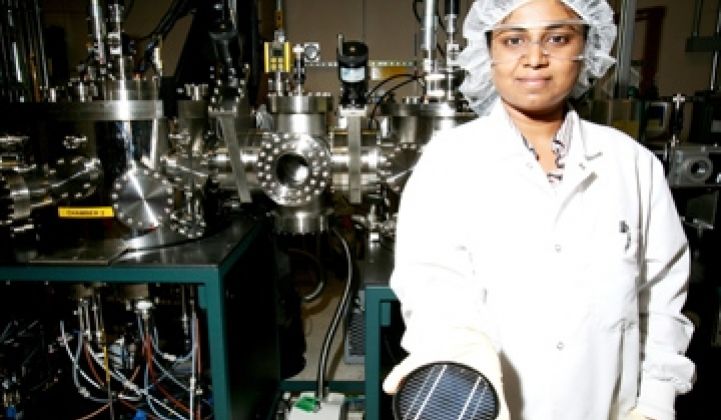
Photo of a woman at AQT's lab holding a prototype solar cell courtesy of the company.
21 Comments

  • JoeJoe 11/20/09 2:42 PM

    With crystalline performance steadily improving and prices falling as they are these startups are going to have a hard time competing. It looks like Q3 c-Si module ASPs have been around $2.00/watt. Q4 ASPs are projected to fall another 10-15% with a further 5% drop in Q1. That puts expected factory gate module ASPs in the $1.50 to $1.75 per watt range in the next 6 months - talk about a moving target.

    Look at the trends… Wafer processing costs are headed towards 25 cents/watt within the next year or so. Feedstock costs should head toward a range of $35-40/kg in the same time frame resulting in wafer costs coming down to 45 to 50 cents/watt. Meanwhile non-silicon costs are headed towards 50 to 55 cents per watt in the next year or so. These trends seem readily capable of pushing crystalline module costs to $1/Watt.
    And to this performance factors that should be considered… If you assume a 5 cent per watt penalty for each percent of efficiency difference between modules you have 11% efficient modules selling for 25 cents/watt less than 16% efficient modules. All things considered even First Solar is going to have a hard time.

    Reply
  • Solarkook 11/21/09 4:42 AM

    Aloha JoeJoe! You’re very knowledgeable, and I’d like to ask a few questions.
    1) iSuppy just reported that rates for silicon modules would average about 2 bucks in 2010. Do you really think that this price can be cut in half in just one year?
    2) If demand really begins to pick-up in China, the U.S., India and a few other countries by the end of 2010 or 2011, do you think that feedstock costs could head higher than $100/kg again?
    3) Do you think that this situation is causing, or will cause, First Solar to accelerate their R&D? I know that first Solar is looking forward to efficienies of 16% or so in the future. And I’ve also read that First Solar’s costs will be down to about 50-55 cents/watt by that time. What are your feelings?
    Thank you and aloha, Richard!

    Reply
  • StevePluvia 11/21/09 11:09 AM

    JoeJoe, I think your cost reduction estimates are too aggressive.  Many BOS have seen a bottom and begun to rise; specifically copper, aluminum and glass.  Labor won’t get cheaper.  The fully integrated C-si guys generally have lots of debt to service (paying for their poly plants etc) , as such much of their under-one-roof advantages are wiped as they pay off debt. 

    My models suggest the best-in-breed C-si guys will have a very hard time cracking $1.20/watt production costs.  Add SG&A and ASP’s will need to be $1.40-$1.55 to generate a very slim margin.  (VERY slim).  The volume of c-Si that can generate a profit at $1.50 ASP is tiny, while demand is huge. 

    The mistake many make is forgetting to consider the supply/demand along the price curve.  As many analysts babble about gluts, and lower poly translating to lower asp’s, they forgot to model lo priced supply and demand.  I corrected Greentech media analysts on this very subject some months ago. 

    The demand for lo-priced product is so hi that it easily outstrips supply.  During the last 2-3Q’s we had a temporary supply of lo-priced modules that won’t be seen again (i.e. the glut of hi production cost modules that had to be blow out below costs to get inventory off the books). 

    Looking at the big picture going forward, while several c-si mfgrs may challenge FSLR lo costs for the reasons you’ve mentioned (higher efficiencies reducing bos costs), they don’t represent enough supply to take away FSLR market share.  Particularly when FSLR is moving to a model where they deliver installed plants at industry leading prices.  This clever move allows them to controlling a large chunk of their demand internally which effectively reduces the supply of lo-priced product further.

    The glut of overpriced modules that had to be blow out represented the biggest challenge to FSLR’s profit margins.  That supply overhang is now gone; Going forward, its smooth sailing for FSLR margins until next gen pv can deliver commercial scale supply at lo prices.  FSLR should be bought at these prices as results going forward will produce a substantial short squeeze in the stock.

    Reply
  • JoeJoe 11/21/09 2:19 PM

    Richard… The projection isn’t for PRICES to come down from $2/Watt to $1/Watt. Factory gate ASPs were around $2/Watt during Q3 and all the companies are generally forecasting another 10% to 20% drop in prices in the next two quarters. i.e. Factory gate ASPs should go down to $1.60 to $1.80/Watt in the next two quarters and hopefully stabilize in that zone. The other projection is that COSTS are moving towards about $1/Watt in the near term. The math is simple: if you add together the projected silicon costs to the processing cost estimates from the silicon to wafer stage and the wafer to module stage you come up with about a $1/Watt.

    I don’t see China and India being a big part of the market in the near term. I think several of the projects in the news have been designed to help Suntech et. al limp through this downturn we’ve been in. My general feeling is that the 10 and 20 GW announcements are climate propaganda aimed at giving China/India leverage in GHG negotiations.

    Rogol forecasted Si costs going high again but I don’t think so. It really depends on how the economy as a whole behaves. Remember that FBRs have production costs as low as $20-25/kg. I expect MEMC and REC to continue building plants to beat the band.

    I don’t know what First Solar is going to do. In the silicon space you have the luxury of comparing several companies against each other - not so with CdTe.

    Reply
      • JoeJoe 11/23/09 8:16 PM

        Looking at module manufacturing costs or ASPs alone is not enough… We’re in agreement… check… When you consider product efficiency from a PROJECT perspective you need to account for how installation costs change due to the efficiency of product A vs. product B. The 7.5 cents per watt per percent difference is simply a thumb rule that allows you to scale for the extra BOS costs. When I say BOS costs I mean everything past the module.

  • JoeJoe 11/21/09 3:44 PM

    Steve… I took LDK/Renesola’s wafer processing cost estimates and added them to Suntech’s non-silicon processing cost estimates. The $35-$40/kg silicon estimate comes from Renesola as well. I fully admit it’s a jiggered formula but I think it gets you in the ballpark. Your $1.20/watt figure could be more accurate.

    I don’t see copper, glass and aluminum being a problem. I’ve only seen one estimate of glass costs in one of Nemet’s papers and it was low (around 10 cents/watt IIRC). I also see labor effectively getting cheaper with more automation and scale so that shouldn’t be a problem. Suntech has reduced its fully loaded non-silicon costs from 66 to 60 cents in the last two quarters. As they ramp in higher efficiency production and improve utilization I’m confident they can push their numbers down to the 50 cent/watt range.

    I agree the feedback between supply and demand needs to be considered. Lower prices lead to more demand… We’re seeing that… check… The problem I see is on the subsidy side. If I were Germany I would be putting on the brakes. Wouldn’t you?  If I were a country watching Germany I would be reconsidering how to implement support mechanisms. Again, wouldn’t you? From my perspective, you can’t get a good feeling for the supply/demand feedback until you clean out the subsidies.

    First Solar assumes that each percent difference in efficiency translates to a 7.5 cent/watt penalty in BOS costs (I listed a more favorable 5 cents/watt assumption above). When I think about this BOS penalty, I see Suntech’s 16.5% efficient product having a 41 cent/watt chunk of leverage. This “leverage” is going to be a big problem for First Solar down the road.

    Reply
      • StevePluvia 11/22/09 2:36 AM

        JoeJoe, are those costs w/o profit or sg&a?

      • JoeJoe 11/22/09 4:23 AM

        Suntech says the 60 cents/watt cost is “fully loaded” so I’d assume so… As a cost it doesn’t include profit by definition.

        Renesola’s SG&A expenses would add another 5 cents/watt to the processing cost. I’ll check LDK’s numbers on Monday.

      • JoeJoe 11/22/09 4:57 AM

        Bringing up the SG&A expenses is fair but allow me to add some perspective. Last time I checked First Solar didn’t include SG&A in their widely quoted $/Watt totals. As far as I can tell SG&A expenses for Suntech and First Solar are about the same on a $/Watt basis.

      • JoeJoe 11/22/09 8:58 AM

        Hmmm… I’m having second thoughts on whether SG&A is factored into the processing costs - for Suntech that is… I’ll try to find out.

      • StevePluvia 11/23/09 2:49 PM

        JoeJoe, you need to include SG&A, some profit and any debt payments.  The objective of this exercise is to determine the lowest price they can sell product (break even) and where they would sell at x% profit margin.  Use those numbers to determine the thin film (read FSLR) discount.

        As you know, you can’t cherry pick (for example) wafer “costs” if the company has in house poly production which translates to debt payments on x millions…  Then you need to add in +SG&A, +Profit to get a reasonable projection for future ASP’s (and reasonable thin film discount).

        What you will find is the volume of c-si available at lo prices is substantially lower than demand.  Thus lo priced PV is supply constrained while higher price PV is not. (read no worries for FSLR)

        The other red flag to consider is credibility of management.  Look back to Q4’08 CC’s from many of these guys where they claimed $3.80ish asp’s hi production volume with forecasts of more of the same.  FSLR was the most honest and conservative. And the most profitable thru the entire mess.  They were the only company able to expand production, operate at greater than 100% of capacity, and do so at a substantial margin.  Everyone else missed their forecasts, lost money and took on debt to finance negative cash flow.  Debt they’re still paying off that’s damn expensive.  Betcha dollar FSLR outperforms all other PV mfgrs again in ‘10 while squeezing shorts who don’t understand the supply constraint on lo priced PV.

      • JoeJoe 11/23/09 6:44 PM

        Steve… I pulled the ASP projections from a half-dozen earnings statements… A decline of about 15% in the next two quarters seems to be the consensus view and that translates into average crystal prices of around $1.70/Watt entering Q2. From this I’d wager First Solar’s ASPs will be about $1.40/Watt entering Q2. What’s your guess? What do you think First Solar’s ASPs are currently running?

        The efficiency penalty exists whether you’re comparing different crystal products or crystal and thin-films. The efficiency penalty has nothing to do with SG&A, R&D, Cholesterol or whatever else.

        As far as manufacturing costs go… you’re right… I cherry picked like a mutha… I hope it’s clear I was ballparking that schtuff… A more realistic estimation of “product costs” would have to include SG&A, R&D, debt, profit between stages (if applicable) etc…  Unfortunately, you can’t do this on a $/Watt basis because these companies are all moving into project development and whatnot… I’d argue if you want to compare the technologies rather than the companies, you have to go back to the manufacturing costs and account separately for SG&A, R&D and profit between stages in the best way you can.

        We seem to differ on what next year brings… I think Germany is going to pull back harder than expected. I actually hope they do… This industry needs to shuffle out of the Luke gear and Jedi up. We’re up against the Empire man… The industry can’t go on the attack until it gets out from under its subsidies. Sooner the better… Cheers.

      • StevePluvia 11/23/09 7:43 PM

        JoeJoe, I thought the issue was when does FSLR stop enjoying a cost advantage.  To know this you must determine a cost/break-even & cost & profit for the lowest cost c-si guys.  To get those # you can’t cherry pick stated production costs as they don’t include SG&A or debt payments for poly plants etc. 

        “The efficiency penalty exists whether you’re comparing different crystal products or crystal and thin-films. The efficiency penalty has nothing to do with SG&A, R&D, Cholesterol or whatever else.”

      • JoeJoe 11/23/09 8:23 PM

        Do you want to take this offline? (JavaScript must be enabled to view this email address)

        I’ll give you my real email from there if you like…

      • JoeJoe 11/23/09 9:15 PM

        Steve… I consider Suntech the main competitor to First Solar at the moment. All things considered they have the best technology and they are the biggest. Their debt worries me but what’s a few billion dollars in the big scheme of things? Next year Suntech should add another 400 MW of Pluto lines… I also expect them to bump up their already impressive m-Si efficiency and pull down costs with scale and better utilization. Up until now they’ve had a virtual integration strategy but when the time is right I expect them to move headlong into wafering and feedstock in that order. I don’t know if this will occur through merger or acquisition or some other route but I think it’s going to happen one way or another. As the best of breed techniques from feedstock to module get integrated in one house it will push manufacturing costs down to the $1/Watt range. How long will this take? I’d say 2 years and some change.

  • JoeJoe 11/21/09 6:14 PM

    One other thing comes to mind… When $/Watt costs for wafers are mentioned there’s an assumed efficiency that goes along with the figure. For example, LDK assumes a cell efficiencies of 15.3%. When you estimate $/Watt costs at the module level using wafer ASPs you need to account for this assumption. i.e. Anyone with module efficiencies above 15.3% effectively reduces their wafer costs and the reverse is true for those with module efficiencies below 15.3%. Make sense? Your turn Steve.

    Reply
  • JoeJoe 11/21/09 9:18 PM

    The 7.5 cents/watt penalty can’t be derived from the slides… Sorry about that. Here’s the actually quote.

    “If you look at slide 11, it’s the same data adjusting for a balance of system penalty of $0.15 a watt, which is what you get assuming 12% conversion efficiency on First Solar modules versus 14% on polycrystalline silicon, and it demonstrates a range that while higher is still fairly significant.”

    http://seekingalpha.com/article/134102-first-solar-inc-q1-2009-earnings-call-transcript?page=-1

    Reply
  • Solarkook 11/22/09 1:11 AM

    Aloha from the Kook. JoeJoe, Steve and others thanks for your insight! It looks like First Solar better made some serious headway in efficiency over the next year or two if it wants to REMAIN at the forefront of low prices. Again, thanks!

    Reply
  • JoeJoe 12/16/09 12:35 AM

    I’m second guessing myself StevieP…. Perhaps the silicon producers (vs, waferers)  will be the best buys in the coming year.

    Just eyeballing here but it looks like the Siemens producers should get edged out by FBR as we go forward. Don’t know the timeline.. Do they realize it? I’m not sure. I understand why silicon production moved in such a way as to allowed flexible production that could satisfy both PV and semi. At the same time it looks like facilities that optimize for solar silicon will win out and capture market share. If so, some of the Seimens facilities might see what’s coming and bail out. That would make them cheap acquisition targets. How cheap? Don’t know. Cheap enough? Don’t know? But it’s got me second guessing the order of vertical integration strategy.

    Do you care StevieP? Don’t know?  Just throwing out some thoughts…

    Reply
  • StevePluvia 12/16/09 2:31 PM

    JoeJoe, to play the PV space, I like Eric W’s idea—find the winning inverter plays that can maintain hi margins; poly & module mfgrs will face an ongoing cost battle.  It’s hard to keep up with every one of those guys, particularly when they all try their hardest to hide their true costs.  We think lower costs = MANY more installs, every one requires an inverter.  So big growth to inverters. Find the hi margin inverter plays and you’re golden.

    Reply
.