Study: Batteries to Add $14,400 to EVs, $5,900 to Plug-Ins

Adding batteries to a plug-in will add $5,900 to the cost of a car in 2035, said Daniel Sperling, founder of the Institute for Transportation Studies at UC Davis.

The National Academy of Sciences will weigh in on the debate over plug-ins and electric vehicles soon, and the news is not comforting.

The study states that adding batteries to a plug-in will add $5,900 to the cost of a car in 2035, said Daniel Sperling, a professor of civil engineering and the founder of the Institute for Transportation Studies at UC Davis, during a presentation at the Almaden Institute taking place at IBM's Almaden labs.

The batteries in fully electric cars will add $14,400 to the price of a car in 2035, the study states, according to Sperling. The study isn't out yet, he said. It will be released later this summer.

Diesel cars will carry $1,700 to the price of a car. Cars powered by hydrogen fuel cells, meanwhile, will have an additional cost of $5,300.

Regular gas cars, meanwhile, will cost about the same as they do today. A car that costs $19,600 today will cost $21,600 in 2035.

I'll have some more on Sperling's talk in a bit. He's a supporter of electric cars. "Almost everyone agrees that electric drive trains are the future," he said.

Still, the price remains a major impediment. Electricity also will have to come from cleaner sources for these cars to help keep atmospheric carbon dioxide at the 450 parts per million level in the future. Charging a car in a coal state doesn't really cut emissions. Sperling is also the somewhat rare supporter of continued research in hydrogen – it might work, after all.

Costs aside, research and policy directives need to be implemented to de-carbonize the transportation sector. Left to their own devices, oil companies will put their research and development dollars into synthetic fuels like coal-to-liquid. If you count unconventional fuels like tar sands, "there is almost unlimited fossil fuels for under $100 a barrel," he said.

"Unless we have policy intervention, that is what we will go back to," Sperling added. "The oil companies, left alone, will invest in unconventional oils."

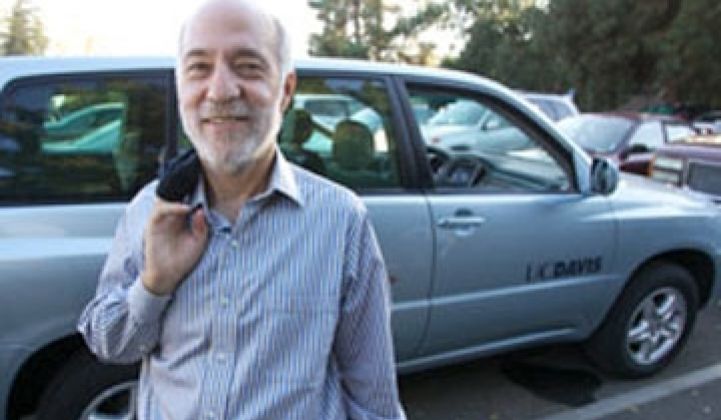
Image of Daniel Sperling courtesy UC Davis.

Comments [13]

  • Steve Pluvia 08/26/09 2:35 PM

    It is supremely arrogant to believe you can predict the state or cost of battery tech 25 yrs from now.  No doubt this stunning research was paid for by tax dollars.  It reminds me of the saying “if you can’t do—teach”.... Pls add: “And support yourself by conducting spectacular research (like this) paid for by tax dollars”...

    Reply
  • Peter A 08/26/09 3:34 PM

    It is equally arrogant of you to to pollute this web site with your smart-ass comments. Do you REALLY have an opinion on everything Mr Know It All? Or are you just bored out of your mind? Do you actually DO anything?

    Reply
  • Jay Turner 08/26/09 3:36 PM

    Since my car’s lithium-ion battery cost $10K in 2008 and what Toyota seems to be proposing is about half that size for next year, the $5900 figure seems more appropriate for 2010, and given the flurry of recent advances in battery technology, it’s fair to guess that the cost will continue to decline over the next decade.  In 25-years time I would hope that battery electric and fuel-cell vehicles would ordinary and no one will be talking about a cost premium.  As cars get lighter, the range and cost of battery-electric vehicles will improve dramatically.  The professor must be using some very pessimistic assumptions.

    Reply
  • evnow 08/26/09 10:57 PM

    This is quite stupid - assuming the article is correct.

    Nissan Leaf apparently has a battery that costs about $10K. Volt’s battery costs $8K.

    How can the battery cost so much in 2035 ? Makes no sense.

    Reply
      • Steve Pluvia 08/27/09 11:49 AM

        Exactly evnow.  And to think anyone could predict costs on new storage or power technologies with unknown manufacturing processes & costs is simply *ridiculous* (I’m being kind here as I like UC Davis).  Other disruptive technology considerations may include for example a low cost fuel cell (see discussion on this site re Toyota fuel cell release by 2015).  Nobody really has their arms around what this landscape will look like in 5 years; Predicting costs 25 yrs out is so ridiculous I have a hard time believing this story wasn’t released on April 1st….

  • Steve Pluvia 08/27/09 6:00 PM

    Richard, nice find, very telling story.  It is tragic lobbyist scumbags like Sperling end up harming the public good while they line their pockets with blood money.

    Reply
  • Jeffu 08/27/09 8:02 PM

    Daniel Sperling has NO credibility. Is he trying to get fired? Maybe he can’t be fired. Maybe the only real fire Daniel will see is when some static electricity ignites the odorless gas leek in his hydrogen fuel cell car. Then he may see a very fast fire that takes out cars in all lanes. Oh, Daniel forgot to mention that hydrogen is so dangerous that it actually will NEVER be use in any production cars.

    Reply
  • Brammofan 08/27/09 8:11 PM

    Actually, he’s probably not too far off.  $14,400 for batteries in an EV in 2025?  By then, minimum wage will be about $1,000 an hour so, ‘s all good.  Plus, we’ll be riding hoverboards and eating Soylent Green, which is both good and bad, but what do you expect?

    Reply
  • JQW 08/27/09 9:08 PM

    Lithium batteries in China already cost $500/kWh. 100 miles of range already costs less than this price. Is Sperling suggesting that battery prices will increase in 25 years instead of decrease? And this is not counting the fact that EVs don’t need engines, radiators, oil filters, air filtes, spark plugs, alternators, transmissions, catalytic converters, or mufflers.

    Sperling’s book, Two Billion Cars, is full of mistakes. He wrote, “A hydrogen fuel cell vehicle operating on hydrogen made from natural gas generates about half as much as greenhouse gas as gasoline, taking into consideration the full energy cycle.” For this assertion he cited a Scientific American article that said FCVs were 110 g/km compared to 150 g/km for gasoline cars. When someone turns 27% reduction into “about half” you know you better check your pocket to see if you’re wallet is still there.

    Reply
  • drivin98 08/28/09 6:37 AM

    Before I saw this I thought Sperling was a complete idiot. Suspicion confirmed.

    (Yes, I know it might seem a spurious sounding comment with no facts or figures referenced for validation but I have stuff to do and it should be obvious to anyone who knows current battery prices and their trajectory that this study should go immediately to the dust bin without passing Go or collecting $200.)

    Reply
  • Rollin 09/4/09 6:14 AM

    I have a problem with the whole idea of putting all of our EV eggs into th e lithium battery basket. Lithium is the new oil in that it is even scarcer and as such easy prey to political and corporate corruption. It may be better all around if we customers were to try to make some lifestyle changes on how fast and how far we need our cars to go on a charge and just stick with lead acid batteries. If we could get our goverments out of involvement with car manufacturing regulations etc we could see a huge drop in EV prices. Let’s face it if we could eliminate long commutes, slow down our average driving speeds, and pare down safety regulations to only what is truly useful we could all be driving sub $10,000 cars.
    Enslavement to Lithium will be worse than that of oil once it is brought under control of a few elite bankers.

    Reply
  • Andrew Winston 09/9/09 10:25 PM

    One more commnet, there was a study done (possibly by NREL, I’ve forgotten) that says even if EV/PHEVs are charged via 100% coal, it’s still 30-40% cleaner than petrol.  I I have seen this stated many ways over the years, and I am of a mind to disagree with anyone that claims coal and petrol are the same in terms of CO2 output.  Yes—it’s obvious that we want to charge via clean energy—but still, you already get a tremendous gain switching to any kind of electricity.

    Reply
.