Seven Reasons Why Better Place Will Fail and Four Why It Won't

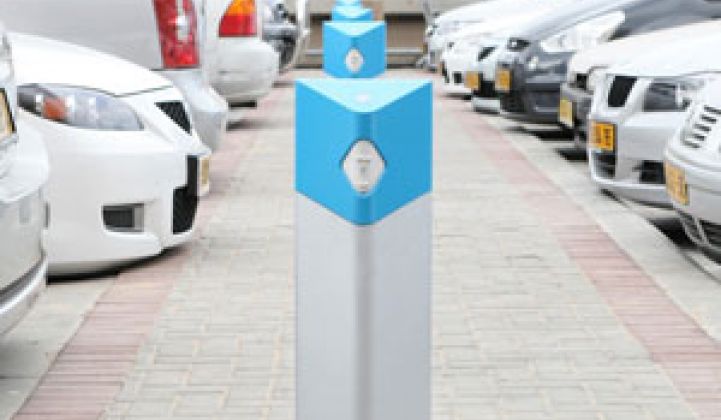
The well-funded Better Place hopes to revolutionize transportation by building a network of charging stations for electric cars. But does it really have the goods?

Some companies just rub you the wrong way.

I've never been a big fan of Apple, for instance. Most reporters hold them as an extraordinary example of fusion between technology and aesthetics.  I just see them as an outfit that makes status symbols for people who pretend to disdain them.

In greentech, that company for me – the one whose business plan seems more shaky than sound – is Better Place. The well-funded company hopes to revolutionize transportation by building a network of charging stations for electric cars. 

Consumers will pay to use to the charging stations, like a service, and get charged for how many miles they drive. The network fees will help subsidize the price of the car, which could become free in some circumstances. It's like a cell phone, the company argues.

To shorten the charge time, depleted batteries can be swapped for charged ones. The air gets clean, we stop using oil, money stops flowing to terrorist organizations and corrupt dictators. All thanks to founder Shai Agassi.

So here's what stinks. Disclosure: I have not contacted Better Place. This is an opinion piece, so it's very subjective. Also, note that I live in abject squalor compared to the guys who run Better Place. If you want financial acumen, talk to them. But here's my opinion anyway:

1. It Won't Plug Into the Wall: The cars, as it now stands, are designed to plug into charging stations owned by the company. If you want to charge at home, you have to get Better Place's charging station. If you find yourself stuck in Visalia and just want to unplug a Coke machine at the Ramada Inn, too bad. You need to charge at the company-approved outlet.

Why? Because under the Better Place cell phone model, you buy electricity from "The Man." That chafes against the core of what it means to be an American: That is, to be someone who is too lazy or un-surly enough to actually live peacefully within the terms of a contract. E Pluribus No Money Down. Deep down, I think even Europeans would get the willies about this. My German relatives treat their cars like a member of the family.

2. Automakers Will Make Cast-Offs for the Company: Everyone – General Motors, Toyota, Ford, Tesla Motors, Nissan, Honda, Fisker Automotive – will be releasing plug-in cars over the next two years. Put yourself in the shoes of a car exec. Are you going to make your coolest, most stylish cars for this network, or are you going to keep your flexibility? Does Ford push the Crown Victoria on the public at large, or government agencies?

3. It's Insanely Expensive: Better Place is essentially an electric version of ZipCar, the rent-on-the-spot car network. But if ZipCar actually had to build and maintain the gas stations its cars stopped at. We're talking huge amounts of real estate and lots of employees.

4. It Will Take Years to Pay Off:  It takes about 15 years for the installed base of cars to turn over. Generally, about 12 million cars a year get sold. Some estimate that there are 625 million cars on the world's roads. Only a few hundred street legal cars will come out this year and next. Even if global warming accelerates and peak oil arrives in 2010, it is still going to take a number of years before enough people get rid of their gas burners and go electric.

Charging stations will be needed someday, so why not build them then? Building them now, when electric cars still cost a premium and few drivers exist, means paying interest on billions of capital while waiting for a critical mass of customers.

5. Battery Swaps Are Inane: This often gets skimmed over. You'll drive into the station, a robot or a person will swap out the depleted battery, and you'll get a fresh one and be on your way. All in three minutes.

The problem? The battery in an all-electric car isn't like that 20-pound thing in your car attached to two wires. These things will weigh around 500 pounds. I'm extrapolating here, but Better Place says the cars on its network will go 100 miles. Tesla's Roadster goes 250 miles and the battery weighs 1,000 pounds. The battery is also one of the most expensive components in an electric.

If you own the car, are you going to trust the guy sitting behind the counter selling champagne-scented air fresheners to swap out the heaviest and most important part of your car? And then trust him to replace it with a part from some stranger that – who knows – went hunting for coyotes in his economy car after a bender? 

And just imagine the real estate needed to store these batteries.

Battery swaps are being used in electric buses in the U.K. – but the municipal bus agencies own the buses, the charging areas and the batteries.

6. Persistent Charging Kills Batteries: The company asks drivers to trickle charge while at work. Hmmm. Lithium-ion batteries can only endure so many charges before their ability to hold power begins to diminish rapidly. The old standard was 300 charges. Imara, Boston-Power and others have boosted it to 1,000 charges (see Boston-Power Gets $55M More to Produce Lithium-Ion Batteries). And that figure will grow.

But do the math. Two charges a day for three years is 2,100 charges. Whoops. It's going to take better batteries first. Automakers hate this.

7. There Are Easier Ways: Much easier. How about this idea. Just put electric charging stations at existing gas stations for a few thousand bucks. Let service station owners charge outrageous, but flat fees, for power. Just pull up and charge, if you need to. Hey, that's what Coulomb Technologies is doing.

And Four Why It Might

1. Embarrassment: San Francisco, San Jose, Israel, Denmark, Australia, Hawaii and other places have already inked alliances with Better Place to build charging stations in their areas. Politicians would rather post bonds than tell voters they screwed up. Thus, governments might decide to pay for this anyway.

And don't forget. Shai Agassi used to be the overlord at SAP, the software company that has sold billions to governments. He knows the psychology. Do not underestimate this.

2. Urbanism Is In: Everyone is moving to the city. Just like China. The country has more cities with 10 million people than I have blackheads on my nose. Megacities are sprouting in India, Malaysia, Africa and Central Asia. In the U.S., the upper-middle class is moving into condos and gang members are moving into abandoned subdivisions.

And in the city, who wants to own a car? The parking is a hassle and someone invariably will break in to steal the change. Transportation-as-a-service dovetails quite nicely with demographics.

3.  Not Many Charging Stations Will Be Needed: "I think there's about 13,000 petrol stations throughout Australia. Our preliminary deployment plan currently estimates that we need 500 battery exchange stations," said Evan Thornley to Cnet Australia earlier this year. 

4. In New Eras, Ambition Is Rewarded: Economic development tends to follow a set pattern: Discovery is coined and commercialized, a giant rises up to monopolize it, and it is then brought down after a fortune is made.

In the U.S., Carnegie, Mellon, Rockefeller an d others became titans and inspired antitrust laws. Ford had his era of dominance before competitors showed up. In South Korea, Samsung has almost been part of the government at times, and opposition to that control has grown. Bill Gates is no longer the titanically feared person he was just ten years ago.

We are moving toward a post-fossil-fuel era. It will be natural for a few people to become giants.

If people are burning Agassi in effigy in ten years, we can say that Better Place was a success. 

Comments [16]

  • Yoni Levinson 03/30/09 10:00 AM

    “Disclosure: I have not contacted Better Place. This is an opinion piece, so it’s very subjective. Also, note that I live in abject squalor compared to the guys who run Better Place. If you want financial acumen, talk to them. But here’s my opinion anyway:”

    I normally find Greentech Media’s articles to be informative and insightful, but I found this one to be amateurish and out-of-place. 

    I fail to understand why the author is so angry - sure, this idea might not work, but is it really appropriate to get so enraged at a company whose name coveys the idea that they are trying to make the world a better place? 

    Do you really think Shai Agassi quit his job at SAP to become some kind of robber baron?

    As a green blogger myself, I can say that although I often criticize ideas I disagree with, I fall short of spitting in their face. 

    Because that’s just a low blow - even if you do put up a “disclosure”

    Reply
  • Kevin Christy 03/30/09 12:55 PM

    Your seven reasons why they wouldn’t succeed strike me as a lot more concrete than the four why they might.

    I think electric cars have a bright future. Better Place? Awfully risky IMHO.

    Reply
  • Gerrett S 03/30/09 1:36 PM

    This has to be one of the most honest and subjective pieces ever written on this website!  Thank YOU!  You have put to words a number of the reasons I never liked better place and more.  Just because something says GREEN and looks like it’s for the advancement of electric cars (I am all for them) it can still do damage.  Personally I won’t buy an EV if I have to lease the battery.  And the last thing I want is a monthly “plan” for my car.  I want to charge at HOME!  EV’s are less complicated than ICE cars.  Project better place seems to be making an overly complex business model for what really should be a simple thing.  Battery technology is only so good TODAY.  Can’t quick charge and can’t go forever.  To implement EV’s today, they need to market to homeowners who can charge at night.  Forget the overly complicated unnecessary infrastructure.  If city dwellers want EV’s, the demand for charging stations wherever they park their car should encourage charging stations.  When battery tech gets better and we can do quick charging, then I’m all for gas stations raping me with a quick charge fill up if I’m on a long trip. 


    But for IMMIDIATE implementation of EV’s, just get them out and market them to folks who want them and don’t need any fancy infrastructure. 

    Reply
  • Eletruk . 03/30/09 1:55 PM

    I don’t get why all these people have a problem with Better Place. Nobody is forcing you to buy their car or subscribe to their charging. If you were REALLY interested in helping the planet and reducing your carbon fottprint, you would already be driving an electric car. I have two. I don’t need Better Place, and nobody else needs Better Place to own an electric car. They are available NOW! You can convert an old clunker (I have a 1991 Ford Festiva converted) or buy a factory EV like ZENN. Neither require any more complicated infrastructure than a good extension cord.
    If you don’t like their business model, fine. Don’t buy into it. However, don’t slam them for making more of a effort than YOU to get people to drive electric.

    Reply
  • Steve Pluvia 03/30/09 2:26 PM

    I’d love for it to work, but… History is never kind to gen 1 designs of new ideas… Better design, better batteries and better technology will likely make the plug-in model a much ~Better Place~ for green transport money.

    Reply
  • Gerrett S 03/31/09 6:17 AM

    To Yolevins,

    Personally I do believe he is trying to be some kind of robber barron.  EV’s can get implemented TODAY without infrastructure.  They have distinct disadvantages compared to ICE cars, but that will increase with technology.  If peoples first dealing with an EV is something they have to pay a monthly plan on and never actually own the battery, they’ll never want one.  In the end that HURTS the EV market because potential customers are feeling shoehorned into some contract.  Cars for most of us mean freedom.  I want to own my car and be able to fill it up where I want (at home). 

    Reply
  • Peter Antypas 03/31/09 8:33 AM

    Their business model is predicated on current limitations of EV technology. Any such model has an expiration date in my mind.

    Reply
  • john mac canna 04/1/09 5:40 AM

    The lack of research of this artical. Not even to talk to betterplace is amazing.
    I also think the writer has not look at the videos on betterplace website.
    1 the statement:It Won’t Plug Into the Wall - false
    It is a basic part of the betterplace plan
    http://www.youtube.com/watch?v=NfGEbTcNuzA
    go to 12:16 where he talks of 4 major places to change your car 1 Home 2 work 3 retail 4 downtown.
    2Automakers Will Make Cast-Offs for the Company - false: Tesla model s has choose of batteries and battery swap for betterplace. See tesla web site.
    http://www.teslamotors.com/models/index.php

    3It’s Insanely Expensive:false: The cars are cheaper. and a contect of 5 years at cheaper then oil electricity see video http://www.youtube.com/watch?v=NfGEbTcNuzA
    4It Will Take Years to Pay Off:- false see above.
    I could go on: may be you should do your homework

    Reply
  • Inna Ponomarenko 04/1/09 7:40 AM

    Mr. Konellos, you obviously need to make a better research and develop a better understanding of basic technologies behind the Better Place business model. For example, your point on “persistent charging killing a battery”: please, note that a “# of cycles” of a lithium-ion battery is defined as the number of complete charge - discharge cycles a battery can perform before its nominal capacity falls below 80% of its initial rated capacity (Depth of Discharge). So, you basically need to discaharge it by 80% and recharge to 100% again to call it a cycle. By the way, current generation of li-ion batteries gives 2000+ full(!) cycles. I do not comment other flawed arguments you are providing.

    Reply
  • jason jungreis 04/3/09 11:46 AM

    I am an avid follower of GreentechMedia, and this is without a doubt the worst piece I’ve ever read here, by far.  Where do you get off writing an article that is so woefully and even fundamentally misinformed?  Did you even review the Better Place website or the various press items BP have produced or listened to any of Agassi’s speeches or spoken to any Better Place reps?  In a nutshell, your criticisms 1, 2, 3, 5, and 6 are just flat-out wrong.  (Responsible GreentechMedia writers like Ucilia and Jeff must be embarrassed to be associated with you: seriously, never write anything so foolish again.)

    Reply
  • Mark Goldes 04/3/09 2:57 PM

    Better Place is likely to be replaced by Better Technology!

    Revolutionary energy conversion breakthroughs are becoming realistic prospects for electric and hybrid cars. Self-powered magnetic generators, tapping ambient energy, are expected to replace the need to plug-in a plug-in hybrid. 2,000 watts can be taken from a typical wall socket. A 2,000 watt self-powered generator is on the horizon. When completed, it will demonstrate a capability to end the need to plug-in.
    If the development of self-powered engines and generators is put on a 24/7 footing, it may be possible to provide 100 kW systems on a prototype basis far more rapidly than might otherwise be expected. If that occurs, since no fossil fuel or battery recharge is required, automobile manufacturers may conclude that engines requiring such fuel are en-route to becoming obsolete. Consumer purchasing patterns could begin to reflect a new reality, with the market deciding most future cars will never use gasoline or diesel fuel.
    The economics are likely to prove compelling. Until now, car ownership has been an expense. Vehicle to Grid Power (V2G) has been explored in a modest way for hybrids. When equipped for V2G, plug-in hybrids, equipped with a two way plug, can feed power to the local utility while parked. This is 95% of the time for the average vehicle. Professor Willet Kempton, at the University of Delaware, has stated the car?s owner could earn up to $4,000 every year.
    Future cars reflecting this new technology are expected to be capable of generating at least 75 kW and perhaps 100 kW. In the case of luxury cars, trucks and buses, it seems 150 kW will prove practical. This has been called Super V2G. Technology already exists that can wirelessly couple up to 150 kW to the grid from parked vehicles. No plug connection will be required.
    Today a large plug installed in a hybrid car can allow 240 volts to be accommodated. A 240 volt connection cord can provide a maximum of 20 kW to the utility. If that 20 kW can annually pay the vehicle owner $4,000, imagine what the income might be with a wirelessly coupled 75 kW or larger self-powered generator. If the price per kW is the same as that used in the University of Delaware analysis, we could be anticipating more substantial payments.
    When a substantial number of vehicles powered by such generators fill a parking garage, it will become a multi-megawatt power plant. 
    Doubtless, when millions of cars and trucks are selling power to the grid, the price per kilowatt paid will gradually decline. However, it still seems likely that the cost of many vehicles might be paid for by utilities, as they purchase power whenever needed. The parked cars, trucks and buses, each become decentralized power plants - a rapid, cost-effective alternative to the many tough and costly challenges of constructing new coal burning and nuclear power generation facilities.

    Reply
  • oliver queen 04/4/09 5:44 PM

    Well, 4, which you seem to agree with, is kind of the killer, right? 15 yrs to pay off is a long time, especially considering how many advances EVs are likely to have in that time. The worry here that I have is that someone could get in early and saddle ALL adopters of EVs with this charging-station model. They won’t, of course, but I just don’t get the appeal of Better Place at all. Thanks for the article.

    Reply
  • Ron Edwards 04/4/09 6:57 PM

    A few pluses for the better place model that are not immediately obvious are:  When buying an electric car, I don’t have to worry about the battery - how old it is, how many times it has been cycled (if that information can even be tested?), how old the technology in the battery I have is compared to newer alternatives that are consistently coming to market, or even the range.  I can just swap it out for a newer, better, recharged one.  The battery is the part of the car that is most perishable and in danger of becoming quickly redundant as newer better batteries come on line.  In my opinion the average consumer would not need to upgrade their vehicle nearly as often as electric motors and other parts of the vehicle are not expensive.  There is no expensive motor becoming old.  That’s why better place is truly a whole new business plan for cars and is more like a mobile phone plan.
    There are other synergies in the model, such as the companies ability to store variable renewable energy sources in what will be a massive store of batteries in cars and swap stations.  DONG wind energy previously paid for its excess night wind energy to be taken by neighbouring Germany.  The ability to smooth out and store electricity flows is worth huge money.
    Americans dont seem to have a problem buying their mobile phone minutes “from the man”. If the deal is as good or better why wouldnt they buy electricity for their car the same way?  Better place is also encouraging standards be put in place by governments so that Coulombs units and others will work as well as better place.  With the right agreements there is no reason the charge stations wont be like ATM’s.  I can go to any bank teller to get my cash out.  You seem to be throwing up arguments that have not been thought through and don’t present alternatives.  Not very balanced.Points 3,4 and 5 of your arguments are not even worth reading.  How can you make those assertions with no figures and not having spoken to BP?

    Reply
  • jason jungreis 04/4/09 8:05 PM

    The reason I ignored #4 is that it is BP’s burden: if it pays off or doesn’t is only an issue for BP’s backers and is of no concern one way or the other for the consumer.

    Reply
  • G T 04/5/09 6:01 PM

    This is the most biased, inaccurate, false-balanced piece I have ever read on this site. The fact that you didn’t bother contacting Better Place for fact checking is just unethical journalism! As Editor in Chief, you have a greater responsibility to report fairly to educate the public.

    “Why IT will fail…why it MIGHT [not]”—With such blatant biased verbiage, one has to wonder if the author has some affiliation that has created a conflict of interest.

    Reply
  • Jason Nitzberg 06/3/09 12:04 PM

    I think everyone’s comments are somewhat warranted ... the author, Michael Kanellos, is obviously opinionated - and he does expressly state that as a disclaimer. But what no one has really said is that Better Place is really tight lipped about how they are going to do things in the detail anyway ... because they are a start-up with some seriously awesome salesmen selling what might be penicillin OR snake oil. Yes they bring up charging at home when they talk, I have watched the videos, and as Michael said, with at least with one California utility, they want a BP pedestal at your home ... but they don’t really believe that it makes sense.

    Let me give you one example of Better Place not being clear (because everything is in development for them): According to their website, they want to be ‘standards compliant’ but they try to focus on IEC standards (global is their buzz word for good reason) but when they presented to Calif. Elect. Commission last month, Sven I think it was mentioned their cars would be SAE J1772(tm) compliant ... where in the world did that come from? SAE, though it supposedly is ‘international’, really is focused on cars for ‘engineering best practices’ in the US, and their is a slight probability that IEC will pick it up. But using that standard in BP cars clearly goes against their business model of charging through their pedestals since the point of J1772(tm) is that the vehicle coupler set (plug and inlet) will work with any charging station from any manufacturer with any car - so are they vender locking or not? So in other words, if I was a betting man, their strategy of being top dog is pretty focused, but they can shift the details around ... that is what salesmen do best. They try to say the right words to the right people ... and in my opinion, they are REALLY good at it.

    This isn’t exactly old school journalism anyway ... just the facts mam, just the facts. Their are lots of connecting the dots ... and Michael made a decent stab at it ... but I don’t think anyone, in or out of BP is clear on what the result will be (or even threw out enough dots TO connect)  ... so hang on folks ... a crazy ride is ahead.

    Reply
.