PG&E Wants DOE Dollars for Underground Air Energy Storage

The utility wants $25 million in smart grid stimulus funds to build a compressed air energy storage system. While it’s one of the most efficient ways to store power on the grid, it also has some severe limitations.

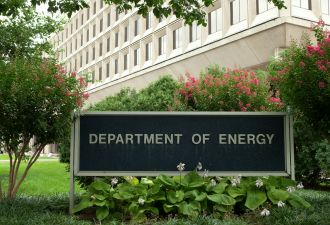
Pacific Gas & Electric will seek $25 million in Department of Energy stimulus funds to help pump lots of air underground, then release it to help generate cheap electricity at peak demand times.

That's the plan the utility outlined on its Next100 blog on Wednesday for a 300-megawatt energy storage project in western Kern County. It's the second publicly announced utility project seeking funds for grid-sized energy storage from DOE's $615 million smart grid demonstration grant program, which sees its first application deadline expire today.

PG&E envisions using cheaper electricity – mostly from wind turbines – to pump air into an underground reservoir when electricity is cheap. The compressed air can then be released to boost a gas turbine, helping to generate up to 300 megawatts of stored energy for up to 10 hours.

Such systems have some drawbacks compared to batteries, including the limited availability of underground caverns or geologic structures to store the air, as well as its limitation to boosting natural gas-fired generation rather than providing power directly.

Fellow utility Southern California Edison said Tuesday that it would seek $25 million in smart grid demonstration grant funds to install a 32-megawatt-hour lithium-ion battery, to be built by A123 Systems, to help incorporate more wind energy into its grid (see SoCal Edison Wants A123's Biggest Grid Battery Ever).

Utilities including American Electric Power, Xcel Energy and Tokyo Electric Power Co. have installed megawatts of sodium sulfur batteries for grid storage, and General Electric is among the companies working on improving grid battery technologies to bring down costs (see GE Aims at Energy Storage for Trains, Grid).

But batteries – whether the more expensive lithium ion or cheaper sodium sulfur and flow batteries – are still far more expensive than compressed air energy storage, or CAES (see What Is the Cheapest Energy Storage Idea of Them All?).

In fact, according to the Electric Power Research Institute, it's among the cheapest, besides pumping water uphill and letting it flow to spin a turbine – another technology limited by the availability of water and reservoirs to hold it. PG&E's Helms Pumped Storage Facility is one such "pumped hydro" storage project.

Still, backers of grid batteries – as well as systems like flywheels and fuel cells – say they could lower prices as more systems get deployed (see Batteries for the Grid and GridPoint to Manage Wind Power Battery Storage).

It's led some market watchers to predict a big boom in the grid storage market in the years to come (see Grid Storage Batteries and Ultracaps: An $8.3B Market by 2016).

But so far, most of the smart grid stimulus applications have shied away from storage as a focus, looking instead to accelerate smart meter deployments or grid automation and control systems (see Green Light post).

Beyond stimulus funding, a bill proposed by Sen. Ron Wyden (D.-Ore.) could offer grid storage some tax incentives equivalent to those now enjoyed by solar and wind power investors (see Energy Bill Could Boost Storage Technologies).

PG&E is also asking the DOE for $42.5 million to install energy monitoring and control systems at about 75,000 of its commercial and industrial customers. The request is for DOE's $3.4 billion smart grid investment grant program, which is aimed at commercial-scale projects (see PG&E Seeks $42.5M in Stimulus Grants).


Interact with smart grid industry visionaries from North American utilities, innovative hardware and software vendors and leading industry consortiums at The Networked Grid on November 4 in San Francisco.
Comments [5]

  • Chris Long 08/26/09 7:46 PM

    A byproduct of “compressed air energy storage” is condensed atmospheric moisture.
    The Total atmospheric moisture in the air, from my observations in the desert outside Palm Springs, varies from about 600 – 1200 lbs per million standard cubic feet. I don’t know the annual average.
    I used a Mannix digital sling psychrometer, http://www.generaltools.com/Products/Digital-Psychrometer-w-Dew-Point-and-Wet-Bulb__SAM990DW.aspx  and a free humidity calculator from http://www.vaisala.com/instruments/humiditycalculator.html  for my calculations.
    A 300 megawatt “compressed air energy storage” plant in Huntorf Germany has a capacity of 108 Kg of air per second in compression mode. http://www.unisaarland.de/fak7/fze/AKE_Archiv/AKE2003H/AKE2003H_Vortraege/AKE2003H03c_Crotogino_ea_HuntorfCAES_CompressedAirEnergyStorage.pdf
    108 Kg/sec is about, 11,400,000 scf/hr and contains 6840 – 13,680 lbs of water, (824 – 1,648 gallons per hour) what is the value of water in Western Kern County?
    A much larger CAES plant proposed for Norton Ohio with maximum capacity of 2,700 megawatts would conceivably compress air at 9 times the volume of the Huntorf plant with a moisture load of 7,416 – 14,832 gallons per hour. A 12 hour a day average compression cycle, would involve handling between 100 and 200 acre feet of atmospheric moisture per year. (32/65 million gallons)
    I do not know the percentage of atmospheric moisture that actually condenses at these facilities but the humidity calculator adjusts the weight of moisture per million standard cubic feet as the pressure entered is increased and the potential for condensation seems to be very high, 90% or better.

    Reply
      • Glenn2ns 08/28/09 2:07 PM

        interested in such insights. . . please contact (JavaScript must be enabled to view this email address)

  • F Arasnia 08/28/09 2:19 PM

    For a facility built at higher humidity areas, the water content of the air could approach ~1% by weight. I wonder how the cost of “byproduct” water out of Compressed Air Storage facility compares to conventional desalination plants.

    Reply
  • Samir Succar 08/28/09 4:20 PM

    While suitable geologic formations must be carefully screened, I don’t think this technology will be limited by lack of adequate storage volume. I looked at this carefully in a report last year, and even excluding the potential for using depleted gas formations there appears to be sufficient opportunities for a large deployment of CAES in the US

    http://www.princeton.edu/~ssuccar/caesReport.html

    The research EPRI has done in this area and the literature on natural gas storage supports this as well. There are other reasons why CAES has been slow to take off but lack of suitable geology is not one of them. Also, I discussed the PG&E announcement on my blog yesterday in the context of whether energy storage is really needed for wind and other variable generation:

    http://switchboard.nrdc.org/blogs/ssuccar/does_wind_need_energy_storage_1.html

    and addressing the fact that the wind industry seems reticent to embrace storage

    Reply
  • samiam 09/5/09 4:17 PM

    We have a system like that here in Iowa as a test system right before they added a NG gas assist for power generation so much for being green.  Its in Algona Iowa for any that care to research it.

    Reply
.