Uni-Solar Plans to Lay Off 400

United Solar Ovonic is cutting 20 percent of its workforce. It gave notice to about 80 employees at its factory in Greenville, Mich. earlier this week.

Uni-Solar Plans to Lay Off 400

United Solar Ovonic (Uni-Solar) plans to let go 400 employees, or 20 percent of its workforce, the latest sign that the company is struggling to weather the economic downturn.

The company, which makes amorphous silicon thin films, said the cuts would include the layoffs it had previously planned as part of its recent acquisition of Solar Integrated Technologies.

News of layoff began appearing Tuesday night, when local media in Greenville, Mich., began getting calls from Uni-Solar employees who got the pink slips that day (see Greenville Daily News andWOODTV8).  

Uni-Solar gave notice to about 80 employees at its factory in Greenville, Mich., on Tuesday, confirmed Mark Trinske, vice president of investor relations at Uni-Solar, via email early Thursday. He said the company would issue a press release about the layoffs later in the day. Before the layoff announcement, Uni-Solar had about 1,900 employees overall.  

The press release showed up late Thursday, didn't specify which factories, besides the one in Greenville, will be affected by the restructuring plan. Trinske said the cuts will take place at various sites, most of which are in Michigan, the base of Uni-Solar's operations. 

Like many other companies in the solar industry, Uni-Solar has struggled amid an economic downturn that has strangled investments in building solar power projects worldwide over the past year. Earlier this year, solar panel manufacturers and their suppliers were reporting steep revenue cuts and even losses.

Uni-Solar had shut down its factories in Greenville and Auburn Hills for about a month between May and June this year.

The market conditions improved in the third quarter of this year thanks mainly to Germany. Germany has a well-established market and policies for subsidizing solar power generation (see Germany Installs 2.34GW, FIT to Decline 9-11% and Solar Market to Decline for First Time Ever).

While other solar companies began to see a boost to their revenues and profit during the summer, Uni-Solar continued to post losses.

The company is part of Energy Conversion Devices, which reported last month a net loss of $11.8 million, or 28 cents per share, for the fiscal first quarter, compared with a net income of $11.8 million, or 27 cents per share. The company had posted a net loss of $17.6 million, or 41 cents per share, in the fourth quarter of fiscal 2009.

The day Uni-Solar gave employees the pink slips, its chairman, Subhendu Guha, appeared at a solar conference in San Francisco and spoke about the fierce competition for limited customers this year.

Guha said manufacturers in China have inflicted pains on the rest of the industry by slashing their prices. He also noted that solar panel makers had been expanding their factories just before the market demand plummeted.

"The relentless pressure is coming from two sides. One is the low-priced products from China," Guha said. "In order to sell the products, you have to lower the price of the systems. It's great for consumers but not for manufacturers. But those with a vibrant business model will survive. Many will not."

Uni-Solar was embarking on a big expansion plan before the credit market collapsed a year ago.

In October 2008, the company said it would build a 120-megawatt factory in Battle Creek, Mich. The company had hoped to start operating the factory by the end of this year.

Uni-Solar has postponed that plan, Trinske said. The factory building is there, but it has no equipment, he said.

"Because we are on a 'demand-driven' expansion, when demand slowed we postponed the continued development of Battle Creek," Trinske wrote in the email. "This new restructuring [in Greenville] does not impact the Battle Creek facility since it has no equipment or employees yet."

Back in 2006, it announced plans to build a 120-megawatt factory in Greenville in two phases. The company was operating a factory in Auburn Hills at the time and was about to open a new factory in the same city soon.

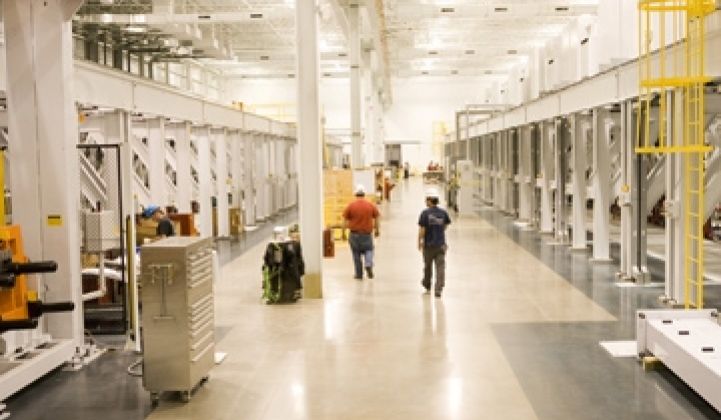
Photo of workers in the Greenville, Mich. plant via Uni-Solar.
41 Comments

  • StevePluvia 12/3/09 1:56 PM

    Shocker.  Going forward look for the execs to milk every last penny from this dead pig before they exit.  This thing’s a ZERO bid.

    Reply
  • ECD Fan 12/3/09 2:03 PM

    I don’t understand.  Mr. Guha issued a press release in 2002 stating this:  “ECD pioneered and developed the continuous roll-to-roll solar cell deposition process (analogous to low-cost, mass production processes such as for newsprint or photographic film). ECD and United Solar hold the fundamental patents in this technology. This approach is unique in the industry and in high volume production (100 MW) makes it possible for solar energy to become competitive with conventional fuels.”

    http://www.ovonic.com/ne_ecd_ovonics_press_releases_more.cfm?pressrelease_id=204

    Unisolar’s nameplate production capacity has been over 100MW since January of 2008 and Unisolar’s roll-to-roll machines have been producing over 25MWs each quarter (or over 100MW annualized)  starting in the June 2008 quarter, according to ECD’s official disclosures.  So Unisolar must have become “competitive with conventional fuels” almost two years ago, without the need for any subsidies - why would Mr. Guha feel any “pressure” from such minor things as Chinese PV products (which are nowhere near grid parity yet) when Unisolar have the whole energy market to themselves?

    Reply
      • ECD Fan 1 12/3/09 10:58 PM

        This is for ECD Fan….You are constantly criticizing ECD. It doesn’t matter what they do…you can always put a bad spin on it. Uni-Solar panels are a unique product and this company has the tools to exceed in this market when the economy regains momentum. I don’t know if you are a former disgruntled employee, but most of your statements are inaccurate. I hope that people are not taking your word for gospel and are actually doing research on the solar industry. Before the economic crisis hit, Uni-Solar could not make panels fast enough for their consumers. Just because the economy took a downturn does not mean that their product is no good.  When the solar market returns, Uni-Solar will be a huge player.

  • ECD Fan 12/4/09 10:03 AM

    To ECD Fan1:  How exactly do I constantly criticize ECD?  All I did was point out Mr. Guha’s statement, the one he made in 2002. How was that a bad spin?  Is Unisolar’s product competitive with conventional fuels today, as promised, or not?

    Unisolar’s product is not unique, not at all.  Xunlight, Flexcell, Powerfilm, Ascent, Global Solar, Konarka - all these offer flexible PV “laminates.” And, of course, Lumeta and Open Energy glue crystalline cells to flexible membranes.

    Unisolar did indeed have a great time for a few months in 2008 when the Spanish bubble raged and when crystalline was input-constrained - greedy people were buying anything that even remotely resembled PV.  But these times are gone.  Unisolar’s problems have nothing to do with the economy - they have everything to do with Unisolar’s technology and manufacturing costs.  First Solar, SunPower, and the reputable Chinese crystalline module makers were all profitable in the September 2009 quarter and showed year-over-year revenue growth.  Not Unisolar.  The solar market has already returned, but Unisolar is firing 20% of its workforce.

    Reply
  • femtobeam 12/4/09 1:52 PM

    Hopefully they will pull out of it, although… there is so little support for US Industry.

    Reply
  • Peak Oil 12/4/09 4:09 PM

    EDC Fan has been much nicer to EDC lately…must be done shorting their stock.

    Yes, track back to EDC Fan..anonymous website chocked with specious info - classic FUD strategy. Faulty use of detail in this case…

    This person has also been known to email EDC’s customers directly when they make an press announcement—“Oh by the way did you know…blah, blah, blah,” for pages with no real point whatsoever except to scare the be-jesus out of them.

    Don’t forums ban this kind of behavior?

    Reply
  • Solar Fan 12/7/09 9:37 AM

    I am a bit confused why everyone is ranking on EDC Fan.  He is right.  Unisolar is dead.  They, like many other pursued a technology path (a-Si) that can not win in the marketplace.  Right now that market is somewhat on hold.  A lot of campanies got burned with a-Si, CdTe is doing well.  Will GIGS live up to promises?  One thing I do know, a-Si will die a slow and painful death.  Don’t blame the Chinese, blame yourself for over-investing in a story rather than a winnng technology.

    Reply
      • glenn2ns 12/8/09 8:39 AM

        Solar Fan, I would suggest that a-Si was in fact a winning technology in its day, as was Sony’s Beta, etc.  but the market moves on.  Present technologies may look like the last word as well, but there is too much opportunity in the market for the next XX years for the capitalist system not to improve on the existing last word, which will produce new disruptions. Three junction devices are tested over 40% efficiency - costly yes but the capitalist manufacturing curve will beat that down.  Dr. Andreas Bett (Fraunhofer) stated (6-9-09) in Philadelphia the likely development of 6-7 junction devices pushing 60-70% efficiency.  My point is, we all have to make a choice and be part of the learning curve.  I agree a-Si is a dinosaur, it’s an albatross which in its day was the bright star, but we’ve moved on.  That is what chapter 7 is for: bulldoze the site and build new (XXX jobs and better use of utilization of resources).

  • Larry A. Staffen? 12/8/09 3:39 PM

    Why doesn’t Uni-Solar allocate their solar panels for future loans?  It would start the ball rolling for their employees and other customers.  Let’s get with the program!

    Larry A.Staffen

    Reply
      • StevePluvia 12/8/09 4:23 PM

        Larry, sorry to break the news, but Unisolr’s product is simply not cost effective.  They sell into a commodity market where multiple replacement products exist.  In this market, Unisolar’s production costs are higher than the price others are selling final product.  As such, to cost compete, Unisolar must sell every module they produce at a loss.  If you can come up with a successful business plan for that situation please let me know. 

        ECD Fan nailed this story early, anyone critical of him is either Texan or learning delayed…

  • Larry A. Staffen 12/8/09 3:45 PM

    Why won’t Uni-Solar allocate loans for their employeees and customers?  C-mon, let’s get real!

    Reply
  • michelle via droid 12/11/09 9:22 PM

    i just found this cause I use Uni-Solar panels on my little jungle cabin in the rainforest-hawaii. so cloudy out here that some solar “professional” told me pv doesn’t work here (for his rental, he doesnt really support pv or do research, you see). My panels chug away even when its pouring.

    also, i benefitted from a recent trade on ENER stock. i know, the fundamentals aren’t there :) i just believe the head guy inventor has good ideas :)

    Reply
  • Thomas Stein 12/12/09 8:18 AM

    I´ve been following this discussion from the time it started, and I can´t agree with everything said here. It´s about time that I vent my opinions . I am personally involved in selling Unisolar in Europe, and I had to make a business case out of it, finding out everything about pro´s and con´s. And I´ve found a lot of good stuff for the product. 1. there is no alternative in BIPV when it comes to covering a roof with a sturdy, if needed even watertight material - every other mono or poly or CIGS or CdTe or a-Si product is either delivered behind glass, or the manufacturer is so small that it´s not worth thinking about it. 2. Unisolar with a steel backing (ThyssenKrupp Solartec) is the only product I´ve found that is walkable, that can be installed without any mounting system, is therefore immune re. windforce etc. If the wind blows your roof away, your pv system will be gone too, but everybody can deal with that, 3. even with the low efficiency of around 6,3 % under STC, in real world conditions th product delivers 15-20 % more energy yield at the end of the year than mono or poly - I have collected dozens of case studies from Unisolar, where well known institutions and labs have tested, and confirmed the facts. I have Unisolar installations in Germany that deliver a specific result of about 1000 kWh per installed kW/p - for Germany a really good value. Mono or poly doesn´t do any better, most do worse. First Solar could be the winner in this comparison, because they have good results and are quite cheap, but again they are behind glass - but don´t forget the impact of cadmium. 4. In Spain, with almost double the irradiance than Germany, temperature in the module are a lot higher, and Unisolar again delivers more energy because of the lower temp. coefficient, 5. Low light conditions - again advantage Unisolar. 6. Shading (partial) has almost no effect - contrary to poly or mono. 7. Rain - the same. 8. the ability to cover whole facades with the product - and get good results ! 9. Orientation and tilt angle - very little efect compared to mono or poly etc.  I could name a few more, but the point is - despite low efficiency and higher price (never forget that you can not put the laminate on your roof and that´s it - you have to have a certified backing material - steel, alu, plastic foil etc. in order to get a “product” that you can install), all that counts is : “how much money did my ystem make at the end of the day/month/Year?” If that count is better than poly or mono, and the safety is higher, advantages re. walkability, rain tightness, roof improvements, thermal isolation against heat or cold are taken into consideration there is no better solution on the market - yet. I am not talking about pv-shingles or other funy stuff that don´t make sense to me - I am talking about industrial installations on roofs. Neither Konarka nor Fuji nor Flexcell nor anybody else is at the point were they can deliver the same that Unisolar does - not yet. So, unil someone points out a new contender I will stick with the product - right now there is no alternative. And in the case that we are fixing an older building, and we take away the cost for replacing the roof alone, all the sudden the pv-laminate is not so much other all. Unisolar prices have come down quite a bit in the last 12 months, thanks to the credit crisis and the non-existing spanish market, and the fact that everybody else is lowering their prices . That is the only thing that troubles me-USO has to sell product at a loss, in order to get the company going. And nobody to this day could explain to me why the stuff is so frigging expensive to produce in the roll-to-roll process - compare that to poly modules, the whole process - ingots, wafers, cell cutting, sizing, soldering, testing, laminating, glass, alu frame etc. That stuff should be much more than a-Si thin film. Imagine what would happen if Unisolar could deliver 500 MW instead of the meagre 50 MW or so they have done this year - what the cost per W woudl be then, and wht acceptance they would receive ! But here lies a mayor problem with USO-there is almost no advertising, no marketing, very little information, no support - I don´t know what they want or plan. Maybe you out there know, and can enlighten me.

    Reply
  • ECD Fan 12/14/09 2:46 PM

    Dear Thomas Stein:

    You have been brainwashed.  In your overzealous quest to sell Unisolar, you have fallen a victim to fraudulent research and marketing.  Point-by-point:

    1.  Glass PV is perfect for roofs.  Solutions like s-5! clamps are ideal for metal roofs, while solutions like First Solar’s rack system or SunPower’s T5 are ideal for flat roofs, as proven by the CSI data.  Gluing any PV (be it flexible, like Unisolar, or crystalline, like Lumeta and Applied Solar) saves you a rack (up to 30c per Watt) but it is a fire hazard (despite what UL says, as proven by the Long Beach Convention Center fire), and leads to higher installation costs, difficulties in roof repair, and underperformance due to suboptimal tilt and overheating,  And of course, the low-efficiency Unisolar laminates (as you point out, 6.3% on module level for PVL-136) have BOS costs (excluding the racks) that are higher by at least 25c per Watt vs First Solar and at least 40c per Watt vs crystalline.

    2.  Unisolar on metal is a dangerous product (the laminates slid on the roof of the Science House in St Paul, MN in 2004, causing a ground fault, per ASHRAE).  Walking on the bypass diodes or the wiring is a recipe for disaster, as well.  Glass PV on S-5! clamps is a more reliable and wind-resistant solution (the clamps strengthen the roof) and allow for ventilation and proper tilt, which improves performance.

    3.  In real world conditions, Unisolar DOES NOT “deliver 15-20 % more energy yield at the end of the year than mono or poly.”  In the real world, Unisolar laminates are tilted suboptimally and overheat due to lack of ventilation, thus delivering no more than 5% better kWh/kW vs optimally tilted crystalline, and only in the first few years, before the severe long-term degradation kicks in and eliminates any performance advantage.  The research you have “collected” is likely fraudulent. For example, the so-called 2006 “Technologie-Report,” specifically page 7, is fraudulent.  And so are the Santa Cruz study (the Kyocera panels were intentionally crippled),  the Tucson study (the framed Unisolar panels used there were ventilated and optimally tilted, unlike the laminates that are currently sold), the Bolzano study (ThyssenKrupp’s summary of the data contradicts Unisolar’s report of the data), etc.  High-profile installations such as the 12MW GM Opel in Spain, the 400KW Staples installation in CT, the 700KW East Coast Warehouse in NJ, and, of course, the 750KW Long Beach Convention Center installation in CA are either dead or underperperforming vs expectation, based on reported data from the remote monitoring systems.  Unisolar is actively suppressing the results of the NREL’s long-term degradation study which indicated likely warranty violation within 10 years.  But you are welcome to provide actual data from systems in Germany (or elsewhere) to prove that the Unisolar systems do in fact overperform and can survive at least 10 years - note that Unisolar supposedly produced about 10MW combined in the years 1999 and 2000 (using the same a-Si triple junction technology as today’s) - are you aware of even one Unisolar system that has survived 10 years and is still performing within warranted parameters?
    4.  No, in Spain, Unisolar laminates underpeform due to lack of ventilation and suboptimal tilt, as proven by the fatspaniel data from the 12MW GM Opel installation in Zaragoza. 

    5.  No, real world results of systems operating in low light conditions indicate that Unisolar underperforms vs optimally tilted crystalline (as low light usually means lower temperature as well)

    6.  Any panel, including poly and mono, with bypass diodes can survive partial shading as successfully as Unisolar’s lmainates.

    7.  Rain is the enemy of Unisolar laminates, particularly on flat roofs.  The warranty specifically excludes “damage due to water pooling on the PV Product surface or any evidence thereof.”  Tilted glass PV panels, of course, face no such danger.

    8.  PV on facades is a waste of material due to the suboptimal tilt and overheating.

    9.  Orientation and tilt angle both have significant effects on Unisolar’s performance.  For example, the Santa Cruz, CA data indicate about 25%-30% annual underperformance of the glued-on laminates vs the tilted framed Unisolar product using the same PV material.

    (continued)

    Reply
  • ECD Fan 12/14/09 2:47 PM

    (continued)

    So, to reiterate, Unisolar’s systems underpeform glass PV in terms of kWh/kW, particularly after the long-term degradation kicks in, due to lack of ventilation, suboptimal tilt, and rough plastic surface that attracts dust, soot, and snow.  And Unisolar’s all-in system costs per Watt are still higher than those of First Solar or Chinese crystalline, due to overpriced panels and higher BOS costs caused by the lower-efficiency (the savings from the lack of rack are simply not enough to compensate).  Thus, Unisolar laminates on industrial roofs do not make sense at current prices (Unisolar’s factory prices, or ASPs,  are guided for $2.10 per Watt for the December quarter, while Chinese crystalline prices are about $2.00 per Watt).  To make sense for industrial roofs, Unisolar laminates have to be priced below $1.70, or so, per Watt today.  Unisolar’s cost of manufacturing in the December quarter are guided over $2.20 per Watt - so, yes, it appears that Unisolar is selling a gross loss and will do so in the foreseeable future.  If they lower prices to become competitive, they will be selling at an even bigger loss, while the reputable module companies are profitable.  Unisolar’s high costs are inherent - increase in scale is not going to help them.  In 2005, Unisolar was making and shipping more MWs that First Solar, yet, their costs were double vs First Solar’s, per Watt.  Today, Unisolar’s costs are more than double those of First Solar, per Watt, and are higher than even crystalline’s.  No wonder Unisolar’s shipments are shrinking and the company is firing 25% of its workforce (and all these big MW announcements appear simply an inventory flush) .

    So, now, are you enlightened?

    Reply
  • Thomas Stein 12/15/09 6:06 AM

    Dear ECD Fan, I was expecting that or a similar return. You are right in some points, but not in all. Dont´t think I´ve been brainwashed, but I work in the spanish market - try to sell any cristalline module there right now, and you know what I´m talking about. There are installation companies that have no idea what to sell. banks and clients are rejecting cristalline. Due to the extremely poor performance and problems standing the severe heat that some of the cristalline installations from 2007 and 2008 show, they will not even be considered by most installers - even the spanish government is talking about rejecting these installations - especially ground mounted. In the last severe storms in 2008 several cristalline installatins were simply blown off the roof - try to figure yourself in the middle of that. May the reason for that have been incompetence on part of the installer, or incorrect calculations by the architect or whatever- these things will not satisfy any client or installer in markets like Spain anymore. Yes, there are still several big installations currently under way, and they mostly use crsitalline or thin film because for lack of alternatives, but that is not what the commercial market will accept.
    And are you seriously trying to tell me that a system of aluminium or steel racks with glass panels in aluminum frames will strenghten the roof because the clamps will hold it together ? Come on, get serious ! Most roofs in southern European countries are less stable than their counterparts in the northern countries. Installing Unisolar (or any other product) with a steel backing directly onto the roof will strenghten the roof, but not installing wind sensitive structures that are screwed on and actually increase the force applied to the roof when its windy.
    And the installation in Spain at the GM plant had better be done by somebody who knows his business - all of Spain is talking about this. The modules were shorted because they were mounted flat on the roof, without tilt or not enought tilt, so water collected there and shorted most connections - because, yes, it does rain in Spain, and quite often so. USO mandates a minimum tilt angle of 3 Dregrees, better 5. And because the installer tried to glue the stuff directly onto the roof material, failure was pre-programmed. I dont know what´s going to happen there, but that roof is certainly not a reference for anybody. But there are dozens of others. And Unisolar on metal is dangerours. hm. Do you think ThyssenKrupp knows that ? Maybe you should enlighten them. Then they better remove all their facade panels at the factory (check their website), before they cause trouble.
    What it all comes down to is simple : lack of care or experience or failure to stick to manufacturers guidelines can cause trouble to any installation - be it cristalline or thin film. Unisolar glued to a steel panel under incorrect conditions will lead to a failure - no question. But don´t blame the product, blame the installer.
    And yes, I know all the facts on USO- thanks to the information you provided earlier. You seem to have excellent access to inside information. That´s perfect, since it has helped me already a lot. 

    So, I am afraid I was not enlightened, but I am open to look at fraudulent data you have. If you are right, I will not use my data any longer.

    Reply
  • ECD Fan 12/15/09 11:41 AM

    Dear Thomas:

    Thank you for responding.  Spain was the epicentre of a massive PV fraud in 2008, so nobody should be surprised that banks might be a bit skeptical this year, not just of crystalline. 

    S-5! ( http://www.s-5.com ) claim that glass PV installed on metal roofs with their clamps strengthen the roof, and that wind resistance is not affected negatively.  They have some major customers who understand PV, so I do not have reasons to doubt their claims.  We do agree that Unisolar on steel backing will strengthen the roof as well.

    Let’s now address the 12MW GM installation in Spain.  As you know, the “project manager” for that installation was DEERS (also known as Clairvoyant).  DEERS has a vast experience with Unisolar installations on flat roofs since 2006 (see http://deers.org/projects/solar/ ), including the two GM roofs in California (worth 1.8MW combined).  If DEERS cannot oversee a Unisolar installation properly, then who can?  Unisolar’s management claim Unisolar is easy to install and an excellent choice for flat roofs.  You are now telling us that the “modules were shorted because they were mounted flat on the roof, without tilt or not enought tilt, so water collected there and shorted most connections.”  How could this happen with such an experienced project manager?  How could this happen with the largest rooftop installation in the world (according to Unisolar)?  How can you exclude such an installation?  By the way, are you also going to exclude the 750KW Long Beach Convention Center installation, another one of DEERS’ gems,  where the Unisolar laminates ignited in February of 2008?

    Yes, Unisolar on metal roof is dangerous, as proven by the Science House metal roof installation (see http://findarticles.com/p/articles/mi_m5PRC/is_1_113/ai_n25007378/pg_7/?tag=content;col1 ), where the Unisolar laminates “slid on the roof, causing a ground fault” in 2004.  What, you are going to blame that incident on the installer again?  By the way, how is the funny ThyssenKrupp facade doing these days?  Care to share the kWh/kW performance for 2008 and 2009?  Can it even make 650 kWh/kW these days?  Such a waste of PV material!

    If “lack of care or experience or failure to stick to manufacturers guidelines” were the cause for the problems, how do you explain such high-profile failures as the East Coast Warehouse in Newark, the Staples installation in Killingly, the Long Beach Convention Center in Los Angeles (even if we exclude the 12MW GM disaster) which were all supervised by experienced project managers/installers (TurtleEnergy, SunEdison, DEERS) familiar with Unisolar’s guidelines?

    All the information I have is publicly available (that is, it is not inside information), including public data from remote-monitoring systems.

    Reply
  • Thomas Stein 12/15/09 2:14 PM

    Hello ECD fan, thanks for the information. I will certainly check it out. I must admit that I did not connect to the PV world before sometime last year, and therefore some news may have gotten past me - I am grateful when I find out stuff that is important, I was told that for GM´s installation they used local companies, maybe that was the crux, because for them it may have been the first time. Maybe I´m wrong with that too. But believe me, Unisolar can´t be that bad, otherwise a whole bunch of installation partners in Europe would not have the product in their portfolio for years and sell their laminates with a proven and working backing - check Hoesch Contecna, Centrosolar, Parabel, Alwitra, Marcegaglia, Rheinzink, Kalzip (Chorus), Soprema, Rubberfuse etc. They all use the laminates it seems for quite some time- they would not do so if they had the problems you describe. I don´t honestly know how much of their business is with and without Unisolar, since they don´t publish that. but I am speaking to some of these people and they never alerted me of any troubles. 
    And the people at JM Roofing must have thought something when they picked USO recently over other contenders.
    And look at ThyssenKrupp´s Facade with the view of an architect / planner : If not Unisolar on steel, than what ? Glass panels on a steel structur ? You must install a very rigid substructure, and still have the wall sealed behind it. besides talking about a lot of weight, the process is much more labour intensive. And you won´t get away with 0,30 $ extra for that. It will be way more. And to maximize power production was not the goal - as you can see when looking at the object. but still, about 650 kWh/kWp in Germany for a facade is not that bad when compared to a roof that makes about 900 - 950 in the same location. Local irradiation is only around 1000 kwh/m² per year there, not more. So we both have our points.

    Reply
  • ECD Fan 12/15/09 5:06 PM

    Dear Thomas:

    By your logic, Mr. Madoff did not commit a $20 billion fraud for over the past 30 years.  After all, he was a former Chairman of the NASDAQ stock exchange, his firm was one of the largest market makers on Wall Street, and he counted many prominent investors and institutions among his clients - reputable and highly admired funds and banks with billions of dollars under management invested with his firm over the years:  see here http://s.wsj.net/public/resources/documents/st_madoff_victims_20081215.html .  He swindled all of them.  Because all these people liked a good story and never cared to ACTUALLY verify his profit claims - not once in 30 years!  And none of these institutions and funds (not even the SEC) ever alerted the new gullible investors of any troubles.

    So, have you ACTUALLY verified Unisolar’s claims?  How many installations with Unisolar laminates actually do exist?  For example, I admit finding actual third-party installation data for Europe is hard, but it is very easy for California (which accounts for about 60% of the US PV market).  According to the California Solar Initiative (which collects data on ACTUAL rebate reservation requests and installations), Unisolar’s (and SIT’s) share in the PV market there is just 0.4% over the past two years.  Let me repeat, according to the California Solar Initiative dataset, Unisolar+SIT “reservations requests” (that have not been canceled) in California amount to just 1.3MWs since Dec 31st, 2007 (which comes to about 0.35% of the 360MWs of non-canceled reservation requests for all PV modules in the CSI database over the past two years).  So, it seems that Unisolar is “missing in action” in their home market, where they have been selling their a-Si triple-junction product for 12 years or so.  And that’s despite the 42MWs (probably well over 50MWs, if we include SIT) of unsold laminates sitting in their inventory as of September 2009 end.  Why do you think that is?

    As far as all those European “partners” you cite, what is their oldest Unisolar installation they can reference and how has that installation performed last year, for example?  Many of those “partners” are building-materials vendors who have very little understanding of PV solar.  And the people at JM Roofing have been known to make huge mistakes -  let’s not forget JM’s history - they went bankrupt in 1982 because it turned out they knew very little about the risks of their main product ingredient, asbestos.

    ThyssenKrupp´s facade may look nice, but it is a waste of PV product, because the same PV product, when installed properly, could have generated almost 50% more electricity.  By the way, the facade would have definitely looked nicer if it were made of pure gold (it would have also cooled the building better in the Summer) - so why didn’t the architect / planner use 50 tons of gold alloy ( the facade would have cost just $1 billion)? There are many thin-film and crystalline PV makers (including several European ones) that specialize in glass PV for facades (including transparent and semi-transparent modules), but PV for facades simply makes no economic sense at the current PV prices, and that’s partially the reason why the BIPV “segment,” in general, will not take off in the foreseeable future (despite all the ambitions of the architects trying to bring in higher fees, and despite the misguided “differentiation” efforts of the French and some other European governments).

    By the way, are you sure the facade generated 650 kWh/kW last year?  What about over the past 12 months?

    Reply
  • Thomas Stein 12/16/09 4:31 AM

    Dear ECD Fan, it seems you want to beat me to death with your research. And I really don´t know what Mr. Madoff has got to do in this, but I won´t argue. And I won´t speak for the European Companies - they know what they are doing, and they know it better than you do. So I will say good bye now and keep my opinions to myself, and leave this battelplace (sorry - forum) to you.

    Reply
  • metalstorage 12/17/09 4:04 AM

    Metal Storage Systems Pvt. Ltd. is a Manufacturers and Suppliers of Modern Storage Systems like Racks, Storage Rack, Storage Racks and Industrial Rack in India.
    Url:- http://metalstoragesystems.com/

    Reply
  • LBinFLA 01/1/10 11:57 PM

    Mr. Stein and ECDFan
    I appreciate both your inputs and will add them to my own research.
    I’m curious about your thoughts on another company NanoSolar, another flexible thin film PV producer. They aparently have a 3 year backlog, robotic panel assy plant in Germany and a ton of capital backing. It appears their technology produces a less expensive product whith surprisingly high efficiency.
    Thoughts?
    LB

    Reply
      • StevePluvia 01/2/10 10:30 AM

        LBinFLA:  Nanosolar may ultimately produce a very cost competitive, reliable product, but for now nobody (but them) knows what they can produce.  Marty R announced 2yrs ago they were in commercial production… and yet as of 60 days ago they were producing about 12mw/yr—that’s pilot production i.e. still a science project. 

        Credibility is earned by timely execution; Nanosolar spent several years telling the PV community how every operating, commercially scaled PV plant (and pretty much every emerging technology) were mere stone age artifacts to be mothballed by the *spectacular* Nanosolar machine. 

        This *fantastic* sales pitch raised Nanosolar a giant pile of cash but failed to produce a commercial plant or a reliable, lo-cost PV panel. Time will tell if they will every meet their lofty claims. I for one hope they do but I’m not holding my breath.

  • JoeJoe 01/2/10 11:03 AM

    Steve… That was a restrained response. Did you make a new year’s resolution to be nice? Just kidding man. I wrote a response myself but couldn’t post it. Mine went the same as yours except there was more rambling and punctuation and whatnot and so on.

    Happy New Year Steve. Good luck in the market. Q4 results are going to be abfab baby. Goofball analysts don’t know nuts. I betcha Germany put in an extra GeedubbaYew over standard projections. Should pad the sheets nicely. Cheers.

    Reply
  • StevePluvia 01/2/10 6:45 PM

    JoeJoe, as you know, restraint is my middle name, right between the other middle initials—F and U =).  Happy New year to you also, and lets hope 2010 is a launching pad for renewables, green tech and lo cost storage.

    Reply
      • LBinFLA 01/2/10 11:20 PM

        Steve(restraint)Pluvia
        Thanks for the input and notable absence of explatives.
        I also saw Heliostat a NanoSolar CIGS competitor recently hired J. Flanary COO from FIrst Solar. Do you think he left FS for a better technology or just leaving a sinking ship?
        I’m working on a project that can utilize several million sq ft of flexible PV panel material and I’m in a toss up on the approach to use. CIGS sounds like the up and coming technology, but as you said, it may not be practical for another decade.
        LB
        Larry

  • StevePluvia 01/3/10 1:35 PM

    LBinFLA, I don’t think First Solar is a sinking ship, just the opposite.  I think they’ll sell everything they can produce for at least the next 5yrs with higher margins than anyone in the business.

    In terms of product selection, I’d strongly advise you to look at product performance in heat; ECD found some excellent real life performance stats showing different product performance (CIGS, a-SI, c-Si) in summer desert conditions.  The take home was better heat performance = much better yield in areas with hi heat and long summers.  If you can take full advantage of the longer summer solar hours your yield is MUCH higher.

    Look also to emerging technologies that cool pv using a liquid system; this design has the potential advantage of better summer PV performance and lower net costs if the hot water can be utilized. 

    I don’t think CIGS is a decade off, more like 12-18 months.  Flexible PV however is not IMO a viable solution despite progress made by Ascent and Global Solar (forget about ENER they’re essentially bankrupt).  Good luck.

    Reply
  • JoeJoe 01/3/10 3:22 PM

    I often hear this performance under heat thing. This paper says it ain’t such a big deal: “A 4 year study of kWh/kWp modelling of different technologies at more than 50 sites Worldwide”

    I meant to ask you Steve. First Solar’s manufacturing Cost are about 85 cents/watt right. What are their non-manufacturing costs per watt? Do you have a ballpark number?

    Reply
      • LBinFLA 01/3/10 7:35 PM

        Is the increased efficiency under hot conditions due to utililzation of the IR portion of the spectrum?

        I wonder if this is offset by an inceased resistance/losses at higher temp. which might explain the conclusion in Ransome’s paper that the findings of higher output in warm climates is inconsistant.

      • StevePluvia 01/3/10 9:02 PM

        JoeJoe, I look at SG&A non-manufacturing costs, they’re broken out in every quarterly report; 

        http://www.investopedia.com/terms/s/sga.asp

        Please link me the paper you ref’d above as that conclusion does not jive with the calcs I’ve made based on real life performance data.

  • JoeJoe 01/3/10 9:03 PM

    Check out the report. It’s only a few pages long.

    http://www.bp.com/liveassets/bp_internet/solar/bp_solar_spain/STAGING/local_assets/downloads_pdfs/0_999/4_year_study_50_sites_bw_2_.pdf

    The report finds that, “actual values of kWh/kWp depend more on Wp declaration, measurement errors and BOS losses than on technology.”

    This tells me that temperature performance claims are jibberjabber. Make your own conclusions

    Reply
      • StevePluvia 01/3/10 9:26 PM

        JoeJoe, thx for that link.  You might find it interesting that BP (who funded and *influenced* the methods and data in that paper) is one of the poorer performing products in heat.  The issue of heat degradation is fairly obvious when you see a system produce relatively similar power production in winter & summer months.  As you know, summer = more solar hours than winter therefore summer should produce more power.  As I read that paper it seemed to be based on all the wrong information…

  • JoeJoe 01/3/10 10:28 PM

    I’m not an expert on the subject but I find BP’s results reasonable. I should care more but I don’t.

    I’m coming up with $1.04/Watt all in. Sound about right?

    Reply
  • Thomas Stein 01/7/10 7:32 AM

    LBinFLA, sorry it took so long to answer, I havn´t been following for quite some time now. I have to admit that I do not know a whole lot about Nanosolar yet; I have also been following their development as close as I could, So far all I can say is that it sounds more than interesting to print CIGS nanoparticles instead of deposting them as usual. If this leads in the short term to substantially lower production costs than First Solar´s - who knows ? Mabye FS is getting lower and lower, while NS is trailing behind, trying to catch up. What if then, all the sudden we find out that glass and aluminum are the most expensive part in a solar module - and then what ? Just kidding…. But seriously, I am riding this Unisolar-horse because it´s an excellent BIPV product if installed correctly, and with the right backing material, As long as NS and FS don´t come out with a similar idea, I can´t really use them anywhere. So anyboby out there that makes a proven BIPV flexible solution besides USO and Fuji ? Konarka is not far enough, even though they may have plans, and Lumeta´s Power Ply looks really good, but is too big to install in difficult situations, and it´s cristalline - which I do not want. So what else is there ? Please enlighten me, if you can. Maybe I missed something. Oh, and p.s. : Nanosolar´s website cannot be reached, and have not heard from any installation with their product yet. But that really doesn´t mean a lot, since all installers in Germany are still busy trying to get that backlog cleared that they must have carried over from 2009. More then 3 GW installed in 2009 ! If NS had indeed put 10 or 20 MW on the market, I doubt it would show.  I guess that the first 100 MW would go to their big customers, and they will probably do some test installations before getting the product to their clients - they must try to get real world data.

    Reply
  • Paul from Chile 08/19/10 9:31 AM

    well, this is a very interesting forum. Now, if to recomend a stock to buy today, what would that be…...ECD is tempting in tha short term, considering they have big fish friends and an surprising buyout or bailout is not out of the question, is it?. On other hand First Solar is much more stable and perhaps still with the potential to increase their EPS in the next couple of years. Trina also sounds good but the price of share is quite high.,,,,,,,,,,so, any ideas?
    best regards

    Reply
  • Paul from Chile 08/19/10 9:52 AM

    sorry, just to make the case clear:
    i find ECD stock atractive because of being in the lowest historical price, nearly, and with all those big clients like coca cola, ikea, et al…....and the obvious relations with their other business units i find hard to believe a possible bankrupcy.
    I mean i read ovshinsky wishes to the company and they are not bad at all…..bit of satire there…...but really, it sound a lot to a BIG waste!!....and this companies like Chevron,Texaco, Intel…...they all own a part of it.

    Reply
  • xcqcxspi 02/12/11 7:19 PM

    Submit Query

    Reply
  • dikbmqjd 02/16/11 9:12 PM

    Submit Query

    Reply
  • mhwwypsb 02/25/11 5:27 AM

    Submit Query

    Reply
  • qejaawcc 03/3/11 11:47 AM

    Submit Query

    Reply
  • oozmihay 04/25/11 3:47 PM

    Submit Query

    Reply
Need an avatar? Get one here: Gravatar