
[pagebreak:IsDemandResponseDoomed]
Is demand response in it for the long haul?
Demand response service providers like EnerNoc and Comverge – which curb power consumption at homes, offices and industrial sites, often during peak periods – say yes. After all, for years they've been gathering together utility customers, installing devices and networks to turn down key power-using devices, and delivering reliable "negawatts" of power not used to mitigate the peak power demands that make up a significant portion of utility's overall costs.
But the longer-term promise of two-way communicating smart meters to could replace those demand response systems with hardware and software the utilities can own and operate on their own. And if two-way networks that allow customers – particularly homeowners – to play a part in deciding when their air conditioners power down become more widespread, that could pose a serious threat to demand response aggregators middleman role.
For the time being, it's a bit of an academic argument, says Tendril CEO Adrian Tuck. But it won't be for much longer.
"The idea of one-way load control systems, where you just turn things on and off, seems to be receding," he said. "In its place is coming a next generation product [from Tendril and others] that offer a much more collaborative process of allowing consumers to opt in and opt out."
The Boulder, Colo.-based company's technology is being used that way today in two small-scale, "multi-hundred" residential smart meter deployments, he said. The utilities send pricing signals to customers' in-home devices, which can be given pre-set commands to adjust thermostats and turn down appliances when prices get too high.
While Tuck wouldn't reveal the utilities involved, he expected that the news would soon be publicly released. And results for how well those projects are delivering reliable negawatts could well set the terms for future deployments of their kind, he said.
Still, demand response aggregators say that there's a long way to go before such two-way, customer-optional systems can provide the same kind of service that they do.
"In a perfect world, you could think that," said Tim Healy, CEO of EnerNoc, which now manages about 3,150 megawatts of power it can turn down to help utilities lower peak power demand (see Green Light post).
Among other reasons in favor of demand response services, is that direct customer control can make make it harder to exploit demand response to reduce peak capacity. Outsourcing demand reponse as a service forces someone else to staff up support desks. The history of programmable thermostats also indicates American consumers won't jump at the opportunity for regularly optimizing their thermostats.
Interestingly enough, some companies are already splitting the difference. EPS Corp., which raised $30 million earlier this, year sells demand response equipment to food processors to cut the power to boilers and other machinery. Recently, it also began to provide its technology as a service to attract those capital sensitive types.
With its 3.15 gigawatts, EnerNoc remains among the largest demand response providers in the United States. All in all, about 41 gigawatts of power was under demand response management as of December 2008, or about 5.8 percent of nationwide peak power demand, according to the Federal Energy Regulatory Commission.
Still, that's just a fraction of the 38 to 188 gigawatts of demand response capacity that the nation could harness to reduce overall peak energy use by as much as 20 percent, according to a June report from FERC. And, while EnerNoc generally specializes in harvesting from large companies, outfits like Advanced Telemetry say negawatts can be harvested at stores and fast food outlets. Others include CPower, EnergyConnect and Constellation NewEnergy.
Doubtless multiple means to turn down that power will emerge in the coming years, Healy said. But smart meter-enabled systems are probably "decades" away from becoming a significant part of that equation, he maintained.
"I think true, real-time demand response – where you have a dispatchable resource – we feel demand response and the role of the aggregator, who's giving the utility a firm resource, will become essential for operating tomorrow's smart grid," he added.
The phrase "firm resource" is critical in this argument. Healy said that smart meter-enabled systems for turning down customers' power use may spread in the coming years and decades, but that they could continue to suffer from the potential for customers to opt out.
That would make their negawatts a bit less like the firm generation resources like coal-fired power plants, and more like solar power – a fair-weather resource, so to speak, that can be relied on only when the sun is shining, or in this case, when those CFO-less and CIO-less homes are willing to agree to turn down their power use.
Tendril's Tuck agreed that this will continue to be an argument against the new model of demand response until real-world deployments prove it works. The counter-argument, he noted, is that utility customers – and the regulatory bodies that decide what utilities can spend money on – are far more likely to approve customer-optional systems.
[pagebreak:Is Demand Response Doomed?]
Traditional, one-way utility-controlled load control projects that did things like issued radio signals to crank down air conditioners typically are accepted by 15 percent to 30 percent of customers they're offered to, he said.
"What we're hoping to see as these [two-way] systems roll out is that the collaborative nature of our systems mean that the take-up rate will be much higher," that is, 50 percent and up, he said. Even with a certain percentage opting out of every demand response event, that could be a lot more overall power reduction to make it worthwhile, he noted (see Smart Grid: Test Customers Give Thumbs Up).
As more and more smart meters are installed at homes, "they are going to enable utilities to do these types of programs themselves," Rick Nicholson, vice president at IDC company Energy Insights.
That, after all, is the fundamental promise that a host of startups with home energy management and control systems – EnergyHub, Energate, Control4, Greenbox Technology, Onzo, AlertMe, eMeter and OpenPeak, to name a few – are banking on (see The Smart Home, Part I).
It's also the premise to which appliance makers like General Electric and Whirlpool are planning to build "smart" appliances that can power down at utility or homeowner command (see GE's Smart Appliances: Smarter With GE Home Energy Manager).
"Now, is that the kiss of death for aggregators? No," Nicholson said. "I think there will always be a role in the market for aggregators, particularly for utilities that just don't want to deal with it."
"But at least the current aggregator market will lose some market share to utilities" willing to take on the task themselves, he predicted.
While most of those projects use older, one-way paging networks, Comverge has developed software to enable demand response through smart meters and has two utility projects that are intended to shift to smart meters once they're deployed (see Comverge's Home Demand Response: Pagers First, Then Smart Meters).
It also has a partnership with leading smart meter maker Itron to integrate their technologies for in-home power control (see The Elusive Smart Meter-Demand Response Combo).
"Maybe we're not going to see every customer with a smart meter-enabled home in 10 years," said Bud Vos, Comverge's chief technology officer. "It's not all utilities – it's those on the leading edge."
Still, "I think we're going to see that second wave occur over the next couple of years," and Comverge intends to be ready to serve that "second wave" of smart meter-enabled demand response, he said.
Other technologies could unleash the ability of commercial and industrial customers to work directly with utilities on demand response, according to Zach Gentry, chief strategy officer for commercial lighting wireless controls maker Adura Technologies (see Is Mesh the Answer for Managing Buildings?). Specifically, he sees an opportunity in linking all the smaller commercial buildings that haven't been able or willing to spend lots of money on energy management systems. Only about a quarter of all commercial floor space is served by such systems, according to Department of Energy surveys, leaving an opportunity for lower-cost offerings, he said.
Demand response aggregators "are an intermediary between the utility and the end-use customer," one that may be necessary for now, he said.
"But I believe software will in the future disintermediate them in the same way that Ameritrade and Charles Schwab changed how people bought stock or travel sites altered people's airline ticket purchasing habits."
Given the amount of power that FERC believes could be brought under demand response management, there's probably room for all these different models, said Dan Delurey, executive director of the Demand Response and Smart Grid Coalition, a trade group.
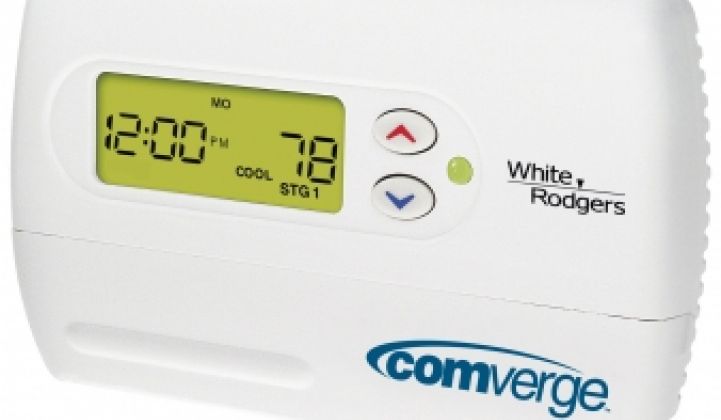
Image via Comverge.

Interact with smart grid industry visionaries from North American utilities, innovative hardware and software vendors and leading industry consortiums at The Networked Grid on November 4 in San Francisco.






 41
41
 15
15
 9
9