
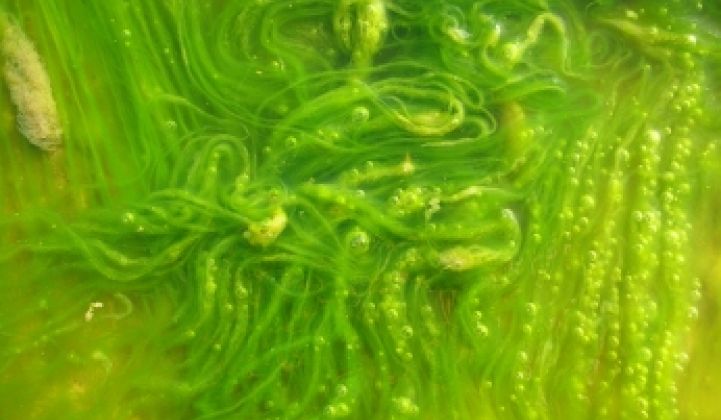
Five years ago it was easy to divide up companies trying to make fuel out of algae. There were only a handful in the market and all were in and around the "science experiment" phase.
Now, at least 57 companies have cropped up with plans to either make fuel, organisms or tools for converting oily microorganisms into fossil fuel substitutes and dietary supplements. Some come from the labs of giant universities or have cooperative agreements with oil companies. Other ones are two guys and some stale water.
Luckily, one can break them down by certain variables, which is the purpose of the scorecard below. The most important variable – the acumen of the management team – isn't included, so the "score" is largely hypothetical. But it provides an opportunity to see which companies might have the best technology.
1. What's the growing environment? Five growing environments exist. The cheapest, and the one currently employed by spirulina growers, are open racetrack ponds. 10 points. Fermentation tanks – i.e. beer kettles where algae are overstuffed with sugar – are more expensive and the only ones that require the algae get fed sugar, instead of free sunlight and carbon dioxide. But they work. 5 points.
Bioreactors and closed ponds get 1 point each. Algae can live off of sunlight and carbon dioxide, but swirling carbon dioxide isn't cheap. And getting rid of water is problematic. 2 points.
The last environment is fish. In this plan hatched by LiveFuels, algae grow in the wild – as cheap as you can get – but get converted into oil by fish, which then get pulled ashore, clubbed in the head, and squeezed for oil. We love the elegance, but not sure it if works. 1 point for now; 8 points if it works.
2. Wild, genetically optimized, or transgenic? Growing plain wild algae is extremely cheap and efficient, 10 points, assuming it works. Genetic optimization, or selective breeding, though, has become the standard and gets 5 points. Transgenic algae, or GMO algae, hold the most potential, but most believe they would need to be growing in fermentation kettles or bioreactors. Because it's still in developments stage, three points. Sapphire Energy says it can grow GMOs in ponds. Ten points when the company (or anyone else) can demonstrate it, 1 point for now.
3. Multiple strains or one? Multiple strains in a single point cost less and maximize solar radiation. Some of the companies working with cyanobacteria say they can tolerate multiple strains of algae in the same environment. So do the fish eaters. 3 points. 2 points for different species in separate environments. 1 point for monocultures.
4. How do you get rid of the water? De-watering is the usually where algae companies get de-flowered. A liter of water might contain 3 grams or less of functional algae. Shedding that water requires time and/or energy. Fermenters do not require algae so 10 points here. Biolight Harvesting (and a few others) say they can work with damp algae. 4 points. Everyone else for now: 0 points. "It is probably the biggest single challenge remaining in terms of economics," said Mike Melnick, Biolight's CEO.
5. How do you get the oil out? Everything in a living cell's nature guards against being cracked open for someone else's pleasure. Synthetic Genomics says it will genetically optimize algae so the cell wall breaks easily, allowing the oil to float to the top. 10 points if you can do it. OriginOil wants to shake it out with microwaves. 5 points. Everyone else squeezes it: 2 points.
6. Milk or kill? Some algae growers, such as Phycal, claim they don't have to kill their algae to get oil. Avoiding death is not being done so the algae can get rehabilitated and land a job in the halfway house cafeteria. Protein and other tissue can make up 70 percent of an algae. Re-growing that takes metabolic heavy lifting. Milking the same sorry organism for a few generations cuts growing cost and time. 10 points if you can do it. Everyone else: 5 points for realism.
7. How many gallons per acre? If they claim 2,000 to 5,000 gallons an acre per year, it's realistic. Seven points. 10,000 to 14,000 sounds out there but possible. 3 points. Over 14,000? Prove it. 0 points for now.
8. Food, fuel or chemicals. Five points for anyone that brings up food. Nutraceutical oils sell for far more than gas. While most companies have touted liquid fuels, a few like Genifuel say they will make natural gas.
9. Lipids or hydrocarbons? Sapphire and Biolight claim they can convert naturally occurring lipids into hydrocarbons during the growth and harvesting phase, which cuts out a step. 4 points if you can do it.
10. Any industrial partners or strategic investors: 5 points if so. Martek Biosciences, which has made food supplements for years, recently cut a fuel deal for fermentation with BP.
Score:
68 to 50: You can grow multiple strains of extremely greasy algae in open ponds that shed water and oil. You also don't exist yet.
50 to 40: Congratulations! You're in the top rank of algae companies and probably have raised money.
40 to 30: Hope exists, but a merger may await
30 to 20: Like the products you grow, you are part of the unwashed masses.
20 to 0: He's just not that into you. Drop him like a hot potato.
Image via lovelydead / Creative Commons





 41
41
 15
15
 9
9