• Wednesday, March 18, 2009 Latest Update: 9:00AM

Greentech Solar

Heating Your Home With Mirrors

Have a high oil heating bill? Practical Solar says it can whack it down with mirrors in your lawn.

Practical Solar wants to bring solar thermal home, but in a somewhat unusual manner.

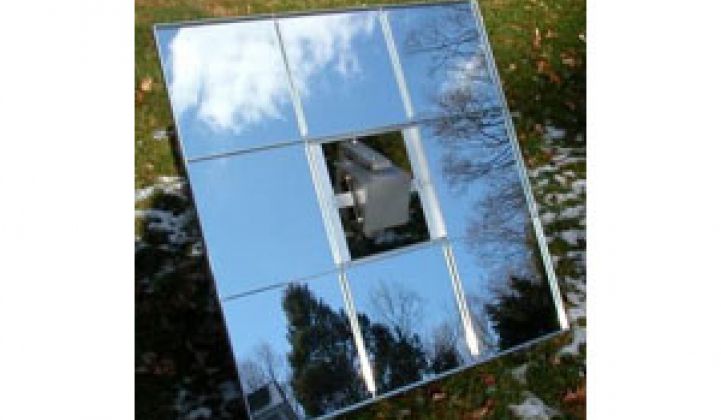
The company has created a system for harvesting heat from the sun to heat up a house. It plants heliostats – i.e., metal poles festooned with an array of mirrors – in your lawn or a nearby patch of real estate. The mirrors collect heat and then beam it into your living room.

A computerized control system guides the heliostats to maximize the harvesting of heat.

Although you'd think that something like this might sell best in the South, where it's hot, Practical is mostly targeting New England. It's the region where people need to heat their homes.

Solar thermal water heaters have been used to replace or supplement home water heaters or pool heaters for years. A number of companies – Sopogy, Chromasun, Millennium Solar and others – now want to expand how solar heat can be exploited. Chromasun, for instance, has a device that collects solar heat to run air conditioners. Some other companies use the heat for fluid pipe heating systems. 

Cypress Semiconductor and a new crop of start-ups also want to harvest solar (and waste) heat and turn it into electricity with thermoelecttric semiconductors.

Practical cuts out the middle steps and beams that heat as well as sunlight directly into your rooms. A single heliostat provides about 600 watts of thermal energy.

The hardware and real estate requirements are a bit daunting. "You need about 25 heliostats for a home in New England," said CEO Bruce Rohr. It takes about four hours to assemble a system.

That number of heliostats will need about 2,500 square feet of real estate, he added. Additionally, homeowners are advised to also install a 5,000 gallon thermally insulated water tank for storing heat. That tank will heat your house for ten days or so.

A total installation costs about $20,000. With tax credits, it will pay for itself in seven or so years, he said. Unlike solar photovoltaic panels, however, there is no mechanism for selling the heat onto the grid. Thus, heat collected in the summer can't serve to provide credit with your utility, but it can be used to heat water.  

Pets, kids and anyone else will also want to avoid standing in the path of the heat bouncing off the heliostat for long too.


Join industry leaders and influencers at Surviving the Shakeout: Greentech Media’s 2009 Solar Industry Summit in Phoenix, Ariz., April 14–15.

Comments [6]

  • Frank Oudheusden 03/18/09 11:30 AM

    is it just me or does this system basically say…you will be blinded when you look out your living room windows…can anyone say orange people and skin cancer? your basically making your home into a CPV “power-tower” from my understanding.

    Reply
  • Sean Caughlan 03/18/09 3:32 PM

    Seems a bit impractical to me.  Are we sure the company is not called ‘Impractical Solar’

    Reply
  • zillah snap 03/18/09 5:35 PM

    i just went on Practical’s website and i don’t think this article has it right. you obviously wouldn’t shine sunlight from 25 heliostats directly into a house. it looks like you’d use a receiver of some kind for an integrated hot water system. you only shine it directly into windows when you’re doing natural lighting (e.g. 1 heliostat) or space heating (2 heliostats sound like they’re about equal to a space heater—1200 watts). the writer says Practical “cuts out the middle steps” like solar thermal water heaters, but based on Practical’s website, it looks like their heliostats could work together with other solar products to boost solar input and efficiency. it looks like there are tons of applications for these things!

    Reply
  • Bruce Rohr 03/19/09 7:55 AM

    I am the founder of Practical Solar, Inc. and was interviewed by Michael Kanelios for this article. Unfortunately Michael completely missed what I told him about our technology and its applications. Obviously, we would never beam concentrated sunlight through a window. I explaned in great detail to Michael that we would use a remote solar thermal receiver and a heat exchanger to charge a large thermal mass such as an insulated water tank. We do have many users who directly beam sunlight into windows to warm and illuminate dark cold spaces, but these customers use only a single heliostat per window. It is no more concentrated than natural sunlight shining though a window.
    Bruce Rohr
    President, Practical Solar, Inc

    Reply
  • michael kanellos 03/19/09 1:46 PM

    Bruce: I have to disagree with you. I reviewed my notes, looked at your site, and looked at the story. You are trying to deliver heat and light directly into homes through heliostats. I asked how many customers need to buy, and you said 25. You reccommended a water tank for storage, but said it wasn’t necessary. In fact, the site says storage is still under development.

    As for light, you are using the heliostats to bounce light into the home. You admit it and the site says so. It doesn’t say all 25 will be used, or that 25 will beam their light through one window, or that light is the main purpose of the system. But clearly, you are beaming light into the home.

    But there are other issues here too. Namely, you argue that this is better than PV, but consumers can’t qualify for credits. Also, the heat and light get produced when people aren’t home.

    And who really has 2,500 square feet of spare lawn.

    Home thermal is interesting, but there are issues that need to be overcome

    Reply
  • Bruce Rohr 03/20/09 8:00 AM

    Michael,
    It’s hard to respond to such nonsense. You simply don’t understand anything we discussed or the information contained in our website.

    Reply
.