
What kind of power can a 30-ton shipping container generate?
Roughly 100 kilowatts to 200 kilowatts, says Louis Romo, the vice president of sales for Vycon Energy.
In one of the more titanic examples of energy harvesting on the market, Vycon has created a flywheel that captures the energy contained in cargo containers being lowered by cranes and feeds it back to the crane for the next hoist.
Port operators using the system have managed to cut diesel consumption by 30 percent on average with the company's REGEN system and in some cases by 45 percent. Maintenance and downtime is also improved.
In California, the technology is seen as a way to reduce emissions. Groups have formed to lobby federal and state agencies to clean up ports and use them as incubators for new technologies.
"Outside of California, it is, 'How much will it cost,' " he said, adding quickly that, yes, Vycon has a good answer for that question. Customers are seeing a return on their investment in three-and-a-half to five years. Vycon's flywheels have been installed in China, Japan and other ports in Asia. The company installed the 100th system in April.
The system essentially exploits the unusual circumstances of the cargo business. Cranes need large amounts of power in rapid bursts in quick succession for several hours a day. A single hoist might require 160 kilowatts to 300 kilowatts, take about 30 seconds, and get repeated every five minutes, says Octavio Solis, a product manager for the company.
Although cranes now mostly run on AC motors, they aren't grid connected, he noted. The constant movement (and gigantic power requirements) wouldn't allow that. As a result, cranes derive their power from smoke-belching diesel generators. And because cargo loads vary in size, port operators have to install generators for the worse case scenarios, leading to more fuel consumption and emissions that are warranted in most circumstances. Some of the generators are capable of generating 500 kilowatts to 800 kilowatts.
Besides needing power for the lift, cranes burn diesel when lowering cargo to control the descent. On the drop, the AC motor is run in reverse. In a Toyota Prius, that generates power for the battery. On a cargo crane, the power is burned off as waste heat.
"You generate 200 kilowatts of power when lowering a container but you have to use it immediately," Solis said.
In Vycon's system, the energy is absorbed into the rotating mass of the flywheel, which stores the energy and feeds it back into the system. The fuel saving largely come in through the fact that port operators can employ smaller generators once they have a flywheel.
Vycon sells both a retrofit kit (take it away for $120,000) and a kit for new cranes. One of the key selling points is the rapid installation. Diesel generators regularly undergo scheduled maintenance; an overhaul can take a few weeks. Vycon goes in and offers a complete new system-generator and flywheel-that can be popped on to the crane in three days.
The flywheel also lasts 20 years, which Romo says is probably longer than battery-only systems.
"Batteries are made up of chemicals and chemicals wear out," he said. "In our system, there are no touching parts."
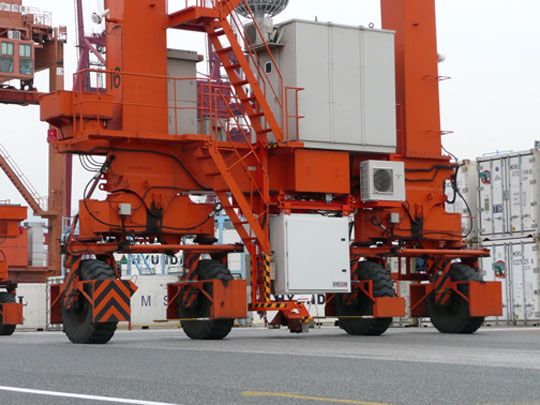
One of Vycon's flywheels installed in a crane.
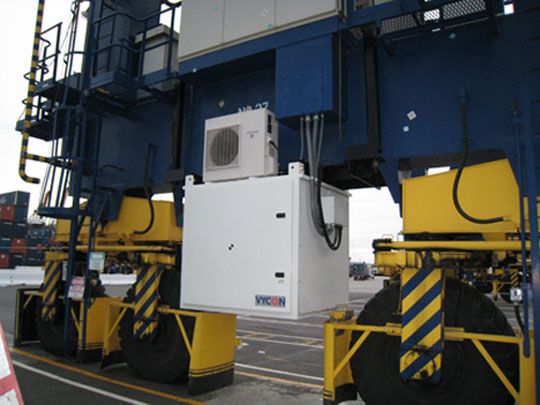
A close-up of one of Vycon's flywheels.




 41
41
 15
15
 9
9