
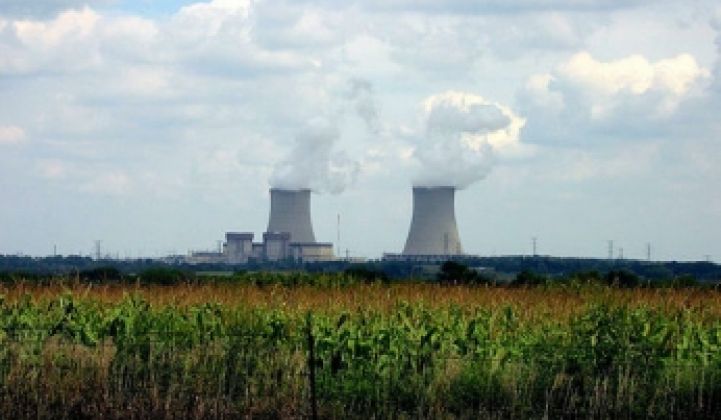
Next-generation nuclear power and "clean coal" technologies – ready or not, the country's energy industry will need them if it wants to reduce its share of greenhouse gas emissions without making cleaner power ever more expensive.
That's the gist of an Electric Power Research Institute report released Monday which found that the U.S. energy industry could reduce its greenhouse gas emissions by 41 percent by 2030 if it can implement a "full portfolio" of low-carbon technologies, including lots of new nuclear and clean coal plants.
Taking those steps could save the country about $1 trillion in emission reduction costs to the economy by 2050, EPRI reported. It could also put the energy sector on a path to help the overall economy reduce greenhouse gas emissions 80 percent by 2050, a goal of the Obama administration and the energy and climate bill now being debated in Congress.
Of course, it won't be cheap. Taking all the steps outlined in the report – what it calls its "full portfolio" scenario – would raise the cost of electricity about 80 percent by 2050, representing a cost of about $16,000 per U.S. household.
Still, that's not too steep, compared to options that leave nuclear and clean coal out of the mix. Leaving those two out, as well as dropping widespread adoption of electric cars and smart grid technologies, could boost that projected increase in electricity price by 210 percent by 2050, at a cost of about $28,400 per household, the report found.
The result is in keeping with the long-standing view of the utility industry that renewable energy sources like wind and solar power just won't be able to keep up with the expected growth in demand for energy generation that doesn't contribute to global warming.
In short, the report calls for a massive investment in carbon capture and sequestration technology over the next 10 years to avoid big increases in the cost of energy later on, said Bryan Hannegan, vice president of environment research for EPRI.
"We're going to move towards a lower carbon society," he said. "The question is whether we do it in an economically efficient and absorbable way for the economy, or if it becomes a real lurch for the economy."
The report's full portfolio of solutions includes an 8 percent reduction in electricity consumption through more efficient use of power by utility customers, as well as a four-fold increase in today's wind and solar power generating capacity and 100 million plug-in electric vehicles on the road.
It also calls for a huge boost in nuclear power by 2030 – 45 new plants generating about 64 gigawatts of power, the report found. That's up from the 104 nuclear reactors in the United States today.
About 34 more nuclear plants now in the planning stages could add about 45 gigawatts by the mid-2020s if they're built, Rosa Yang, VP of Technology Innovation at EPRI, said in February (see Green Light post).
But the nuclear industry has so far been unsuccessful in its efforts to get Congress to make nuclear power plants eligible for energy bill incentives by putting them in the same "low-emissions" class as wind and solar power (see Former EPA Chief: Building 100 More Nuclear Reactors is Doable).
In addition to nuclear power, "clean coal" technologies that don't exist in commercial form today will have to make huge strides as well, the report found (see Carbon Capture: Possible Solutions, Pt. I).
First, all of the 35 gigawatts or so of new coal-fired power plants planned in the country have to capture and store about nine-tenths or more of their carbon emissions. Also, about 60 gigawatts worth of the country's existing 300 gigawatts or so of coal-fired power plants will have to be retrofitted with the technology, the report found.
Without these efforts, coal-fired power won't be economically viable in a world in which emitting carbon dioxide carries a price of about $50 a ton, Hannegan said. Various pilot projects underway show promise, but will have to be brought to commercially viable costs through new technology, he said (see Canada to Beat U.S. to Carbon Storage and Vattenfall to Trap Carbon Emissions.)
The United States' big push to develop a carbon capture and sequestration pilot project, the FutureGen Alliance, recently received a new lease on life from the Department of Energy, which reauthorized the public-private partnership after it was canceled in 2007 due to projected cost overruns (see DOE Gives Go Ahead for FutureGen to Be in Illinois).
Hannegan pointed to technology being developed by French energy company Alstom as another bright spot for carbon capture. Alstom has reported an 88 percent carbon capture rate at a pilot project at We Energies' coal plant in Pleasant Prairie, Wisc. that uses chilled ammonia to capture CO2 from a coal plant's smokestacks, and is doing a similar pilot project at a West Virginia coal plant owned by utility American Electric Power.
EPRI's report also assumes that less expensive energy efficiency efforts are undertaking on a broad scale, including a host of efforts that would cost less than $50 per ton of greenhouse gas emissions reduced laid out in a recent report from consulting firm McKinsey & Co., Hannegan said (see McKinsey: Invest $520B in Energy Efficiency, Save $1.2T).
Those include more efficient lighting and commercial electronics, more fuel-efficient cars, more efficient insulation for homes and businesses, the development cellulosic biofuels and combined heat and power systems for factories and commercial buildings.
"We're doing all that, but at the level of decarbonization we're aiming at, we need all that and then some," Hannegan said.
EPRI's report adds more data to the growing body of research that indicates the challenge the world faces in cutting man-made greenhouse gas emissions at a cost that doesn't wreck the global economy.
The International Energy Agency said in a June 2008 report that cutting emissions 50 percent to bring atmospheric carbon dioxide levels down to where they are today by 2050 would cost $45 trillion in investments in CO2 capture and storage, solar and wind energy and emissions-free transportation (see Can You Spare $45T to Curb Global Warming?).
Put another way, the world will need to see $515 billion per year invested in new cleaner forms of energy generation to meet a 60-percent reduction in greenhouse gas emissions by 2030, according to a report released in January the World Economic Forum and New Energy Finance (see World Economic Forum: Clean Energy Needs $515B a Year).
Image courtesy Flickr / Creative Commons



 41
41
 15
15
 9
9