
Robert Noble, the CEO of Envision Solar, has said that solar installation has (or will) become the domain of builders and electrical contractors, since these companies are already on the rooftop with extensive building experience. He claims that solar installation is now "about the building industry."
One of Envision's differentiators, according to Noble, is that "we are architects and planners" who know how to "design, engineer and build." The San Diego, California-based company began trading on the OTC bulletin boards via a reverse merger a few months ago.
Envision is already in the business of building solar carports. In Noble's thinking, carports were "the largest single market for distributed solar power generation. [. . .] It's better than drilling into a waterproofed roof," according to the CEO.
"The best market for solar is out over parking lots," said Noble. Noble's architectural team designed a solar “tree” with a central pillar supporting a platform topped with solar modules, which shades about eight cars. A typical solar tree design can generate about 7.5 kilowatts of DC power. Noble's firm has completed 17 projects, with a total of about 9 megawatts installed or designed, and has a "pipeline of solar parking projects" in the works.
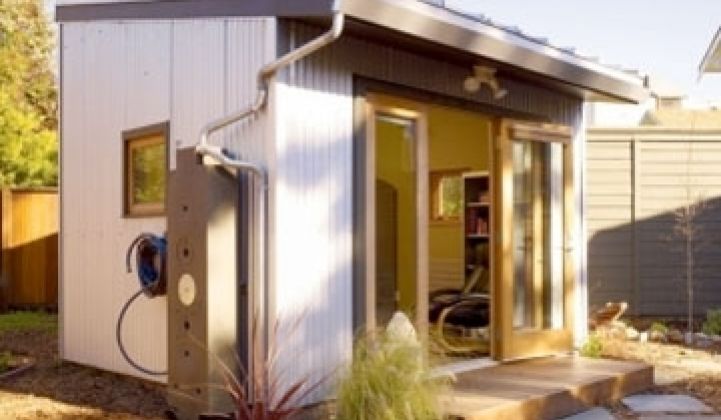
Noble's next idea is Life Village -- a line of prefabricated buildings for a variety of applications and geographies.
These are "very simple solar buildings, sized to be a carport, garage, storage building, school, clinic or house." The units are habitable and can be integrated into the grid. They are constructed out of light gauge steel, a material very familiar to and used extensively by the CEO of Envision during his tenure as an architect.
Noble is looking to build a prefabricated PV village in Haiti and sees opportunities all over the developing world.
Up to 85 percent of the African continent does not have electricity and the remaining 15% only has irregular electrical service. Noble sees the Life Village concept, combined with energy storage, as "a kit of parts to solve an enormous number of problems," moving towards "an endgame of cleantech building systems. Noble adds, "It immediately gets communities away from toxic and expensive diesel generators."
"Just as mobile phones have leapfrogged land line phones in developing nations, this model can leapfrog centralized power production," declared Noble.
Customers for the prefab solar building could include non-profits like Rotary International and myclimate.org, which are already constructing buildings in developing nations "in a big way," as well as government contractors in "security zones" for "command and control centers" along with oil companies and the like.
Noble sees the idea as profitable and "scalable in an extraordinary fashion." In his words, "There are no technology hurdles," and "integration is the new innovation."
These "manufactured building systems" act as "hard tents" that are much cheaper than a permanent building and much more effective for shelter than a soft tent. Roll formers can fabricate the "hard tents" onsite and the building can be produced and assembled by unskilled workers in a matter of hours.
In solar expert Jigar Shah's view, countries like Nigeria, Uganda, Kenya and South Africa (with support from the World Bank, OPEC, ADB and Export Import Banks) are ready to install massive amounts of solar, but are held back by the lack of expertise in those nations. Envision Solar's products could change that.
Here's a video limning out Envision's ambitious plans with Life Village.
The CEO said, "We are absolutely unique. We are a deployment of solar that most people from the building industry can understand."
The success of the Envision Solar idea, from carports to habitat, remains to be seen. But it represents a maturation of sorts of the solar industry, wherein builders and architects begin to use low-cost solar panels as part of their building materials palette.



 41
41
 15
15
 9
9