
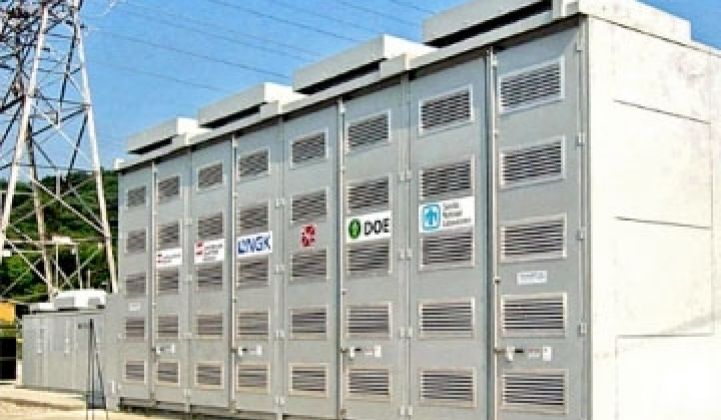
Utility-scale energy storage in the field today is limited to pumped hydro, a few large deployments using compressed air energy storage (CAES), hundreds of megawatts of sodium sulphur (NaS) batteries, mostly in Japan, and some experiments with banks of lithium-ion batteries, nickel-cadmium batteries and regenerative fuel cells (flow batteries). Greentech Media has long covered the energy storage market with technologies that include:
- Batteries (Li-ion, NiMh, Zinc Air, NaS, etc.)
- Flow Batteries
- Flywheels
- Phase-change materials
- Ammonia
- Thermal Storage as heat or ice
- Hydrogen systems
- Compressed Air Energy Storage (CAES)
- Pumped Hydro
- Superconducting Magnetic Energy Storage (SMES)
- Ultracapacitors
- Using off-peak wind energy to synthesize fuels such as gasoline and diesel from CO2 and water
Despite the tendency to nerd out and get lost in the technology, the real challenge in energy storage is more in the policy and large-scale manufacturing realm. We'll get to that in a bit.
Five players across the energy storage ecosystem spoke today at an Agrion event in Palo Alto, California -- spanning the entrepreneurial, policy and investment fields:
Primus Power, Rick Winter, CTO
Primus Power is a flow battery firm founded by Rick Winter, who also was involved with the founding of flow battery startup, Deeya Energy. In November 2009, Primus Power was selected by the U.S. DOE to receive a $14 million award as part of a $47 million project to commercialize a 25 megawatt, 75 megawatt-hour energy storage system in Modesto, California as part of the DOE’s Smart Grid Demonstration Program. Primus' VC investors include Chrysalix.
Primus Power's flow battery technology is based on a zinc bromine system with zinc plating and de-plating. Winter notes that there are at least ten different flow battery technologies in development.
EnerVault, Dr. Craig Horne, CEO
Enervault's flow battery technology is aimed at large-scale utility storage. The firm's founders have wide-ranging technical experience in energy storage and started their company "with a white sheet of paper," according to the CEO. They asked themselves, what is the best way to store one megawatt-hour of power? They ultimately decided on the relative safety of flow batteries, where there is a true separation of the power and energy component. The firm has closed an A round of $3.5 million from Oceanshore Ventures and U.S. Invest, and has won a $650,000 grant from the New York State Energy Research and Development Agency (NYSERDA). In Horne's view, the "big opportunity" lies in storage of greater than 100 kilowatts.
VantagePoint Venture Partners, Mr. Mark Platshon, Partner
VantagePoint's portfolio includes Tesla, Better Place, Premium Power and Amprius -- firms directly involved in or at least with adjacencies in energy storage. Platshon stated a common theme at this event, "Energy Storage is not a monolithic single application." (See ESA chart below.) As an investment firm, they are "looking for people who are in the weeds of individual storage applications." He also expressed "big frustration with the FERC" and their reluctance for batteries to collect multiple revenue streams. He saw this tendency as a result of lobbying by gas turbine manufacturers.
Platshon likened asking utilities for their thoughts on storage akin to asking horses what they thought of cars at the dawn of the automotive age.
MegaWatt Storage Farms, Dr. Ed Cazalet, Co-Founder and Vice President
MegaWatt Storage Farms proposes to become an ISO, an independent storage operator -- technology-agnostic with storage deployed on a massive scale. MegaWatt's analysis of the California grid indicates that about four gigawatts of storage (i.e., about five percent of peak demand) will be needed to support the 33 percent California RPS goal of 2020. Despite their technology agnosticism, MSW can only use proven technologies such as NaS, Li-ion, lead-acid batteries or flywheels from established firms like Beacon Power. Cazalet believes that unless true dynamic pricing can be established, energy storage is difficult if not impossible to realize on the utility scale.
Velkess, Bill Gray, CEO
Velkess is an early-stage energy storage firm using a kinetic flywheel to store energy in the momentum of a massive spinning wheel. The flywheel is basically a large mass spinning on a non-contact magnetic bearing, Because of high costs, these devices are used in frequency regulation or UPS applications, not actual utility-scale megawatt-hour energy storage.
While flywheels from companies like Active Power, Beacon Power and Pentadyne Power are typically built from carbon fiber or high tensile steel, Gray claims a "fundamentally different approach to flywheels" using a different set of materials and engineering principles than traditional flywheels.
The audience at the event included other VC investors (Greylock's Isaac Fehrenbach, Bessemer's Umesh Padval and Matan Friedman).
Fehrenbach commented that in energy storage (as in many cleantech verticals), technology is a necessary but not sufficient condition for success. Without a thought process on design
for reliability and design for high volume manufacturing early and throughout the development cycle, the projects will continue to litter the roadside as they have in flow batteries (for example) for many years.
Bessemer just participated in the $29.5 million Round C investment in Xtreme Power, a large-scale advanced lead battery firm.
Also in the audience were storage entrepreneurs like flow battery vendor Deeya Energy's Ajay Arora and LightSail Energy's Brooks Kincaid. LightSail is a Khosla Ventures-funded startup that is working on compressed air storage. Danielle Fong, the CSO of LightSail, discusses energy storage and the perverse nature of utility incentives at her blog here.
Policy, language, and culture issues in the world of energy storage
Without the right pressure from the Public Utilities Commission (PUC), grid-scale utility storage will remain a good idea that will likely never get implemented. Ed Cazalet of Megawatt Storage Farms alluded to utilities that claim, "We can't sign this storage contract until we have a regulation telling us to do that."
Platshon of VantagePoint said that utilities see their customers as the PUC. Folks who actually write out checks paying utility bills every month are not considered customers -- they're ratepayers. Someday, utilities might actually realize just who their customers actually are.
Batteries aren't storage devices to utilities -- they're "negative loads."
And storage, because it doesn't have a true regulatory category, doesn't truly exist in the minds of utilities -- depending on who you ask, the technology could look like generation or it might look like transmission or perhaps even distribution. Rick Winter, Primus' CTO, spoke of factions within utilities that can't agree on where storage fits into their system.
AB 2514
AB 2514 is a bill currently in the California legislative process that has been, in part, suggested by Cazalet and recently championed by California gubernatorial candidate Jerry Brown. It has gone through some changes as it has made its way through the legislative sausage maker but nevertheless, the measure remains a mandate for energy storage. If you are a Californian and believe that storage needs to be part of our renewable energy future, you might want to look into the bill and call your state senator.
Cazalet sees the potential passage of the bill as "great news for electricity storage and renewables."
***
Energy Applications according to the ESA (Electricity Storage Association)






 41
41
 15
15
 9
9