
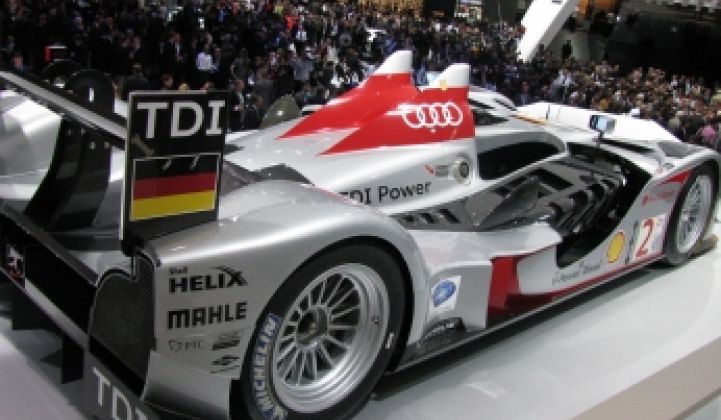
Apparently, hybrids and electric cars aren't the only thing Americans are lining up for.
Volkswagen and Audi both recently experienced a surge of sales for diesel cars and diesels will likely become a larger part of the overall market as gas prices climb, clean emissions regulations get imposed and electric cars continue to struggle to drive down the price off batteries, according to company execs during interviews at last week's International Auto Show in Frankfurt.
"We think that diesel could grow to around 15 percent of the [U.S.] market," Johan de Nysschen, president of Audi of America. "There are many complimentary technologies that we should embrace that can take us ahead. We don't want to maintain the status quo in the industry. We can't."
More than 50 percent of the Jetta sport wagons sold in the U.S. are diesels. Up to 30 percent of the models that come in both regular and diesel will likely be diesel in the future, said Stefan Jacoby, CEO of Volkswagen America. (TDI stands for turbocharged direct injections: these engines run on diesel.)
During Cash for Clunkers, VW in fact sold out of diesels: the company could have sold more if it had had them, Jacoby added.
It's been a similar situation at Audi, the luxury volume brand in the House of Volks. A diesel version of the Q7, an SUV, hit 35 percent of the mix, said. The company ran out of diesels in the U.S. for about two months.
"We ran out of cars," de Nysschen said. "I think that we could reach a point where around 20 to 25 percent of the Audis we sell in the U.S. could be TDIs."
The enthusiasm for diesel in many ways should be expected from Volkswagen. Both Volks and Audi have extensive histories in diesel technology. Technical advances, though, buoy the argument. Many of the problems – particulate emissions, noise and smell – associated with diesel cars have been steadily ameliorated over the past several years.
At the same time, mileage efficiency has increased. A diesel can get 30 percent or better mileage than an equivalent gas car. (The Volks Jetta gets 30 in the city and 41 on the highway – below a Prius but well ahead of U.S. averages.) Ford has prepped an Escort for the European market that gets 65 miles per gallon. Diesels now account for around 50 percent of European car sales.
Low-sulfur diesel fuels have also finally started coming to the U.S. and the popularity fo biodiesel in some places like Northern California has grown substantially in the past few years. (The U.S., by the way, also has minted a few diesel startups including engine designer Achates Power and Nanostellar, which has catalytic powders for reducing sulfur emissions.)
So what might hold it back? Even if it's shrinking, a price premium still exists over gas cars. Diesel makers in the U.S. face a bit of a dilemma, said Audi Chairman Rupert Stadler. Consumers and legislators want strict sulfur emissions guidelines, but then they don't want to pay extra for the research that goes into it.
"Society cannot ask for better emissions if they are not willing to pay for it," Stadler said.
Many U.S. customers still have to be won over as well, de Nysschen added. The perception of diesel and smelly and dirty (earned through trial and error) remains to be changed.
Then there is the big bugaboo: the electric car. Like Daimler, the Volkswagen group will come out with electric cars: a Volkswagen-branded economy car for the U.S. is slotted for 2013 and an electric sports car from Audi comes in 2012. But the enthusiasm is definitely on the reserved side.
"When we think about limited resources, this will be the way to go, but nobody knows the return on investment," said Stadler. "We will see gas and diesel cars for the next 30 years."
For diesels, the idea and enthusiasm around electrics effectively forms another perception hurdle. If consumers think electrics will start rolling off production lines in large numbers, diesels start to look less attractive. Regulators and politicians are also less inclined to award tax breaks.
Electric car enthusiasts admit all-electrics will come in gradually: Tesla CEO Elon Musk says electric could be 10 percent to 13 percent of the car mix by 2020 while Carlos Ghosn, CEO of the Renault-Nissan Alliance, says electrics could be 10 percent plus of his company's products. Even if you add a generous 30 percent more for plug-in and regular hybrids, that leaves 60 percent of the car market.
Still, electric is a tough idea to sell against.
"There are a lot of people on the street who say that the industry should switch tomorrow morning because it is beautiful, it's clean and it works," de Nysschen. "But we are talking about a 20-year-plus horizon before they can become all that commercial viable for the volume markets.
"We must be cautious that perfect does not become the enemy of good," he added later.



 41
41
 15
15
 9
9