Deforestation: Not So Bad for the Climate?

New research shows that destroying the world’s tropical forests doesn’t lead to the amount of man-made emissions as previously claimed by a U.N. study.

An oft-quoted figure to demonstrate amount of emissions caused by deforestation is an exaggeration, according to a research published by journal Nature Geoscience.

A 2007 report by the U.N.'s Intergovernmental Panel on Climate Change said destroying forests in places such as Brazil had contributed 20 percent of the manmade carbon dioxide emissions. The figure became widely used to stress the importance of forest protection.

But new research by Guido van der Werf at the VU University of Amsterdam shows that the figure should be around 12 percent (see his research page).

Van der Werf said the IPCC report used wrong or outdated data. Specifically, the international team of scientists who worked on that report used figures that exaggerated the rate of tropical forest destruction.

He told the U.K. Guardian: "It's a tough message because everybody would like to see forests better protected and it is difficult to tell them that carbon dioxide emissions are less important than assumed. Still, the good news of lower emissions is no bad news for the forests."

His study will likely add fuel the current debate as to whether or not a new international treaty to curb emissions needs to be created and to the efforts by the U.S. policy makers to draft a climate change bill.

Although there is no national emissions cap-and-trade system in the United States, there are already a number of private carbon exchanges, such as American Carbon Registry, that facilitate the sales of credits from forest protection.

"If you want to put a price on carbon [in forests] then you would get less carbon for your money now," he said in the Guardian story. Van der Werf, of course, cautioned that deforestation still makes a significant contribution to emissions.

His study does have a caveat: The 12 percent is an estimate, and the actual number could be anywhere from 6 percent to 17 percent.

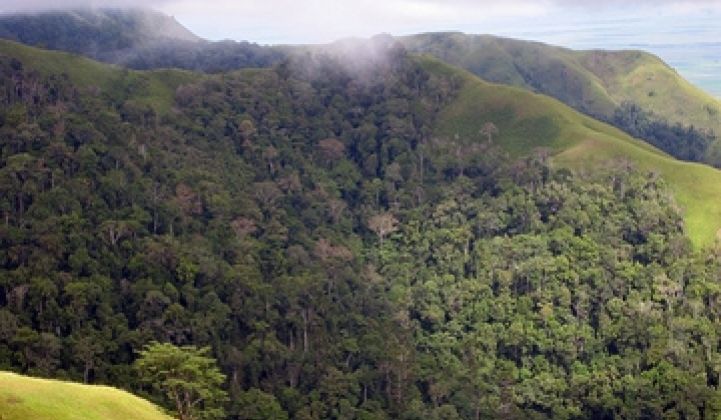
Photo via Flickr/Creative Commons.

7 Comments

  • Guido van der Werf 11/4/09 2:48 PM

    Probably good to clarify that the IPCC did NOT intentionally used bad data (some if it came from ourselves) but it was just the best data available at the moment. In addition, a large chunk of the lower contribution comes from increased fossil fuel emissions, the downward revision of deforestation estimates was relatively modest.

    More importantly: an important aspect of the paper is that including peat degradation could boost the percentage easily to 15%.

    For more nuance please visit my website: http://www.falw.vu/~gwerf/index.html

    Reply
  • Doc Wheat, HaraBara 11/4/09 10:16 PM

    I am sort of surprised, Ucilla, that even after Prof. van der Werf alerted you and gave you the link to his site you didn’t correct the wrong impression given in your post. The GHG emissions from deforestation, if you include peatland destruction, is about the same amount earlier estimated by the IPCC. We have learned a lot, but the actual number isn’t much changed. It is a lower _percentage_ of total human-caused GHG emissions because other emissions, mainly from fossil fuel combustion, have risen so much since those earlier estimates were done. Prof. van der Werf has a very revealing graph on his site.

    Reply
      • Ucilia Wang 11/5/09 12:16 AM

        Doc Wheat: The goal is not to simply get to that 15% estimate—this is not a game to play with numbers to suit your purpose. The issue is what is a realistic estimate of the emissions from deforestation. Then there is the issue of peatland degradation, something the professor looked into and had results to share. The IPCC report did not include emissions from peatland degradation.

  • mds 11/6/09 1:56 AM

    What about the effect of deforestation on water vapor and this effect on GW?  Water vapor is by far the most abundant GHG in the atmosphere and low lying clouds reduce global warming by reflecting solar radiation.  Ever hiked through a forest just after a good rain?  There are low lying clouds clinging to the trees and hillsides.  Look at the picture with this article.  This does not happen in a grassland area.
    Also, the additional water vapor from trees is a major factor in the formation of some glaciers which also help reflect solar radiation.  The loss of snow and glaciers on mt. Kilimanjaro is primarily the result of upwind deforestation.

    Reply
  • Paul 11/6/09 5:45 PM

    The difference between the original figure and the slightly modified new figure are an inconsequential academic tweak and pale in comparison to the lack of action that has been taken to avoid the deforestation. Even if the number was 4%, it would still be extremely important to keep those forests alive and healthy but, as usual, we feel a need to be excruciatingly accurate and thus create headlines that can/will be used by the denialists to justify even less action. I’m not proposing that we adopt the tack of “lies upon lies upon lies” that the denialists use, but does this type of data tweak really deserve such a headline?

    Reply
  • russ 11/14/09 8:31 AM

    Actually, in the global warming debate, both extremes use ‘lies upon lies upon lies’ and that is what has the public turned off.

    The public is done a great disservice by the spreading of ‘junk data/information’ by those trying to further their cause at any cost. Here I see Paul suggesting controlling data in order to control public opinion!

    Remember the public is getting sick of all of this bickering and I point out again that both sides are very much and equally responsible.

    Reply
.