Commercial-Scale Aviation Fuel from Waste?

Have advanced biofuels finally lived up to their hype?

Commercial-Scale Aviation Fuel from Waste?

This week, British Airways announced that it is partnering with U.S.-based Solena Group to build the first European commercial plant that will produce jet fuel from municipal solid waste streams like food scraps, grass, and tree cuttings, as well as agricultural and industrial waste.

The idea of using biomass to produce fuel is not new.  In fact, on February 23, 2008, British Airway arch-nemesis Virgin Atlantic become the first commercial airline to oversee a flight partly powered by renewable energy (see Virgin to Test Fly Bio Jet Fuel). Virgin used a 747-400 jumbo jet to fly from London to Amsterdam and deployed one of its four engines with a 25% blend of biofuels that included coconut oil and babassu oil.  In the last year, KLM, Air New Zealand, Qatar Airways, Continental Airlines, and Japan Airlines have also completed flights using biofuels like jatropha, camelina, and algae (see Navy Orders 20,000 Gallons of Algae Fuel From Solazyme).

What is striking about the BA announcement is the size. Solena will annually convert 500,000 tons of waste into 16 million gallons of jet biofuels.  BA has refused to disclose the financial value of the deal, commenting that it is unable to predict what the market price for the biofuel will be in four years when the facility opens in 2014.

16 million gallons of jet biofuel is equivalent to 2% of all the kerosene used at London Heathrow -- the world's busiest airport -- and is equivalent to removing 48,000 cars off the road.

A number of 3rd Generation algae and synthetic-biology biofuel companies are pursuing drop-in fuels such as bio-jet fuel. 

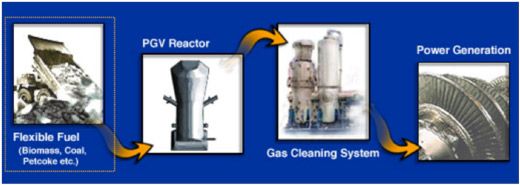
Solena Biomass to Electricity Process

There are some in the industry who believe that coal-to-liquid via Fischer-Tropsch technology is the only scalable technology for alternatives to petroleum-based aviation fuel. Currently, such processes are already produced commercially for the aviation industry in certain parts of the world.  Germany pioneered the process during World War II, and for the past nine years, South African Airways has flown its jets on a 50-50 mixture of CTL synthetic and ordinary commercial fuel. The U.S. Air Force has completed a test program based on a blend very much like the South African fuel mix, using 50 percent Fischer-Tropsch synthetic fuel and 50 percent commercial fuel. While the Air Force and members of Congress from coal-producing states are major proponents of CTL aviation fuels, a lifecycle analysis conducted by the U.S. EPA found that CTL fuel actually releases 118.5% more greenhouse gases than conventional fuel.

Solena's technology involves feeding waste streams into a large plasma reactor whose arc torches heat the biomass to 5000 degrees Celsius. The biomass is then transformed into a syngas that is a combination of hydrogen and carbon monoxide.  After the syngas is cooled and cleaned of its particulates, it is transformed into jet fuel via an undisclosed "advanced Fischer-Tropsch" technology.  Although Solena has been mum on which catalysts it will use to convert the syn gas into jet fuel, the most common F-T catalysts are derived from iron, cobalt, nickel, and ruthenium.

Given that battery costs can add $15,000 to the price of an electric vehicle, there is no electrification option for the aviation industry for the foreseeable future.  That is why the announcement of a commercial biomass-based jet fuel facility is significant.

Still, the industry has a long way to go.

World consumption of jet fuel is estimated by the IEA to have reached 165 million gallons per day (625 million liters) in 2006, the daily equivalent of draining the volume of an Olympic-sized swimming pool (2.5 million liters) every twenty minutes for an entire year. The International Energy Agency's most recent data for global jet fuel demand found that, in 2005, global consumption reached 78.6 billion gallons. In comparison to the Energy Information Agency's estimate that 682 billion gallons worth of transportation petroleum was consumed in 2006, jet fuel encompasses around 11.5% of global transportation fuel demand.

Since aviation petroleum accounts for 30%-50% of an airline's operating costs and comprises 13% of global transport emissions (including 2% of global carbon dioxide emissions), it is imperative that more of these projects get funded.

12 Comments

  • Mackinnon 02/18/10 6:41 PM

    Good article.  My guess is that EU’s ETS will temper demand for coal-to-liquid technology.  The UK appears to be stuck when it comes to renewable jet fuel: not enough arable acres to support both food production and Bio-SPK plant feedstock, and not enough sunlight for algae.

    http://www.biomassintel.com

    Reply
  • infernofuel 02/19/10 12:06 AM

    Dear members of aviation industry,
    The use of 2nd/3rd generations biojetfuel is good, but, we must not produce it at the expenses of
    water and land usages. As the population is lightly to hit 9billions soon. Land and water resources are
    precious. The low hanging fruit for flights will be fuel efficiency in turbines by Infernofuel, where
    land and water resources are not so much a factor in producing it to power aircraft.We are invtiting
    intererested aviation players to run a test on Infernofuel.Please visit http://www.infernofuel.com
    Regards,
    Ron Tan
    +65-9145-9147

    Reply
  • infernofuel 02/19/10 12:08 AM

    Dear Sir,
    We are inviting aviation industry to conduct pilot projects on jetfuel combustion efficiency with Infernofuel.
    Please visit http://www.infernofuel.com
    REgards,
    Ron Tan

    Reply
  • Casey Verdant 02/19/10 7:18 PM

    Great news from BA & Solena Group. By 2014, British Airways will be powering part of its fleet with 16 million gallons of jet fuel made from 500,000 tons of waste. From London Landfills to the World’s Skies!

    Researching how to make your company, product, or next project more Green? Go to http://www.greencollareconomy.com for sustainability white papers and the largest b2b green directory on the web.

    Reply
  • Rhonda 02/20/10 1:03 AM

    Just a quick query. Is the energy required to drive the conversion process sourced from renewables? An industrial scale plasma reactor alone would require a large amount of electrical energy to power it, without even considering the balance of the process. Hopefully the project is genuinely green.

    Reply
  • Siebert 02/22/10 7:50 PM

    I work in the aviation fuel industry developing novel fuels (priomarily jet fuel) and I do not believe for one moment that this project is possible.  It is a PR stunt for BA at a time when they are in desperate need for some good news rather than bad - think: cabin crew strike and huge losses last year…  This type of ficus on the industry is good though, so I should not complain too loudly.

    Reply
  • Mark 07/28/10 11:54 AM

    I think the idea of using things like food scraps, grass, and tree cuttings, as well as agricultural and industrial waste to create bio fuel is a great idea. Not sure of any side effects but the inititial idea sounds great. our business is car parking for people travelling at the airport and we think of ways to reduce our carbon footprints, so any such idea is good. Visit http://www.airportessentials.com

    Reply
  • Nick 07/30/10 10:09 AM

    As a corporate pilot that flies internationally, the prices of jet fuel as well as it’s quality can vary greatly from one country to the next. Alternate sources of fuel, especially those produced fro organic material sounds like a great idea, but the quality control would have to be ensured before flight departments would invest much attention. Impure fuel contamination can be incredibly expensive, not to mention dangerous. http://www.dreampilotjobs.com

    Reply
  • Manik Thapar 08/10/10 2:20 AM

    Generating fuel from waste has been in practise for a long time. In this situation what needs to be considered is, are they only using bio mass or will recyclable elements such as plastic also be used? If this system can be perfected and the cost of Aviation Turbine Fuel and Jet A fuel bought down, specially in countries that leavy heavy taxes on aviation fuel there is nothing like it. Other considerations such as working with engine manufactureres like GE and Honeywell to reduce the carbon emmions from jet engines would be a welcome step.
    http://www.eco-wise.blogspot.com

    Reply
  • AME 08/16/10 4:25 AM

    In times of recession idea of producing bio-fuel is something very remarkable thought.
    Near, future generating of bio-fuel with green efficiency has more positive effect on aviation sector.
    low fuel price = low fares = more passengers = more employment :-)
    GO GREEN :-)
    http://www.aircraftmaintenancengineering.blogspot.com/

    Reply
Need an avatar? Get one here: Gravatar