
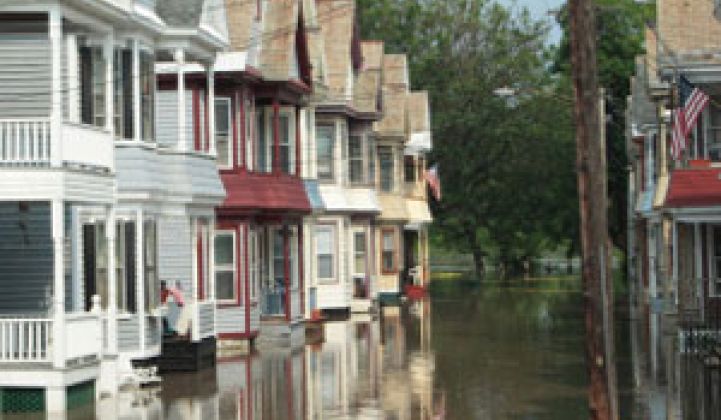
Global warming is likely to lead to ocean levels rising from a half-meter to one meter by 2100, roughly double what a 2007 United Nations-sponsored study on global climate change suggested – and that means trouble for the coastal areas that house one in ten humans on earth.
That's the gist of research presented this week at the International Scientific Congress on Climate Change in Copenhagen, where more than 2,000 scientists and government leaders are discussing the latest dire predictions on the effects of manmade greenhouse-gas emissions on the world's climate.
The news is not good. Researchers from Australia, Europe and the United States presented research backing up fears that previous estimates of ocean level rise – which already threatened to flood land inhabited by hundreds of millions of people – are too low.
A 2007 report from the U.N. Intergovernmental Panel on Climate Change estimated that ocean levels would rise 18 to 59 centimeters by 2100. But it also acknowledged that it didn't have access to all the information it wanted at the time, including key information about the state of ice sheets in Greenland and Antarctica.
But those figures are a "lower bound" because of scientific uncertainty at the time about the state of ice sheets in Greenland and Antarctica, said Eric Rignot, Professor of Earth System Science at the University of California Irvine and Senior Research Scientist at NASA's Jet Propulsion Laboratory (see The Four Horsemen of Abrupt Climate Change).
Newer research shows that "the ice sheets in Greenland and Antarctica are already contributing more and faster to sea level rise than anticipated," Rignot said in a prepared statement. "If this trend continues, we are likely to witness [the] sea level rise one meter or more by year 2100."
About 600 million people live in coastal areas that are in danger of being flooded by such a drastic rise in ocean levels. Even a half-meter rise in ocean levels could cause significant disruption, said John Church, of the Centre for Australian Weather and Climate Research.
Worse yet, global warming threatens to cause a series of "feedback loops" that could lead to releases of even more greenhouse gases into the atmosphere, hastening climate change (see Global Warming Threatens Arctic Feedback Loops).
"Unless we undertake urgent and significant mitigation actions, the climate could cross a threshold during the 21st century committing the world to a sea level rise of [meters]," Church said in a prepared statement.
Urgent and significant mitigation actions will cost money, of course. The International Energy Agency said in a June report that cutting emissions 50 percent to bring atmospheric carbon dioxide levels down to where they are today by 2050 would cost $45 trillion in investments in CO2 capture and storage, solar and wind energy, and making transportation free of greenhouse-gas emissions (see Can You Spare $45T to Curb Global Warming?).
Without those investments, global warming could lead temperatures to increase 6 degrees centigrade by 2100, harming agricultural productions and leading to conflicts over natural resources, the report stated.
The meeting in Copenhagen did yield some positive predictions for the future – the potential for renewable energy to supply a much larger share of the world's power than has previously been predicted.
That share could rise to 40 percent by 2050, if there is "global political support and financial investment" to make it happen, said Peter Lund of the Helsinki University of Technology's Advanced Energy Systems in a prepared statement.
Previous estimates of renewable energy's potential put it at no more than 12 percent of the world's energy appetite by 2030, Lund said.



 41
41
 15
15
 9
9