BrightSource Inks 1.3GW SoCal Edison Deal

The solar energy developer plans to build seven solar thermal power plants with the first in California's Mojave Desert.

The California desert will bloom again, this time with large solar power plants.

BrightSource Energy has inked a deal with Southern California Edison (SCE) to sell electricity from seven solar power plants that will have a total capacity of 1.3 gigawatts. SCE and BrightSource call the agreement the largest solar deal in the world.

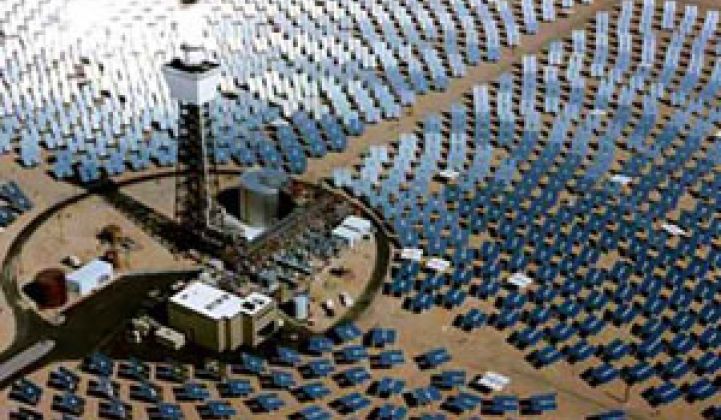
BrightSource, based in Oakland, Calif., is developing a technology that uses the sun's heat, rather than light, to produce electricity. Instead of solar panels that can be seen on some rooftops today, BrightSource's equipment consists of thousands of mirrors called heliostats that redirect the sunlight to a boiler on top of a central tower to produce steam. The steam then goes to a generator to produce power.

This approach, called solar thermal, is finding fans among utilities interested in getting lots of power from a centralized source. Solar thermal power plants require lots of land and are typically located in isolated areas with lots of bright sun. California, Arizona and Nevada have attracted many solar thermal project developers from within the United States and Europe (see Abengoa Q&A: Heating Up the Solar-Thermal Market).

An example of an alternative approach would be to place conventional solar panels on the rooftops of businesses, homes and government buildings across a city or region. SCE is carrying out such a project, which involves placing 250 megawatts worth of panels on commercial rooftops.

BrightSource plans to build the first, 100-megawatt power plant for SCE in the Mojave Desert town of Ivanpah, Calif., on land already chosen by BrightSource to build a 300-megawatt power plant for Pacific Gas and Electric (PG&E). Both the SCE and PG&E will purchase electricity from these power plants, which will be owned and operated by BrightSource.

All of these companies are moving through the permitting process to get approval from the California Energy Commission. Approval and construction could begin in early 2010, said Keely Wachs, a spokesman for BrightSource. The company could start building the PG&E project first, and begin construction of the SCE project six to nine months later, Wachs said.

It typically takes about two years to build a 100-megawatt power plant, and the SCE project could come online in 2013. BrightSource expects to complete the rest of the power projects within six to seven years, Wachs said.

The Ivanpah site wouldn't be large enough to accommodate the other, 1.8 gigawatts worth of power plants that BrightSource plans to build to sell power to SCE and PG&E. BrightSource's deal with PG&E, announced last April, calls for supplying power from up to 900 megawatts worth of power plants.

BrightSource is considering other locations in the California Mojave Desert, as well as in Mormon Mesa in Nevada to build those additional power plants, Wachs said. Overall, BrightSource is looking at developing land that can accommodate 4.2 gigawatts worth of solar projects.

The deal with BrightSource isn't the first solar-thermal project for SCE. The utility announced last June that it intended to buy power from 245 megawatts worth of power plans to be built and operated by ESolar, a startup company in Pasadena, Calif. (see California to Get More Solar-Thermal).

Wachs declined to disclose the costs of building all these power plants. BrightSource will be looking for money to build these projects, Wachs said. The company raised over $160 million in Series C last year.


Join industry leaders and influencers at Surviving the Shakeout: Greentech Media’s 2009 Solar Industry Summit in Phoenix, Ariz., April 14–15.
8 Comments

  • Lindsey Chambers 02/11/09 10:18 AM

    On balance, probably a good solution to pursue. Regarding the desert environment, there are very many sensitive issues (species, ecology, wildfire risk, wind damage, flashflood risk) to consider at the very local level.
    Still, worth considering how this $ investment compares with the cost/benefit of merely whitewashing all those flat asphalt roofs in LA itself.

    Reply
  • Ucilia Wang 02/11/09 11:14 AM

    Hey Elizabeth, I read one story that says the total capacity of the new factory would be 620MW, and another story says 600MW. Am trying to get some info from the company. Sanyo is moving fast on expanding its production all right.

    Reply
  • John Bancroft 02/11/09 10:15 AM

    Holy Crap! That’s almost 16.5 square miles! I’m all for clean energy and I like the initiative of these folks. However, for solar to be a truly alternative source of electricity, the technology is going to have to be advanced in a big hurry. 1300 MW isn’t enough of a jump from what an average nuclear plant can produce to compensate for the HUGE land requirements. Also, just to correct the article a bit, according to the DOE, there are 2 units in AZ that produce just over 1300 MW, the largest of which had a net capacity of 1314 MW in 2007.

    In addition, just from a security standpoint, it will be an incredible headache to keep someone from severely damaging one of these huge arrays. If we’re interested in protecting critical U.S. infrastructure, that needs to be a consideration as well. I’d hate to spend billions of dollars just to create a huge target.

    Reply
  • M Katz 02/11/09 10:20 AM

    This sounds like a great idea, except what happens when the earth rotates and you know the sun sets… I hear this happens at least once each day or so. I think people call it nighttime, that’s when people use electricity to say light their homes.

    Yes, this is a bit of snark. Solar alone won’t do it. Wind alone won’t do it. Nukes alone could do it.

    Reply
  • Elizabeth Williams 02/11/09 10:36 AM

    Just got a call from my brother who lives/works in Japan, also today > Sanyo Electric Co plans to invest more than ¥10 billion in a new solar cell plant in Osaka.  They will also increase production of solar cells at a plant in Unnan, Shimane Prefecture, under a plan to boost solar cell production capacity to 600 megawatts from 340 megawatts in 2010.wi

    Reply
  • Christof Solar 02/11/09 6:00 PM

    I am very happy to see that American people agree with Obama on this point!More and more people are finally becoming aware that green energy is necessary if we want to continue to live on this planet I think we are witnessing a green revolution. Governments are looking at renewable energy as one of the most safe and stable investment, and the sector is booming, in the West as well as in the East.
    China PV Industry, under the boost of International Market challenges and the implementation of domestic policies, has gradually start to grow and is very likely to emerge soon as one of the greatest solar energy production bases in the world. For this reason properly understand what´s going on in such a big Country could make the difference between closing that deal and catching the next plane home

    News on Euro-China Solar Promotion Association website at:
    http://www.solarpromotion.org

    Reply
  • Christof Solar 02/11/09 6:00 PM

    China PV Industry, under the boost of International Market challenges and the implementation of domestic policies, has gradually start to grow and is very likely to emerge soon as one of the greatest solar energy production bases in the world. For this reason properly understand what´s going on in such a big Country could make the difference between closing that deal and catching the next plane home

    News on Euro-China Solar Promotion Association website at:
    solarpromotion.org

    Reply
  • Ucilia Wang 02/12/09 2:02 PM

    ChrisB, I think your relentless promotion of the Chinese PV industry is wearing down my defense—I’ll check out the website for sure. But what’s China doing in developing solar thermal?

    Reply
.