[pagebreak:Analysts Call Obama Election a Win for Greentech]
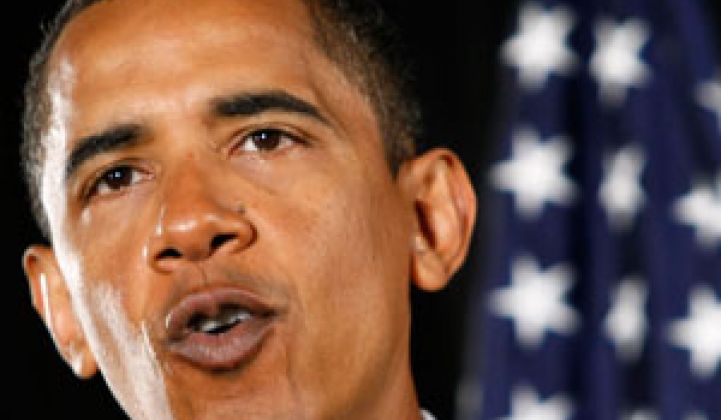
A number of greentech industry insiders are cheering the election of Democratic candidate Sen. Barack Obama as the next U.S. president.
"It's obviously outstanding news for the clean-energy sector," said Ethan Zindler, head of North American research for New Energy Finance. "An Obama win, coupled with pickups in the House and Senate for Democrats, is really good news."
But Zindler added that not all Democrats favor renewables, and said a few more clean-energy supporters did win seats, including Republican Sens. Charles Grassley, R-Iowa, and John Ensign, R-Nev.
That will make it easier to get legislation passed, he said, pointing out a number of occasions when bills to extend renewable-energy tax credits failed by only a few votes before finally getting approved in October (see Lawmakers Approve Energy Tax Credits, Bailout, Volley Continues Over Renewable-Energy Credits, Senate Rejects Renewable Tax Credits Bill, Senate Blocks Renewable Incentives Bill, Renewable Tax Incentive Still at Risk, As National Incentives Fail, States to Fuel Renewables, Senate Rejects Green Incentives to Pass Energy Bill and Senate Sends Energy Bill Back to Beginning).
"Sixty [votes] certainly seems achievable in many occasions, especially with the help of Republicans [Olympia] Snowe and [Susan] Collins up in Maine, who are definitely as supportive of this sector as many Democrats, if not more so," he said. "It's just going to be a lot easier to get the 60 votes to get things passed."
Ron Pernick, a principal for Clean Edge, called Tuesday's election of Obama "a critical election for clean technology and the broader greentech movement."
"I think that in many ways, it was a referendum between two different possible futures," he said. "It was very clear that although there were some things that McCain supported that may have been beneficial to clean energy, it was much more of a 'drill baby drill' approach, with 45 nuclear power plants and a disparagement of conservation.
"If you look at Obama's energy policies, it's very much a checklist of what many in the cleantech movement would be asking."
Among other green initiatives, Obama has proposed a carbon cap-and-trade program, which could limit carbon emissions and set up an auction to enable heavier polluters to buy credits from cleaner companies, pledged $15 billion annually for clean energy and called for a national renewable-energy standard that would require the country to get 10 percent of its electricity from renewable sources by 2012 (see Presidential Picks Cast Solar Ballots).
He also plans to extend federal renewable-energy production credits for five years, to boost the renewable-fuel standard to require the country to use 60 billion gallons of biofuel from nonfood materials by 2030, up from a current requirement of 21 billion gallons by 2022, and to raise fuel-economy standards for vehicles by 4 percent each year (see Ethanol, Farm Industries Split on Candidates and How U.S. Prez Candidates Could Drive Change).
Robert Wilder, CEO of Wildershares, which manages three energy indices, said he was "pretty excited" about the outcome of the election.
"We're looking at not just having, for the first time, a real cheerleader for clean energy in the Oval Office, but also at having a House and Senate that are probably going to be to the left of the president," Wilder said. "[Obama] has already talked about energy independence in a real way - it's not been the throwaway line we've gotten since Richard Nixon - and I think he really means it."
The question is how Congress will pay for what will doubtless be very expensive programs, said Wilder, who attended California's Occidental College with Obama and said he used to call him "Barry."
"Some pundits are saying it will be too expensive to implement [these programs,]" he said. "But if you look at a cap-and-trade [program] or carbon taxes, which some see as just punishing dirty fuels, they also can be revenue generating. Not only will coal get dinged by the weight of a potential carbon tax or cap-and-trade, but it will pay for some of these programs."
Wilder said he thinks Obama will be mindful of keeping new legislation moderate to avoid repeating what he called the mistakes of the first two years of former President Clinton, which he said ushered in a much more conservative Congress.
"They will be clean and green – far different from [the Bush administration] – and I think the country is really thirsty for this kind of change," he said. "It's amazing to me how desperate people are in America for leadership in clean and green technologies. But President Obama is going to be working to retain this Democratic majority far longer than the next two years."
[pagebreak:Obama Win: Continued]
With a new president in the White House, the country could be on the cusp on a new green economy, Wilder said.
"We’re looking to a greener economy in which we can regain the leadership we gave up in the ’80s and sell to China and to other countries," he said. "Typically all we have is services and everything is made elsewhere and we buy it, but it doesn’t have to be that way. We could sell green goods under President Obama."
But he added that the new green economy will result in some losers as well.
"I think the losers are going to be trying very hard to put forth the message that their loss is America’s loss and are going to try to show that moving from dirty fuels to cleaner fuels is a bad thing," he said. "But people are smart and know that coal is dirty.
"There are people who don’t have voices now who are going to have these new green jobs in five to 10 years and are going to be in better industries that could potentially export to the rest of the world. It just takes some leadership."
Meanwhile, John Quealy, a managing director of Canaccord Adams, said Obama’s election bodes well for smart-grid and green-building technologies, as well as for renewable energy and fuel-efficient vehicles.
Clean coal will likely continue to have a fairly high profile under Obama, he said, and ethanol supporters also expect continued support - which is in stark contrast to the platform of McCain, who proposed cutting subsidies for the biofuel (see Ethanol, Farm Industries Split on Candidates).
Still, Quealy added, although some greentech categories will get a somewhat stronger boost from Obama, McCain also would have been a solid supporter of greentech.
"Either way, it [was] a no-lose situation for energy investors," Quealy said.
He added that the new president will need to begin considering the United States’ international environmental platform almost immediately, as government representatives will be reconvening in Copenhagen at the end of next year to negotiate the successor to the Kyoto Protocol.
"It’s kind of a sleeper [issue], if you will, but while the economy clearly has put a bit of a damper on increased costs for environmental outcomes, we can’t look away [from the fact] that Copenhagen is going to begin and that this is the chance for the U.S. to set the agenda," he said. "I think we will see some surprising things on up that haven’t been on the radar, given the Copenhagen timeline."
Zindler also noted that the tone of the campaign has been more about energy independence than about climate change, which could have "interesting reverberations" in the way that policies are made next year.
"There are two very good arguments for supporting clean energy - one is to promote energy independence and the other is to fight global warming, and the former really took precedence over the latter in the conversations on the campaign trail," he said. "We think Democrats will put policies that are pro-renewables ahead of anti-carbon policies that reign in fossil-fuel plants."
That means a carbon cap-and-trade program could end up on the back burner.
"We still expect a cap ... but it’s not going to be at the top of the list compared to long-term extension of the [production tax credit] and other policies specifically geared toward the renewable-energy sector," he said.
The greentech industry's politicalwork isn’t over, Pernick added. Obama is going to have so many different competing interests that it’s going to be very critical for the industry to work to keep cleantech at the top of the agenda, he said.
"We’re really talking about potentially a new green deal," he said. "It’s not a fait accompli – we did not get the proof tonight just from him winning the election – but I think we’ve got a chance of using clean energy and cleantech as a foundation for economic growth."
Roland Schoettle, CEO of Optimal Technologies, said he hopes Obama sticks to his promise to overhaul energy-efficiency standards.
"He specifically stated that we need an overhaul of the grid and the implementation of a smart grid in order to reach our goals, and we also [look] forward to seeing him implement his promise to reduce energy usage in buildings by 25 [percent] to 50 percent," Schoettle said.
He added that the most heartening part of the election for him is that both candidates recognized the crucial problem of fixing the country's aging electrical grid.
"Both advocated the implementation of "smart grid" power lines to improve electrical efficiency, a strong indication that at the highest levels of government there is recognition of the primacy of this issue," he said.
While most of the U.S. environmental-policy leadership has come from states such as California so far, Pernick said he expects Obama’s election – along with the re-election of representatives including Senate Majority Leader Sen. Harry Reid, R-Nev., and House Speaker Nancy Pelosi, D-Calif. – will change that.
"We finally have federal leadership, which we’ve lacked," he said.
Join industry leaders and influencers at Greentech Media’s new conference series Greentech Innovations: End-to-End Electricity on November 17 and 18 in New York City.


 41
41
 15
15
 9
9