Thin-Film Solar Investment Dries Up

Thin film 2010 is thin film 2.0: go small or go home.

Thin-Film Solar Investment Dries Up

VC investment in solar power is still going strong, despite a dismal 2009 and an only slightly more heartening first quarter of 2010.

But the sub-sector of thin-film solar is a different story.  In 2007 and 2008, almost every energy and greentech investor invested in a thin-film firm.  In fact, they did so in a big way -- with $100 million plus funding rounds going to Nanosolar, HelioVolt, AVA Solar, MiaSole, Sulfurcell, SoloPower, etc.

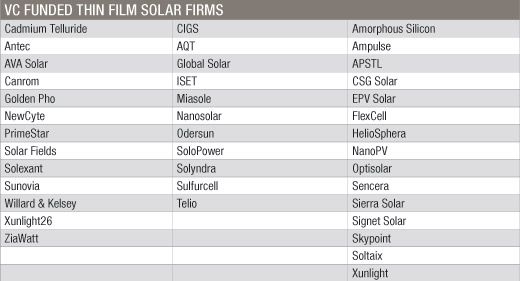
Here's a quick (non-exhaustive) list of thin-film PV firms funded by VCs over the last few years.

All told, more than $2.5 billion went into thin-film solar over the last few years. 

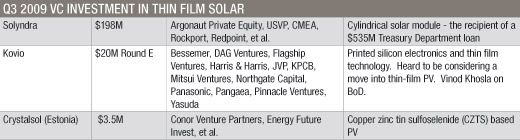
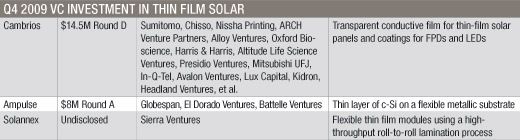
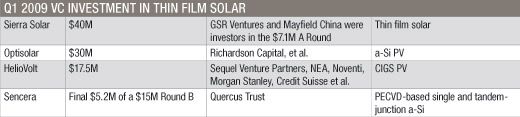
However, investment activity slowed down considerably in 2009 and early 2010.  Here are the thin-film solar firms that were funded in 2009:


What does this mean if you're a thin-film PV entrepreneur in 2010?  For one, it means the days of $300 million factory-building funding rounds are pretty much over.  Two, you're going to have to come up with a new way of doing business.  One startup that gets this message is AQT, a CIGS developer that has made enormous technical progress on a shoestring budget with a business plan that doesn't require half a billion dollars to get to market.  We've written about them here

A few of the things that AQT has chosen to do differently are:

  • Focusing on building solar cells, not manufacturing equipment
  • Using pre-existing high-volume manufacturing equipment
  • Starting with CIS2 (Copper Indium Sulfide), a relatively less complex materials system before they tackle CIGS
  • Ramping up in 15-megawatt to 20-megawatt modular increments, not biting off 50MW-100MW chunks like other CIGS players

Call it CIGS or Thin Film 2.0.

On the other hand, the companies that ramped-up and staffed-up hard in 2008 have bloated headcounts and a rapidly contracting runway on which to get to market.  Their burn rates are either going to get them to commercialization -- or consume them.

8 Comments

  • Jigar Shah 02/9/10 3:14 PM

    Wonderful summary.  The real question is whether all of these companies go public pre-maturely to try and raise the money.  If they do, they will hurt the whole sector like Evergreen Solar did back in 1998.

    Reply
  • not me 02/9/10 3:46 PM

    You must be kidding - you call copper indium disulfide a radical positive step? Ever heard of sulfur cell? Another dumb columnist writing about a trite subject. And yes, the non-fslr thin film companies are in trouble - duh?

    Reply
      • Eric Wesoff 02/22/11 8:29 PM

        Just re-reading this and marveling at your social skills. If you had to sign your real name to this would you still act this way?

  • Solar Knowledge 02/9/10 6:23 PM

    Ouch…true, but Evergreen has gotten is just reward. 
    Nobody with any sense is going to put investor’s/tax equity $ behind thin-film projects—maybe with FSLR providing a backstop…traditional Si has proven to be such a robust material and P99 for PV is going to make wind looked very risky in a couple of years…rotor problems in years 4-6 are going to start coming in greater frequency

    Reply
  • GG 02/10/10 1:18 AM

    Could you elaborate on what you mean by P99 for PV, please

    Reply
  • Solarman 02/11/10 3:03 PM

    I would not invest my own money in thin-film project myself. Crystalline Silicon are still in great demand, have higher efficiency and are dropping in price.  On my last project I bought multi-crystalline modules for $2.15 per watt. My hope is that they will continue to drop in price.  If someone can come up with modules that don’t need to use as much glass and aluminum and are still durable and easy to install, they would win.

    Reply
  • jrminvestor 07/7/10 2:22 PM

    Envision Solar (EVSI.OB) converts parking lots and structures into Solar Groves with vehicle charging stations for hybrids and electric cars. Envision Solar Stockholder here who believes that Solar Trees are going to be BIG moneymakers!

    Reply
  • Sammy 11/1/10 11:32 PM

    These companies should expand its wings to Asia, I’m sure there’s still a huge market there.
    Sammy - RFID

    Reply
Need an avatar? Get one here: Gravatar