



Viewing posts tagged "Algae"

Eric Wesoff 09 14 09, 10:36 PM

What’s It All About, Algae?

Seambiotic, located in Ashkelon, Israel, uses eight raceway/paddle-wheel open-ponds for algae cultivation, fed by C02 flue-gas from a nearby Israeli Electric Corporation power plant. The company employs genetic optimization and has teamed up with Inventure Chemical to turn the algae into fuel.  

And now it has a new CEO.  Daniel Chinn is replacing founder and previous CEO Amnon Bechar who will now assume the position of COO.  Mr. Chinn is a GP at Israel Seed Partners and has a background in M&A and law. 

The last algae company helmed by a VC in a management switch was GreenFuels led by IT-guru Bob Metcalfe.  GreenFuels was the proud winner of the Frost & Sullivan Technology Innovation of the Year Award and oxidizer of $70 million in VC.  May they Rest in Peace.

Like most algae farmers, Seambiotic expects to harvest the algae for nutraceuticals and biofuel.  The CO2 from a nearby power plant as feedstock makes some sense.  I remain curious about where they're going to get a constant large supply of water and nutrients in a water-challenged, resource-starved nation.

Summer 2009 saw an enormous amount of activity in algal biofuels.  Some called it "The Summer of Algae."  I'll have to settle for calling it the "Summer of Algae Hype" until a company actually produces algae-based biofuels in volume at a price close to "pump-parity."
 
Recent announcements have included:

  • Sapphire Energy's plans to build a 300 acre integrated algal bio-refinery in New Mexico.
  • BP investing $10 million in Martek
  • LiveFuels changed course to become a fish aquaculturist.
  • Solazyme received $45 million in funding and was selected by the Pentagon to develop algal biofuels for the Navy.
  • Aurora Biofuels made strides in algal fuel production and CO2 consumption.
  • Algenol Biofuels is working with Dow Chemical to efficiently produce commercial quantities of ethanol directly from algae.


More on algae's future as a biofuel feedstock to come.

Eric Wesoff 08 13 09, 6:04 AM

Hot Algae Nights: Venture Investment In Biofuels

VC investment tends to come in stages.

In the biofuels realm, 2006/2007 was the corn and food-based ethanol stage. That has not worked out too well for VC investors or corn-farmers who dabbled in ethanol factories.  It has been a boon for bankruptcy lawyers, though.

The years 2007/2008 were the cellulosic biofuels phase. That's somewhat in remission with occasional VC outbreaks.

And 2008/2009 has been the era of algae biofuels.

Venture Capital Investment in Algae Biofuels

Considering the immense technical risks and daunting capital costs of building an algae biofuels company, it doesn’t seem like a reasonable venture capital play. And most if not all of the VCs I’ve spoken with categorize these investments as the longer-term, long-shot bets in their portfolio. But given the size of the liquid fuels market, measured in trillions of dollars, not the customary billions of dollars, it makes some sense to take the low-percentage shot.

These startups run the gamut of algae technologies – open pond, closed pond, photobioreactors, aphotic, naturally occurring algae and genetically modified.

And these firms are going to continue to need capital.  According to Jennifer Fonstad of VC investor, Draper Fisher Jurvetson, “The current strategy of many of these companies has been to turn to the government stimulus plan – this is the risk capital we can rely on today.” Ms. Fonstad was an investor in the now defunct GreenFuel.

Michael Kanellos covers recent algae activity with LiveFuels here.  Jeff St. John gives an algae rundown here.  I covered Synthetic Genomics' funding here.  And GTM Research has a brief algae summary report here.

I'm not a phycologist, but after hundreds of conversations with experts and a few years of research – my take on vehicle-scale fuel from algae is that it can be done but it's going to take a lot more time, money, land, water and resources than currently anticipated.

“VCs cannot come in here and just harvest ripened fruit – this is not shovel ready technology,” according to Dr. John Benemann on Venture Capital in algae.

Eric Wesoff 07 14 09, 7:41 AM

Exxon Ups the Algae Ante Big Time

Wow.

Synthetic Genomics announced a $300 million agreement with Exxon to research and develop next generation biofuels using photosynthetic algae. And according to the New York Times, Exxon is going to invest another $300 million in in-house research.

That investment will occur over a number of years – but that's still a lot of cash.  It's more than the total amount of venture capital invested in algae startups since 2005.  A drop in the bucket for Exxon but still, big money. Synthetic also has a deal with BP to genetically engineer microbes for green chemistry.

I've written extensively and skeptically about the hype in this very nascent industry and the breathless claims of algae biofuel firms scaling up at a "pump-parity" price. But Exxon believes and has put its money where its mouth is. (Actually the money came from Exxon Mobil Research and Engineering). And it's going to take an investment of this scale to get algae to market in any significant way. 

Here are some recent algae blog entries:

The Times quoted Synthetic Genomics dynamic founder, J. Craig Venter, as saying, “I came up with a notion to trick algae into pumping more lipids out."

But here's a telling line from the story: "Both companies said they still had a range of problems to solve that include determining what types of algae to use and whether it is more efficient to grow them in open ponds or in closed containers called bioreactors."

If these are still questions at SGI and Exxon – how to grow the algae and which species or strain – then these firms have betrayed that we are still very early in the Research portion of the program, we are not yet at the Development part of R&D. 

Venter is a man of action and it's not a good bet to wager against him. But the problem with algae – is that it's not just tricking the algae to pump more lipids out.  There's an entire process chain in algae farming that needs to be optimized – algae growth, algae harvest, drying and more. And again, if they are still talking about closed photobioreactors for mass algal fuel deployment, then Exxon and SGI have a lot to learn.

Still – great news for algaepreneurs and an investment at the necessary scale in dollars and time to get algae out of the test tube and into the tank. More on this story soon.

The U.S. uses billions of barrels of gasoline each day.

Eric Wesoff 05 07 09, 7:40 AM

Growing Algae: Open Pond vs. Closed Bioreactors

NREL’s Aquatic Species Program concluded that open ponds are the optimal economic design and used open ponds for its experiments and economic models.

Algae can be grown in natural or man-made ponds. The advantage is cost: open pond growth requires less capital equipment than other techniques. The disadvantage comes in quality control. Raceway ponds, shaped like horse tracks, for growing algae for human consumption are not yet economical for fuel production (while nutraceutical algae can sell for several thousand dollars a ton).

Raceway ponds, usually lined with plastic or cement, are about 20 to 35 cm deep to ensure adequate exposure to sunlight. Paddlewheels provide motive force and keep the algae suspended in the water. The ponds are supplied with water and nutrients, and mature algae are continuously removed at one end.

NREL’s Aquatic Species Program concluded that open ponds are the optimal economic design and used open ponds for its experiments and economic models. The productivity of raceways is much higher than unmixed algae ponds.

Raceway Pond (Diagram From NRELOpen Pond Algae Farmers)

Here is a list of open pond algae players:


Aquatic Energy looks to develop, construct and operate open pond algae farms in the Louisiana Gulf area, converting algal oils into biofuel.

Aquaflow Bionomics looks to produce biofuel from wild algae harvested from open-air environments. The firm harvests algae from the settling ponds of effluent management systems and other nutrient-rich water, typical of industries that produce a waste stream including the dairy, meat and paper industries. Aquaflow has a relationship with Boeing, targets jet-fuel production, and are trying to raise capital.

Aurora Biofuels is VC funded with more than $23 million from Oak Investment Partners, Noventi Ventures, and Gabriel Venture Partners. They are using open ponds and selected strains of algae in a pilot project in Florida.

Aurora is looking to use wastewater treatment models and is experimenting with drying algae with a “wet extraction” method. Wet extraction has the potential to eliminate or reduce the costly and energy-consuming de-watering step.

Aurora Biofuels isolates naturally-occurring algae strains with strong fuel-producing properties, ostensibly producing biodiesel with greater yields and lower costs than existing production methods.

According to Matt Caspari, Aurora’s VP of Business Development, the biggest challenges are in selecting the feedstock and sites. The company has patents pending on algae growth, harvesting, oil extraction and conversion to biodiesel.

Aurora expects to have commercial-scale facilities in 2012.

Carbon Capture Corp. operates open algae ponds with a total capacity of 8 million gallons located on a 40-acre Algae Research Center, part of a 326-acre R&D facility in Imperial Valley, California.

Cellana, a JV created by algae-to-biofuel startup HR Biopetroleum and Shell Oil, is building an open-pond demo facility in Hawaii. Cellena is developing a process for extracting algae oil without using chemicals, drying or an oil press.

General Atomics developing improved processes for growing and extracting oil from algae in open ponds.

Infinifuel Biodiesel is developing algae ponds in Nevada.

Ingrepo plans to build open pond algae production facilities in Malaysia.

Kai BioEnergy has a continuous, open system that produces bio crude oil from microalgae. The technology overcomes the risk of algae contamination in open systems and allows for high yield growth of a dominant species.

Kent BioEnergy develops open ponds algae farms with extensive experience in aquaculture and licenses from Clemson University. The company has operations in southern California, including a 160-acre process development/production facility south of Palm Springs.

The Glamour of the Algae Harvest at Kent BioEnergy

Kent Bio Energy’s Development Facility in Southern California

LiveFuels of San Carlos, Calif. received $10 million in funding from The Quercus Trust in 2007 and looks to continue the Aquatic Species Program’s research in using open-pond algae systems to develop biofuel. The firm is trying to develop green crude to be integrated into the nation’s existing refinery infrastructure. The firm initially planned to grow algae in ponds at the Salton Sea, an inland saline lake in Southern California, but has shifted to Texas.

David Jones, LiveFuel’s COO spoke at a recent algae summit and revisited common themes in stating, “The biggest challenge is scale and scope.” And “figuring out how to manage the water and recycling wastewater.

LiveFuels is focused on wild type algae, not GMO algae although they have “come 180 degrees on that.

PetroAlgae of Melbourne, Fla. has 110 employees and plans to complete a 20-acre demonstration algae farm by the end of the year according to Fred Tennant, the firm’s VP of business development. They have patented natural strains and according to Tennant, “are making tremendous strides towards a commercially viable solution.

The company’s business model is to develop turnkey algae farms that they will license to investors with a stress on scalability and cost.

PetroSun (PINKSHEETS: PSUD) of Scottsdale, Ariz. is looking to develop an algae farm network of 1,100 acres of saltwater ponds. They claim the ponds will produce 4.4 million gallons of algal oil and 110 million pounds of biomass per year. PetroSun has a partnership with Science Applications International on algae-to-jet fuel and has been working to convert catfish ponds to algae ponds in the Southeastern U.S. They have numerous DOE grant applications in process.

Tom Konrad of Alt Energy Stocks writes: “Even if Petrosun does execute on its algae farms, will there be any first mover advantage? It seems unlikely to me; growing algae in open saltwater ponds will depend on access to suitable land near coastlines... later entrants who can acquire suitable land should be able to produce algae just as efficiently as Petrosun, since they do not seem to have any special technology or expertise. After all, the company is simply an unsuccessful oil exploration company with an algae farm division.”

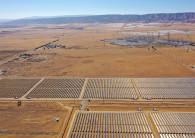
Aerial View of PetroSun’s Texas-Based Algae Farms


Seambiotic, an Israeli firm, uses raceway/paddle-wheel open-pond algae cultivation growth fed by C02 flue-gas from a nearby IEC power plant. The company uses genetic optimization and has teamed up with Inventure Chemical to turn the algae into fuel.

Seambiotic’s Raceway Open Ponds

XL Renewables, formerly XL Dairy Group, of Phoenix, Arizona, is developing an algal production system using dairy waste streams and attempting to integrate and co-locate dairy production, algal production, and biorefineries producing ethanol and biodiesel.

XL is focused on biomass production more than biofuels – using a semi-closed system based on a farming model and a farming mentality – making use of agricultural and irrigation components. Their trough system uses a greenhouse-type process to cultivate algae in 18-inch deep, 1,250-foot long plastic-lined troughs with aeration and lighting integrated along the six-foot wide troughs.

A plastic cover (also called plastic mulch) can extend their season from six months to 240 days. They apply and retrieve the solar cover with low-hp tractors resulting in a low labor cost – one man and one implement can service 160 acres at a claimed capital cost of $35K/acre.

Oil extraction is not necessary in XL’s case as it wants to produce high omega-oil content algae biomass for animal feeds. Ben Cloud, XL’s COO, believes that we are starting to see protein shortages and that the consumption of soybeans and corn has created an imbalance in our diet which algae omegas can mitigate.

Harvesting is accomplished via a simple flocculation system in a weir tank. The design is expected to provide an annual algae yield of 300 dry tons per acre

XL Renewables is developing a 400-acre integrated biorefinery in Westen Arizona that combines a dairy operation with a biofuels plant to produce ethanol, biodiesel, milk, animal feed and compost fertilizer. The biorefinery would use the dairy manure and other waste streams to provide all of the power, heat and steam requirements of the project.

Diversified Energy Corp. has licensed this technology from XL Renewables under the name Simgae for simple algae.

This is a small excerpt from the April issue of the Greentech Innovations Report, which dives deep into the algae pond. You can subscribe to it here.

Eric Wesoff 04 23 09, 12:38 AM

Algae Oil Harvesting Breakthrough From OriginOil?

Algae cultivation for biofuel applications is full of promise and hype.  Until one of the many companies working on the puzzle solves the cost issue -- algal biofuels remain a well-funded science project.  But now, OriginOil might have solved a few pieces of the cost puzzle with new lighting and new extraction technologies.

Harvesting oil from algae is an expensive and difficult challenge.  Algae must be separated from its growth medium -- water -- and the lipids in each algae cell must be extracted.  Companies are researching a variety of ways to filter the algae from water and to liberate the lipids from the algae -- ranging from chemical catalysts to bioconversion.

OriginOil (OTCBB:OOIL) is a small cap early-stage algae farmer looking to use their Helix BioReactor to evenly illuminate algae and create large amounts of biomass.  They recently signed a CRADA with the DOE's Idaho National Laboratory and hope to use ultrasonics and microwaves to crack algal cell membranes.

The firm's process combines electromagnetism and pH modification (using CO2)  to break down cell walls, and release the oil within the cells. Algae oil rises to the top for skimming and refining, while the remaining biomass settles to the bottom for processing as fuel and other co-products.

According to the company, in less than an hour, the oil, water and biomass separate by gravity alone and unlike conventional systems, no chemicals or heavy equipment are used in the one-step process.  No initial dewatering is required.

If OriginOil’s claims are true -- it might be on its way to bringing algae fuel pricing to “pump parity,” the only metric that really matters in bringing this technology to commercial reality.

The April issue of the Greentech Innovations Report dives deep into the algae pond.  You can subscribe to it here.

GTM Research Blog

The GTM Research blog provides brief and frequent market analysis provided by the GTM Research team of analysts. It covers everything from analyst perspectives on greentech market events, insights into existing and future research, posts based on select analyst briefings and vendor meetings, and insights from conferences and other industry events.

.