Eric Wesoff | November 19, 2009 at 4:06 PM

Following the Money in Smart Grid

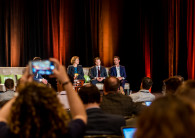
Camille Ricketts of Venture Beat moderated a panel on VC investment in smart grid at the Greenbeat event this morning.

Here are a few notable observations and quotes from the investors on the panel.

Peter Wagner of Accel Partners:

  • He's very interested in the issues in the charging and control of EVs.
  • He encourages entrepreneurs to find customers who are not the utility – go direct to a consumer.
  • Wagner is looking for the company that looks like Opower meets Playfish – bringing social networking plus energy monitoring direct to the consumer
  • "Wouldn't be surprised to see Cisco acquire Silver Spring Networks – although Cisco is probably tired of being extorted in the M&A market." (See Tandberg.)
  • The negative with government smart grid funding is the risk of "false positives" – chasing pools of dollars that seem to exist but are really a mirage.

Don Wood of DFJ on greentech exit action in China:

  • Wind turbine blade manufacturer "Tang Energy will go public" and I think you will see an EV company go public in 2010."


Eric Wesoff | November 19, 2009 at 12:39 AM

KP’s John Doerr on Greentech: ‘The Largest Economic Opportunity of the 21st Century’

Introduced by Venture Beat's Matt Marshall as "The best known investor in Web 1.0, involved in the founding of Amazon, Netscape, and Google," John Doerr and his firm, Kleiner Perkins, have raised a billion dollars to be channeled into greentech. 

"Greentech could be the largest economic opportunity of the 21st century," said Doerr.

Speaking at Venture Beat's inaugural Smart Grid event in San Mateo Calif., he offered his usual thoughts on greentech governent spending, the daughter Mary story ("Your generation created this problem you better fix it.") but he did add some interesting quotes:

  • "The internet is a $1 trillion economy. Compare that with the energy business, a $6 trillion dollar economy."
  • "The super grid is going to be the last great network we buid in our lifetimes."
  • "Google took about $25 million to get to IPO," he said. Doerr compared that to Bloom Energy which has taken $350 million. "There is so much capital required to grow a great green company."  Bloom, which "has substantial revenues and orders required ten times as much capital – and we are seven years into Bloom. I wager nine years to a successful public offering."
  • "Advice to investors: Don't count on additional government incentives."
  • "In green in particular we have woefully underinvested."
  • "My lesson about policy is not to argue about your self interest.  Make an argument that's bigger and about jobs or competitiveness – and you're going to change a few minds."
  • "Energy is the the sum of all lobbyists."
  • "If we had foreseen the crash, we might not have invested in green."
  • He had three suggestions for carbon: "Put a price on carbon, put a price on carbon, put a price on carbon. It will be a signal to have private investors move their capital to low carbon energy."

Kleiner Perkins' cleantech investments include Bloom Energy (Fuel Cells), MiaSolé (CIGS PV), Solexel (3D Silicon Cell PV), Alta Devices (Stealth PV), Ausra (Solar Thermal), Altarock (Geothermal), Fisker Automotive (EVs) and several others.  Their smart grid investments include Silver Spring Networks and Hara Software.

* * *

Here's an interesting thing about VC investment in smart grid: Investors talk about it a lot but the numbers are low. It's a bit surprising to see the small proportion of smart grid deals relative to VC in greentech as a whole:


So are VCs talking and not diving in? Are they looking to see the outcome of Silver Spring Networks' utility roll-out? Are we only in early days? 

Or will these initial forays into Advanced Meter Infrastructure and Home Energy Networks give way to a bigger and steadier wave of other smart grid technologies like Vehicle to Grid, EV charging stations, data management and analytics, network optimization tools, and independent energy storage operators?

The next few quarters will tell. Smart people in Greentech Media's smart grid practice see a new smart grid innovation and investment wave about to break.

Eric Wesoff | November 6, 2009 at 11:47 AM

Optimism in Venture Capital and IPO Outlook

Always On previewed its December Venture Summit with a breakfast at the offices of Wilson Sonsini Goodrich & Rosati (WSGR) this morning where it examined trends in finance and the VC outlook for 2010.

Tony Perkins runs Always On, christened Silicon Valley the "Athens of the Information Age." He asked the panel "if the economic recovery is real?"

Doug Merritt of SAP is in charge of sales to SAP's largest clients  (SAP will have revenues of $14 billion this year) and gave a 30,000-foot view.  "People were so panicked at the end of 2008, they didn't even know how to act," he said. But now "the largest organizations I deal with are actively investing." On the Greentech front, he detailed how Cisco's travel budget has dropped from $750 million to about $250 million, not because the company has reduced travel so much but because it has massivly increased meetings via telepresence.

Mark Reinstra of WSGR spoke of the IPO climate: "There have been ten VC-backed IPOs in 2009, but from an informal survey within the firm, we've seen many more companies preparing for IPOs just within WSGR."  The litmus test remains that a company needs $30M to $60M annual revenues to IPO." 

Ted Smith of Union Square Advisors said: "There's a lot of stuff coming in the top of the funnel but as far as actual M&A exits – it's a very high bar."

Jim Anderson of Silicon Valley Bank (SVB) works in the analytics group, and specailizes in valuations. "There is no question that valuations have dropped precipitously," he said, adding that there is a disconnect between the state of the economy and the multiples and valuations in the stock market.  He likened the state of the economy to a near-comatose patient on pain killers.  Unemployment goes to 10.2 per cent and the Dow jumps. "The U.S. economy is driven by consumer savings but consumers are hunkered down," he said. Anderson certainly sees significant growth from 2009 to 2010.

"But the little corner of the world that we operate in – the world of VC – innovators will continue to innovate. Adverse environment can actuallly produce the best start-ups," he said.

Sandy Miller, a veteran VC at Institutional Venture Partners (IVP) is "much more optimistic" than Anderson of SVB. He believes that "the financial markets almost invariably precede the recovery by two to three quarters. The financial markets have already recovered. There's an appetite for IPOs from institutional buyers, adding "The actual paramenters to go public have been virtually the same for the last thirty years." He also noted that "2010 will be a reasonably active year in the IPO market," and that "when the IPO market rises the M&A market responds as well." 

"Greentech company valuations are twice what we would expect for other sectors," he said. (Which is why he's staying away from those investments.)

"It's a great time to be an investor," Miller concluded.

Eric Wesoff | November 4, 2009 at 3:12 PM

GTM’s Networked Grid Event Packs the House

SAN FRANCISCO -- Smart Grid is the energy theme of the moment – hundreds of millions of government funding, billion dollar smart meter deployments, and hundreds of millions in venture capital have drawn the attention of entrepreneurs, utilities, and corporate behemoths like Cisco, Intel, Oracle, ABB and Silver Spring.

And almost 500 of these smart grid cognoscenti converged at the PG&E Auditorium in San Francisco to assess the state of this nascent many-faceted industry at Greentech Media's The Networked Grid event.

Rick Thompson, GTM's fearless smart grid leader, kicked off the event with a review of some recent industry polling. Here a few tidbits:

  • Utilities view the benefits of the smart grid as a reduction in peak demand, energy efficiency, and an increased visibility and control.
  • As for energy storage, utilities are planning to deploy pilot energy storage systems but there remains lots of uncertainty in storage and many smart grid areas.
  • The major concerns for the utilities are back-end management and data management (clearly an opportunity for startups) as well as regulatory issues.

David J. Leeds, GTM's smart grid analyst, introduced the Real World Deployments and Policies: 2010 to 2020 panel. What follows are some of the more interesting quotes from the speakers.

Thomas Bialek, Chief Engineer, Smart Grid SDG&E:

  • "Smart grid is not a revolution, it's evolution."
  • "In California, we've been very progressive in our utility networks and smart grid is just a furtherance of those activities."
  • "Will the utilities be the gas station of the future?"

Erfan Ibrahim, EPRI:

  • "The rumor is that the grid is antiquated – that rumor is coming out of Silicon Valley and it's not true."
  • Our grid has already been made intelligent "the challenge is we don't have a way of internetworking these nodes, we need a cost effective way of interconnecting already intelligent sensors."
  • On cybersecurity: "We need more than just a big wall  we need successive challenges to the hacker. Think of grid cybersecurity in a systemic way. It's sophisticated and needs to be done with diligence."
  • "Pool pumps, water heaters, AC and thermostats are the items that utilities would like to control in order to tackle peak demand."
  • Amongst the many critical issues with the smart grid are: "Who owns the data and who has the right to use the data collected by the smart grid?"

Andrew Campbell, Senior Energy Advisor, CPUC:

  • The biggest challenge in the smart grid is considered the regulatory aspect, at least in the eyes of the utilities.
  • PG&E, SDG&E, and SCE will deploy 12 million advanced electric meters and five million gas meters by the end of 2012. (That's almost 15,000 meters a day!)
  • There is no specific smart grid related regulatory framework for these deployments.

Kevin Dasso, Senior Director, Smart Grid Strategy at PG&E:

  • "What does PG&E think of when we think smart grid? The simple explanation: An overlay of intelligence and automation over the existing grid – wires and substations – to offer new services and features. It can enable new services and features – uptake of renewables, bill management, and reliability."
  • "There is a lot of excitement but excitement can be fleeting – we need to strike while the iron is hot. There will be some kind of half-life – so strike now."
  • "Build customer awareness and expectations early. Plugging in a smart meter doesn't automatically reduce a customer's bill."
  • Standards and roadmaps can make or break the success of the smart grid. Smart grid is a journey and we really need a roadmap to guide that journey."
  • "There will be features ten years from now that we have no idea that could be done."
Eric Wesoff | October 29, 2009 at 7:01 AM

The Next Wave of Smart Grid Funding?

Smart grid has been the buzzword on utility, entrepreneur and investor's lips in 2009. 

Funding the smart grid has certainly been on the Obama administration's agenda – as evidenced by the billions being funneled into this sector (see Jeff St. John's pieces about the winners and losers in this contest).

Venture Capital investors have been talking about smart grid investments for a while now. Foundation Capital's Steve Vassallo even authored a "Smart Grid Manifesto" to "help drive a single point of view across our four Smart Grid portfolio companies." Vassallo writes, "Smart Grid and smart pricing together answer the riddle of how you get market forces to make a difference in a monopoly environment." 

Foundation's smart grid investments include EnerNoc, Silver Spring Networks, eMeter and Control4.

Another theme amongst VC investors in 2009 has been the capital efficiency of smart grid plays. In other words: Don't expect too many Solyndra or Nanosolar-magnitude deals from the VC community in 2009 or 2010. 

That said, in looking at the numbers, although funding in smart grid is recovering:


It's a bit surprising to see the small proportion of smart grid deals relative to VC in greentech as a whole:


So are VCs talking and not diving in?  Are they looking to see the outcome of Silver Spring Networks' utility roll-out? Are we only in early days? 

Or will these initial forays into Advanced Meter Infrastructure and Home Energy Networks give way to a bigger and steadier wave of other smart grid technologies like Vehicle to Grid, EV charging stations, data management and analytics, network optimization tools, and independent energy storage operators?

The next few quarters will tell. Smart people in Greentech Media's smart grid practice see a new smart grid innovation and investment wave about to break.

Eric Wesoff | October 28, 2009 at 8:07 AM

Bloggage From SPI, Part 2: A Hopeful CPV Panel

I moderated a panel on Tuesday on Concentrating Photovoltaics (CPV) at the Solar Power International show in Anaheim.

I am an unlikely choice for the CPV moderator role as I have not always heaped praise on the CPV industry (see here and here). 

But I kept an open mind, and our panel explored the progress that CPV has made and the challenges that lie ahead.

Our panelists:

  • Mark Crowley, President and CEO, SolFocus 

Jerry Bloom, a longtime energy and renewables attorney at Winston served as a reality check – reminding us that solar competes with 4 cent per kilowatt hour coal and cheap nuclear power. And that renewables face an uphill battle in making inroads in the dominant energy energy mix.

But the CEOs of these CPV firms, selected for this panel because they are on the cusp of full-scale commercialization, are driven and optimistic and they made these points:

  • CPV is just at the beginning of its cost curve.  Concentrix' Lerchenmüller sees CPV achieving costs of 30 cents per Watt in a few years.
  • CPV with high-efficiency triple-junction solar cells behaves better than silicon in high temperatures.
  • CPV doesn't require water like CSP and unlike CSP scales to smaller deployments.
  • Notably, the price of capex for CPV is much less than that of other PV technologies: $0.10 to $0.15 per Watt compared to First Solar at about $1 per Watt and a-Si at about $3 per Watt.
  • CPV, at least for these three firms, is becoming a "bankable" and credible technology.

NREL CPV expert Sarah Kurtz noted that the anticipated timeline for CPV has been far exceeded with Energy Innovations and the company's 1200 sun system claims a module efficiency of 29 percent. 

All of the CEOs expected the prices of the solar cells to drop. Lerchenmüller spoke of the parallel between those cells, which are essentially LEDs, having to follow the falling price trajectory of LEDs whether they come from Emcore, Spectrolab, Azure Space or one of the newcomers like Cyrium or Solar Junction.

And impressively, between the three CPV firms on the panel – there is the potential for almost 100 megawatts of factory capacity within the next year.

These firms still face the competitive challenge of plunging silicon costs and the difficult financing environment.   But, of the more than 45 VC-funded CPV firms, many of them doomed, these three hardy firms have a decent chance of surviving and succeeding.

Eric Wesoff | October 27, 2009 at 3:17 PM

Geothermal From GreenFire: The Lowest Cost Energy (+ CCS)

"CO2-G [CO2 Geothermal] is projected to have the lowest cost of any form of energy and is the only source of energy that permanantly sequesters carbon."

Those are the words of Mark Muir, co-founder of GreenFire Energy, a startup with an innovative twist on geothermal energy. 

Conventional geothermal energy entails tapping a heat source at relatively shallow depths and capturing the heat as steam to turn a turbine. Enhanced Geothermal Systems (EGS) create geothermal energy in hot dry rock by sending pressurized water down an injection well. Water travels through fissures, capturing the heat of the rock when it is forced out of a second well as hot water, which is then converted into electricity via a steam turbine or a binary power plant.  The cooled water is sent back into the earth to heat up again.

GreenFire dispenses with the water and instead uses carbon dioxide as the geothermal "feedstock."

"Geothermal ends up with the lowest cost – but conventional geothermal has big cooling towers and pumps. Hopefully we can get away from all that," adds Muir.

He projects that Carbon Dioxide Geothermal (CO2-G) can have a lower LCOE than any other scalable form of energy.

According to the CEC (California Energy Commission), there are 43 operating geothermal power plants with an installed capacity of about 1,750 megawatts in California, almost two-thirds of the United States' 3 gigawatts of geothermal generation. Geothermal energy production in the U.S. is a $1.4 billion industry – far bigger than the U.S. solar market.  And unlike solar, geothermal power is baseload power – available 24 hours a day, 365 days a year. Iceland gets over a quarter of its electricity from geothermal sources.


GreenFire's CO2 can come from natural sources or from the emissions of coal plants.

One of the largest natural deposits of CO2 is located in the the St. Johns Dome, a region extending across Arizona and New Mexico. It is a perfect site for GreenFire because it has the CO2 resource, a thermal reservoir, access to transmission lines and there are two power plants right at the dome and four more within a 200-mile radius. GreenFire is in a joint venture with Enhanced Oil Resources, the company with the leases to the CO2.

So, in addition to producing low-cost geothermal power, CO2-G can actually find a use for the carbon captured from coal plants.

This is important. Coal provides 50 percent of the U.S.'s electricity and according to EPRI, The Electric Power Research Institute – coal is here to stay. EPRI predicts that coal will continue to dominate our electrical production. But in order to meet any carbon legislation, it's going to have to be coal with carbon capture and sequestration (CCS). 

The U.S. DOE will be making $55 million available to develop advanced carbon capture technologies at existing power plants. An economical technology for CCS has not yet emerged. 

Although not involved in reducing the cost of carbon capture, Greenfire believes they can save up to $25 per ton in total CCS costs (which are predicted to be in the range of $40 to $80 per ton once the process becomes commercial). The energy for for carbon capture could be a third of the plant's output. CO2-G essentially provides the power for the Carbon Capture.

We covered available CCS technologies such as membranes, solvents, solid sorbents and condensed-phase capture in an article earlier this year.  

GreenFire has the option of harvesting the kinetic energy from the wellhead. Since CO2 expands much more than water – it creates a highly pressurized situation.  That expansion's kinetic energy can be harnessed by a new type of energy transducer, the "free piston linear alternator," from the likes of Greenwell Renewable Power.

GreenFire is a small company and is looking for funding.  Muir estimates that he'll need about five years and substantial backing to put together a demonstration site. "It's not inconceivable for the money to come from smart VCs" but the likely source would be funding from the coal industry, "because its a matter of life and death in a carbon constrained world," according to Muir. 

Muir estimates that 5 percent of the world's coal plants might be eligible for the GreenFire CCS technique.

GTM Research Blog

The GTM Research blog provides brief and frequent market analysis provided by the GTM Research team of analysts. It covers everything from analyst perspectives on greentech market events, insights into existing and future research, posts based on select analyst briefings and vendor meetings, and insights from conferences and other industry events.

.