
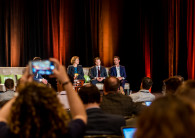

Am en route back to Boston from the Clean Tech Investor Summit, which took place in an incredibly soggy Palm Springs, necessitating a lot of diverted and canceled flights.
Despite the problems participants had getting to and from the event thanks to freakish weather, it remained the very well-attended, hyper-networking, content-laden event I remembered from the last one I went to, four or five years ago. A great event for catching up with fellow cleantech investors on the left coast (and not a few east coasters made the trip out as well). I will attend again for sure.
A particular treat for me was that a lot of the content was somewhat of the "life goes full circle" variety, hearkening back to my days in the "business sustainability" world as a young researcher at the World Resources Institute. Met up with a former colleague from WRI, got to say hi to one of my favorite pundits and experts in the business Joel Makower (who was actually the original inspiration for this blog, nearly five years ago), and got to hear from some of the visionary leaders who had been among the original inspirations for the "green is good business" type of research I did way back when -- including Amory Lovins, and Ray Anderson of Interface.
So I was shocked to then see tonight that Ray Anderson has announced he is going into treatment for cancer. Over a decade ago, when CEOs were only paying lip service to green business practices, Ray and Interface were re-defining their entire business in ways that reduced waste, improved the company's profits, and launched them into a leadership position in their market segment, all by taking green business practices very seriously. The Interface example -- along with other early examples of profitability from green thinking -- were why I went off into the business world with entrepreneurial intents.
Let me tell the story in overly short form, and as I remember it (so: it may not be 100% true, but it's pretty close): Interface was an industrial carpet company. Like other industrial carpet companies, they viewed their business as selling carpet. That's it. It was a highly competitive, low margin industry where differentiation among competitors was difficult. In having to think about the company's environmental vision for a speech, Ray began reading The Ecology of Commerce by Paul Hawken (another formative figure for me). And Ray had an epiphany -- that all the massive amounts of waste being produced in carpet manufacturing was financial waste as well... and as this insight triggered more sustainable-minded thinking at Interface, they began to redefine themselves as not being carpet manufacturers, but instead as being in the service business, providing floorcovering for their customers. So began Interface's really signature effort -- modular carpet squares, enabling not only for customers to keep new-looking carpet all the time without replacing entire carpets, but also allowing Interface to take back worn carpet and better recycle it into new product. Interfaces revenues grew. So did their margins. And customers were happier for it.
If you want to see what we were thinking about this and other examples of win-win green business leadership a decade ago, you can find more here. It's a bit outdated by now, but the principles are still sound.
1. Environmental responsibility can be important preserving the right to operate. At very least, avoid acting so environmentally irresponsibly that your company gets hammered in the court of public opinion (or for that matter, real courts).
2. Pollution and discarded materials = waste and financial cost. Companies pay for inputs, and increasingly often they pay for waste disposal. So any pollution and waste reduction goes straight to the bottom line, even if the products and services don't change. And this isn't just true inside your company, you have to look at the entire supply chain and downstream customers.
3. Look for opportunities to increase revenues by greening your products and services. It can be a good differentiator that helps capture market share. Just ask any real estate developer how they feel about LEED certification these days...
4. Redefine your entire business about what the customer really wants -- and find other ways to satisfy those needs that are on the right side of natural resource trends. In other words, get out in front of the inevitable Schumpeterian creative destruction that's going to happen (or is already happening) to resource-intensive industries and business practices.
These days, most companies get #1. Many now get #2 (which is progress from back then). Increasingly, #3 is something some companies are taking seriously. But #4 remains untouched by most large companies...
The really great thing about having since moved into the world of cleantech venture capital and private equity, is that now I get to support entrepreneurs who are jumping straight into #4. The startups that will end up grabbing market share from those current corporate giants who quickly are becoming corporate dinosaurs. And I never would have ever headed in this direction if it weren't for inspirations including (but definitely not limited to) Paul Hawken, Amory Lovins, Joel Makower, Matt Arnold, and yes, Ray Anderson. Some of those guys won't remember me... but I sure remember them, with gratitude.
So please join me in sending best wishes to Ray.
Rob Day is a Partner with Black Coral Capital, based in Boston. He has been a cleantech private equity investor since 2004, and acts or has served as a Director, Observer and advisory board member to multiple companies in the energy tech and related sectors. Rob was a co-founder of the Renewable Energy Business Network (www.rebn.org), a non-profit organization which was acquired in 2009 by the Clean Economy Network. Rob continues as a member of the Board of Directors of the Clean Economy Network Foundation. The views expressed on this blog are those of Rob and his friends and colleagues, not necessarily the views of any of his colleagues and affiliated organizations. Contact Rob at (JavaScript must be enabled to view this email address).
0 Comments