
Back in 2003, a colleague named Declan McCullaugh and I debated the future of search and whether new companies could upend Google the way Google upended Yahoo. He blurted:
"Google is the new Intel."
You could no longer think of Google as a software or Internet company, he continued. The company's secret sauce lay its massive data centers. Data centers didn't cost as much as a new semiconductor fab, but they still cost hundreds of millions to build and even more to operate over time. 1.5 percent of the power in the U.S. gets sucked into them. Any company that wanted to achieve the same sort of results with search or mapping would have to contend with that massive back-end. Even if Google's algorithms weren't as good, it could win through brute force, just as Intel could always out-manufacture AMD.
It was a somewhat radical idea back then, but events have proved the idea right. In fact, Google's infrastructure has become a looming liability. It has to keep building to stay ahead and meet customer expectations, but real estate, energy and hardware budgets continue to escalate.
And that data center explains why Google will ultimately become a utility and/or energy services provider. Controlling power consumption in commercial buildings, industrial sites and homes is largely a task that should be handed off to large computer rooms.
Now, you turn off the lights. In the future, temperature and occupancy sensors will flip them off for you as well as adjust the thermostat. Additionally, your daily habits will get analyzed by computers and cross-checked against computerized building simulations and a live feed from the national weather service to ensure you're saving as much as you can. You're too busy to tinker with the air conditioner, after all. Let NORAD do it.
Who better than Google to handle this sort of continuous, complex processing? In fact, you can think of building management as a variant of the personal preferences you already entrust to the company. That picture, by the way, is a shot of a storage device built by Google founders Larry Page and Sergey Brin to test out their early work. It's in a glass case in the Gates Building at Stanford University. It just shows what you can do with a great idea and a box of Legos.
Providing these services will allow Google to better leverage its hardware resources. Search will get cheaper because the hardware budget can be amortized over more services. Both Web 2.0 companies and energy services companies will complain about being undercut by the big G. Consumers would also have to get used to Google having even more information about their daily habits.
But can Google charge for management services? That could be a challenge. Americans live for free. (Francis Scott Key wouldn't have gone far if he wrote 'Home of the Brave, and Ten Percent Off!'). The average person might rightly balk at suddenly being asked to write a monthly check to one of the biggest companies in the world, particularly if other companies offer the same services.
This is where the utility part comes in. Consumers will pay for power. If Google combines its services -for free-with competitively priced electricity, consumers will lose that reticence. It will be a better combination than what their utility can provide. Matt Marshall at VentureBeat has said that utility execs he has polled worry about Google getting into their business.
Conversely, Google could charge for these services the same way energy services companies like Siemens do: if Google saves you $200 on your utility bill, you pay them half. You pay, but you save.
Personally, I don't know when or if Google will go forward with this strategy. I am making it up and I live in what most millionaire Google employees would probably consider abject squalor. A shift into energy would also shift the company off the pinnacle of hipness. Energy management is dull. How many times have you bragged about knowing someone that works at Johnson Controls? Or read stories about the gourmet food served at the Honeywell cafeterias. Forget an in-house hair stylist: welcome to comb-over city.
Still, the pieces seem to fit. Back in the early part of the decade, Brin and Page began investing personally into energy start-ups like Nanosolar. The company's charitable arm then began to invest in energy start-ups. It seemed an odd mix: charitable donations to companies bent on making millions. By contrast, the Gates Foundation gave money to Amyris, which specializes in biofuels, not to make money. Amyris also had a promising new malaria medicine.
Last year, Google released PowerMeter, a home energy management console that can be accessed through a personal Google portal. Ed Lu, the former astronaut turned advanced programs manager at the company, denied it wanted to make money.
"We are not trying to build a business model around it," he said.
A few weeks later, Dan Reicher, director of climate change and energy initiatives at Google, told a group of us reporters that Google would start investing in green power plants, the sort of thing that banks and utilities often do.
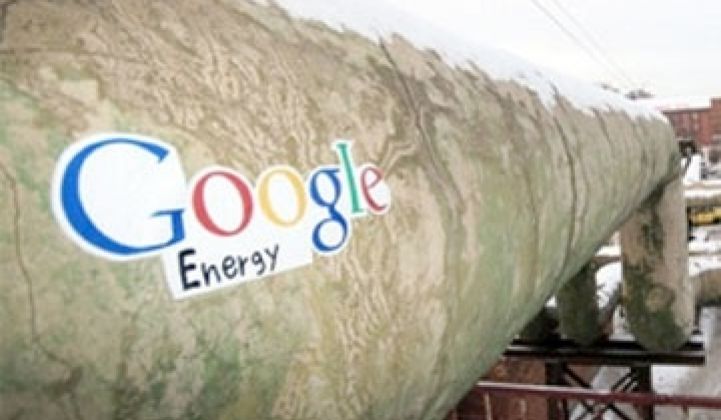
In December, it filed formed a company in Delaware called Google Energy that has applied with the federal government for permission to trade electricity, according to E&E Daily, which broke the story.
After power, the only thing next will be family planning and funeral services.




 41
41
 15
15
 9
9