What Is the Cheapest Energy Storage Idea of Them All?

When it comes to energy storage, an EPRI scientist says simple is best.

Correction: see below.

Researchers and startups might tout flow or sodium batteries, but caves are going to be tough to beat when it comes to energy storage, says Robert Schainker, a senior technical executive at EPRI.

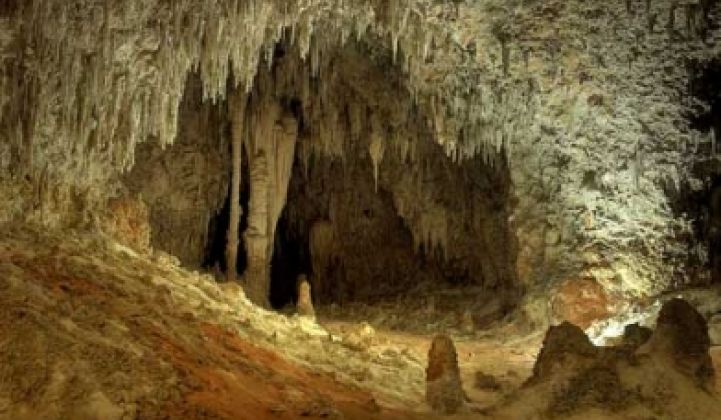
Compressed air storage – i.e., compressing air and storing it in caves, underground aquifers or abandoned mines until the air is needed to turn a turbine – will beat out other mass storage technologies in terms of cost largely because of the relative technical simplicity and the potential volumes for storage.

Compressed air right now costs about $700 a kilowatt/hour, he said. By comparison, Deeya Energy just released its first flow batteries. A 2-kilowatt device costs about $4,000 a kilowatt/hour, says Izak Bencuya. With volume manufacturing, Deeya hopes to lower that to $1,000 a kilowatt/hour.

That is still higher than compressed air. The advantages of air, however, kick in when utilities want to expand their storage. The volume of salt caverns and other underground storage areas can be increased through solution mining techniques.  (You pump liquid solutions underground, it carves out new space, and you suck out the fluid.) An incremental cost of adding another kilowatt/hour comes to around $1 to $2. Electrical devices won't be able to match that, says Schainker.

Compressed air can also be stored at depleted oil fields. If the underground cistern cannot be expanded, the air can be stored at a higher pressure, which will still be cheaper than large-scale batteries.

Finding caves isn't a problem either. There are billions of cubic meters worth of underground salt caverns available, Schainker said. Leaking is more of a perceived than an actual problem, he argued.

Compressed air, of course, has been an idea that has been ready for takeoff for years. Prototypes in Alabama and Germany have operated for years. The Department of Energy, Sandia National Labs, and a host of municipal utilities in the Midwest are in the midst of designing a compressed air generation plant in Iowa. The plant is expected to be operational by 2012 and produce 268 megawatts of power or 50 hours of power storage. That could enough to save a municipal utility $5 million a year.

PSEG Global is also investing $20 million into startup Compressed Energy & Storage.

Correction: we inadvertently used kilowatt instead of kilowatt/hour.


Join industry leaders and influencers at Greentech Media's Green Building Summit in Menlo Park, Calif., June 11.
Comments [7]

  • ken 06/5/09 11:21 AM

    SMES is more economical method for energy storage on a large scale . A new SMES design is being performed which reduce the costs from the previous 1994 designs .

    Reply
  • John L 06/5/09 11:43 AM

    Long time reader, first time commenter.  I really love the coverage you guys provide, and I personally have high hopes for CAES.  But as an engineer working in renewable energy, I humbly ask that you PLEASE keep a closer eye on your units, specifically: kilowatts = power; kWh = energy.  Your assertion that, via cheap solution mining, “the cost of adding another kilowatt comes to around $1 to $2” is misleading and/or false.  Perhaps I’m being overly critical, but it seems that such mistakes would tend to undermine your credibility as an info source in energy world.

    Reply
      • Michael Kanellos 06/5/09 4:10 PM

        That was not well phrased. All of the storage people I talk to these days talk strictly in kilowatt, which of course if shorthand for kwh. Sorry about that.

  • FDDoty 06/5/09 4:43 PM

    Like the previous commenter, I agree that GreenTechMedia is usually better than this -sloppy confusion of units, no new information, and other problems in this piece.  Let me try to help.  As of now the only truly competitive energy storage is pumped hydrostorage in mountainous terrain.  Reality may be setting in on the proposed CAES Iowa Stored Energy Park (ISEP).  It was originally proposed to be completed in 2003.  Drilling of test wells finally started in 2008.  Their current target for completion is 2013.  The facility – as it is currently proposed – will only be able to accommodate the additional load of 280 MW peak, and there’s no real info available yet on how much energy it might store, or what it will really cost, or what the projected peak and mean efficiencies might be…  A recent estimate is $220/kWhr of storage capacity.  Best case storage-cycle efficiency for stand-alone CAES is probably about 54%.  CAES is now usually advocated as being able to help peak efficiency of gas power plants – but do we really need more gas-fueled power plants?  (Read Matt Simmons latest discussion on peak gas.) 

    Energy storage by CAES or batteries probably ranges from $100 to $1500/kWhr. 

    Fortunately, there’s a much better option: store the energy in stable liquid fuels like ethanol and jet fuel synthesized from CO2 and off-peak wind energy.  The tank-component cost of storing energy in stable liquid fuels is only $0.02/kWhr.  There is no better option for storing and distributing large amounts of energy.  The world currently requires 6 PWhr of energy storage (60 days worth) in liquid fuels for our transportation infrastructure to operate smoothly.  That’s about one trillion times the energy storage in a Prius battery, or several million times the amount of energy that might be stored in the ISEP CAES project – a single, 15-year project.

    Enormous progress is being made in efficiently synthesizing WindFuels (hydrocarbons and alcohols) from CO2, H2O, and off-peak wind energy.  With off-peak wind energy at $15/MWhr, these synthesized fuels could compete when oil is as low as $50/bbl.

    Of course, WindFuels still won’t be the best answer for peak grid supply.  For that, the best option will be a novel thermodynamic cycle (called the DORC) that allows a geothermal-CSP hybrid to achieve much higher efficiency during daytime hours than current CSP.  A paper (ES2009-90220) will be presented on this new engine at the ASME Sustainability conference in San Francisco in July.  The abstract is available at the conference website.

    Back to energy storage, there are currently several Gt of dead pines (killed by the pine beetle) covering about 500,000 km2 in North America.  These dead trees will be largely consumed by forest fires over the next 6 to 8 years.  The energy stored in these dead trees is about 3 times more than in the petroleum North America uses in one year.  Harvesting all these dead trees and co-firing them in power plants would result in about 100 times more net GHG and net energy savings than from biofuels (globally) this year. If we really are concerned about climate and energy, we should be insisting that tens of billions of dollars be immediately made available to cut our use of coal in half by burning these trees – as long as this extraordinary (but steadily oxidizing) resource is available. - David Doty

    Reply
      • Michael Kanellos 06/5/09 6:46 PM

        Fuel from CO2? That’s still in the early experimental phase. It is very hard to say if that is a better option if no one is even sure if it can scale and whether it can scale economically. To be honest, those options seem all a lot further off than storing air underground.

  • FDDoty 06/5/09 7:37 PM

    Thanks for the response.  Yes, synthesizing fuels from CO2 and off-peak wind is at a very early stage, but how far away it is depends on resources allocated.  We got to the moon in a decade after we decided to.  The basic physics, chemistry, and proven FT technology present a very strong case for this one being the most scalable of anything yet suggested.  I don’t think it will take long to begin to be widely appreciated, now that the limitations of hydrogen and biofuels are beginning to be better appreciated.

    Reply
  • Bill Woods 06/7/09 8:55 AM

    Storage capacity is now given in “kilowatt/hour”. Power per time would be a ramp rate; it should be power *times* time.

    Reply
.