
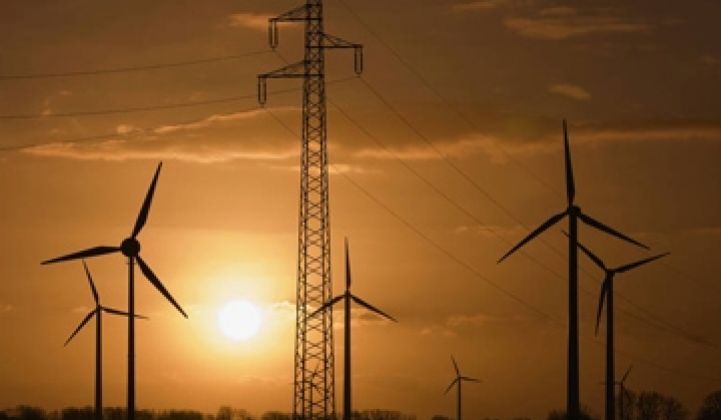
The United States' electricity transmission "grid" is actually made up of three grids – one in the East, one in the West and one in Texas – that aren't connected to each other.
Tres Amigas LLC wants to build a massive triangle of high-voltage, superconducting direct current cables in Clovis, N.M. to connect them. That could allow the three grid systems to buy and sell power – particularly power from big wind farms and solar power plants – from one another.
The company led by Phil Harris, formerly the chief executive of big Mid-Atlantic transmission entity PJM Interconnection, envisions making money by serving as "a renewable energy trading hub" between the nation's three distinct, unconnected networks of transmission grids.
Those consist of eastern and western "interconnections" separated along a line roughly tracking the Rocky Mountains from north to south, as well as Texas, which operates its own grid through the Electricity Reliability Council of Texas, or ERCOT. The few linkages between the three systems aren't big enough to support large-scale power transmission.
The project has the backing of Bill Richardson, New Mexico Governor's and former Energy Secretary under the Clinton Administration, who sees it as a way to link solar and wind power plants harnessing the state's potential 27 gigawatts of renewable power.
Next up, Tres Amigas needs to get approval from the Federal Energy Regulatory Commission to charge for trading power between the three interconnects.
FERC commissioner John Wellinghoff told the Wall Street Journal that the Tres Amigas proposal was a "very intriguing idea," but said it was too early to say if FERC would support the project.
And of course, there's the cost, estimated at $1 billion or more, the Wall Street Journal reported. Tres Amigas is seeking partners for the project.
It already has one – American Superconductor Corp. (NSDQ: AMSC), which said Tuesday it will supply superconducting wire for each of the three 5-gigawatt superconducting legs of the triangular "super-station" Tres Amigas envisions. The Devens, Mass.-based company also said it has invested $1.75 million to take a minority stake in Tres Amigas.
Superconducting cables can carry far more electricity than their traditional transmission cable counterparts, though they need to be cooled with liquid nitrogen to do so. Despite their high cost, superconducting direct-current (DC) cables are seen as a viable alternative for certain high-voltage transmission applications (see Superconductors For the Grid).
American Superconductor is already making superconducting wire for Korea's LS Cable to install in that nation's electricity grid (see Green Light post).
Whether Tres Amigas can raise funding will likely hinge on how the proposal is treated by FERC. Wellinghoff wants Congress to give FERC more authority to fast-track new interstate transmission lines that could help the country meet its goal of getting a much larger share of its power from renewable sources.
That will be particularly important in connecting new wind and solar farms in regions with rich renewable resources – like the windy Great Plains, or the hot and sunny Southwest – to cities on the East and West coasts that need the power.
But making that beefed-up nationwide transmission system a reality will require hundreds of billions of dollars in new investments, according to studies (see Wind Growth Could Cost Eastern U.S. $80B in Transmission Lines).
The scale of the challenge can be seen in California, where state regulators have put a $15.7 billion price tag on linking renewable power plants with new transmission lines (see California Green Transmission Lines Could Cost $15.7B).
The energy bill now before Congress could address that issue. A version of the bill released by Senate Majority Leader Harry Reid, D-Nev., contained language that would give FERC more authority, but the American Clean Energy and Security Act of 2009, a version passed by the House in June, lacked the same level of support for the concept (see Draft Legislation a Boon for Solar, Smart Grid).
That energy legislation faces an uphill battle in the Senate at present, though Republicans who oppose the bill's controversial carbon cap-and-trade provisions have said they may be willing to compromise if Democrats will discuss more support for nuclear power and offshore oil and gas drilling (see Green Light post).
But Wellinghoff has said he'd like to see FERC's authority expanded with or without broader-scale energy legislation (see Green Light post).

Interact with smart grid industry visionaries from North American utilities, innovative hardware and software vendors and leading industry consortiums at The Networked Grid on November 4 in San Francisco.


 41
41
 15
15
 9
9