
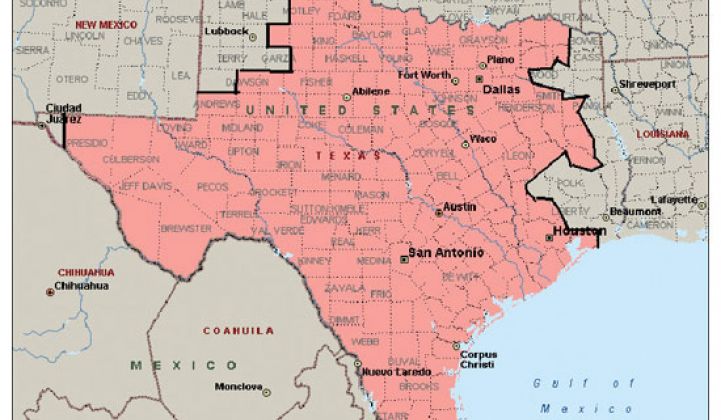
A power producer typically gets paid for the power it generates. In Texas, some wind energy generators are paying to have someone take power off their hands.
Because of intense competition, the way wind tax credits work, the location of the wind farms and the fact that the wind often blows at night, wind farms in Texas are generating power they can't sell. To get rid of it, they are paying the state's main grid operator to accept it. $40 a megawatt hour is roughly the going rate.
For the first half of this year, power producers, mostly wind farms, paid the grid operator to take electricity for nearly 20 percent of the time. It happened 33 percent of the time in March alone and nearly 10 percent in October, said Mike Giberson, an energy business instructor at the Texas Tech University. He recently wrote about this issue in his blog, Knowledge Problem.
The industry parlance for paying someone to take the electricity is "negative pricing." It happens mostly when power producers bid the selling prices in the negative territory because they can afford to pay someone to use the energy.
Why? Wind energy producers get money for generating renewable electricity, but to qualify for these federal tax credits, the generation must be purchased and fed to an electric grid. As long as the money paid to the grid operator to take excess or "unwanted" electricity is less than the federal tax credit, the wind producer can make a profit.
Texas's own state program also allows utilities and power producers to buy and sell renewable energy credits, which has increased the appeal of negative pricing.
With limited transmission capacity, power producers in various places have to compete more fiercely to sell their electricity. But in the Lone Star state, the competition has morphed into a phenomenon not seen in the rest of the country.
"In other places, you might see a few hours of negative pricing here and there, but you don't see days and days in a row," Giberson said. "There are some days in March and April when you have 14 hours of negative prices."
Negative pricing takes place when the grid is congested, prompting energy producers to bid fiercely to sell electricity to the Electric Reliability Council of Texas (ERCOT), the main electric grid operators in the state. ERCOT buys energy at various times throughout the day and night to make sure the grid has a cushion to deal with unexpected demand, such as a hurricane-rendered blackout or when power producers didn't generate enough juice.
On average, ERCOT needs to set aside 5 percent worth of anticipated energy demand at any time. It often buys more than 10 percent, especially during periods of peak demand. Power for the rest of the market, which serves 21 million customers, comes from long-term contracts between electricity producers and utilities.
When there isn't congestion in the transmission system, spot market prices from energy producers from the four regions in ERCOT's jurisdiction should be the same.
That changes when the grid can't accommodate all the energy generated. In one auction in October, for example, the spot market price from producers in north Texas was $34 per megawatt hour while those from the west was $24 per megawatt hour. ERCOT doesn't just buy from the lowest bidder, it has to consider where the demand is and who can supply it promptly.
The competitionno can become so intense that some wind energy producers in the western region are willing to pay ERCOT to take the electricity from their turbines.
Even though the spot market makes up a small slice, its prices will affect the rest of the market, said Dan Jones, vice president of Potomac Economics. The state contracts with Potomac to monitor the power market and recommend policy changes to the ERCOT.
Spot market prices signal the value of electricity, and can be used by retail or wholesale customers to set contract prices, Jones said. In effect, wind energy producers are paying consumers to keep wind turbines going.
ERCOT doesn't tally how much energy and money have flowed its way as a result of negative pricing, said Dottie Roark, an ERCOT spokeswoman.
Which wind energy producers have offered to pay to play? Pretty much everyone, Jones said. Calls to some of the major wind energy developers in Texas, such as FPL Group, weren't immediately returned.
With a boom in wind energy development, Texas will likely to see more negative pricing happening - and for a longer stretch of time. Geography plays a part too. The state continues to experience a dramatic increase to its wind generation capacity in its rural western region. Texas, however, has yet to build enough new transmission lines to carry the energy to urban centers such as Dallas and Austin.
"For the short term, for the next year at least, there is going to be quite a bit of congestion out there," Jones said.
Texas has the most wind energy generation capacity in the country. In November alone, nearly 1.68 gigawatts of wind power generation came online in Texas, bringing the total capacity in the state to about 7.9 gigawatts.
Meanwhile, the transmission lines crisscrossing the ERCOT territory can accommodate roughly 4.5 gigawatts at any time, Jones said. Adding to the imbalance is the mismatch between when people use power and when the wind blows. Wind is most abundant at night and during spring and fall in Texas, Jones said. Power consumption peaks, however, in the afternoon and the summer.
ERCOT has created an ambitious plan to increase the transmission capacity to accommodate about 18.5 gigawatts of new wind power. In September, a group of utilities and transmission operators applied to develop the nearly $5 billion project (see Texas Consortium Seeks $4.93B for Transmission Lines).
State regulators hope to see a lot of new transmission lines in the next four years. Until then, Giberson argues, the generous federal tax credit isn't working as it should.
"You are wasting resources in order to produce subsidized goods," Giberson said. "It shows the subsidies are more than necessary to keep them in business."
Wind power producers would disagree. Some of them also believe that the inadequate transmission system and the negative pricing will curtail wind farm developments. In fact, state regulators already see projects delayed or canceled as a result.
"The market will take care of itself," said Jeff Rhodes, a spokesman for Duke Energy, which began operating a 59-megawatt wind farm in western Texas in recent months. "I don't see how you can make money from just building for the tax credit."
Rhodes declined to discuss negative pricing, adding that Duke aims to minimize having to sell power on the spot market by locking in long-term contracts. Duke doesn't plan to delay any wind energy projects, he added.
For others developers, waiting for a better transmission system will be a better bet.
"If I have a million dollars to spend on a wind turbine, I wouldn't put in wind turbine in western Texas right now. Maybe in two or three years," Jones said.


 41
41
 15
15
 9
9