
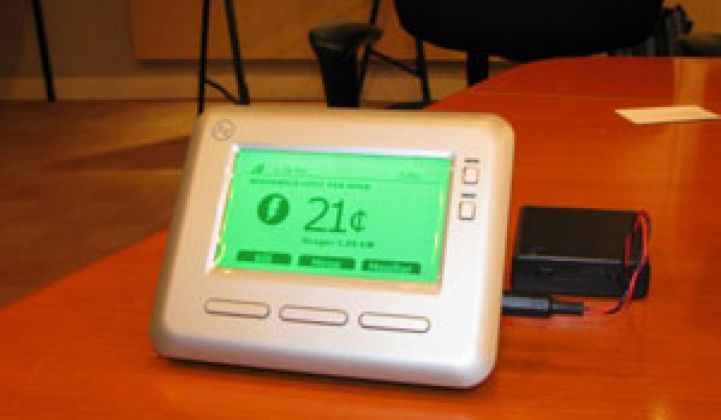
Tendril Networks is creeping in everywhere.
The Boulder, Colorado-based company – which makes Zigbee-based hardware and software for curbing energy consumption – now has signed deals with 29 utilities to test and/or deploy its technology (see In Smart Metering, Watch Out for Tendril). At the end of July, it had 20 deals. Thus, it's seen nearly a 50 percent increase in deals in about four months.
"We are getting a new utility sign up every 10 days or so at this point," CEO Adrian Tuck wrote in an email.
Most of the companies at this point are only testing the equipment in their labs. Nonetheless, one of them will begin a commercial rollout in 2009, according to Tuck. By the end of next year, the utility will be wiring about 5,000 to 10,000 new homes a month.
Ten other customers, meanwhile, will kick off field trials in 2009 involving 100 to 10,000 customers each.
Automated energy management has emerged as one of the fastest growing sectors in greentech. In the third quarter, VCs put more money into energy efficiency and smart grid ($272 million) than in biofuels ($150 million), a reversal in the usual rankings.
Why? Utilities are emphatic that energy efficiency, rather than solar or clean energy production, is their highest priority. Many of the devices for throttling back power to air conditioners, lights and other software also revolve around digital hardware and software, familiar technologies to venture capitalists. And, unlike solar companies, smart grid outfits, for the most part, won't need $200 million to build factories just to get rolling.
Tendril's utility deals are an important metric because power companies will likely play a key role over the next severa l years in determining who makes it and who doesn't. In most cases, the utility will pay the bill and install the equipment. Most people can barely program their digital thermostats and they aren't going to rush out to Home Depot to replace them with demand-response devices. Comverge and EnerNoc, the early leaders in the field, did so through relationships with utilities.
Tendril's equipment is tuned to work with the most popular standard protocols, such as Zigbee. (Tuck actually worked on the low-power wireless standard.). It has also done quite a bit of work on its software interfaces. Tendril's Insight provides homeowners with a visual tally of how much electricity they are paying at any given moment.
When the rate goes higher, the thermostat flashes red. The Insight also provides data on how much power you are consuming compared to similarly situated neighbors. Thermostat and power consumption settings can all be set from a PC. Granted, many other companies such as Threshold and Agilewaves tout similar features, but Tendril has assembled it in a fairly smooth fashion.
Almost every appliance in the house can thrive on less electricity, according to Tuck. Garage freezers, for instance, can be put on a five-minutes-on/five-minutes-off rotation without risking a bout of botulism or freezer burn.
The company charges around $1 per month per consumer to the utility. The actual hardware costs an additional fee, but you can plug in non-Tendril hardware into the system. Consumers can save around $100 a year Tendril has estimated.
Still, victory is far from assured. Although it arguably is the incumbent, Zigbee is far from perfect and could be displaced. Some companies, such as GainSpan, have proposed using low-powered WiFi rather than Zigbee (see Get Ready for the WiFi Thermostat and An Old Favorite – WiFi – Preps to Disrupt Smart Meter Market). GainSpan has also begun to work with GridNet, which wants to connect homes to utilities via WiMax (see The Next Smart Grid Technology: WiMax). Other companies like Sequentric Energy Systems have low-cost systems based on other protocols.
Still other companies, like Greenbox Technology, are avoiding the hardware-software strategy of Tendril and just concentrating on software. And others, such as Trilliant, have signed big deals with companies like HydroOne.




 41
41
 15
15
 9
9