• Friday, March 20, 2009 Latest Update: 11:46AM

Greentech Solar

Solyndra Secures $535M in Federal Loan Guarantees

The solar panel company in California plans to use the money to build a 500-megawatt factory, its second facility for making the unusual tubular thin films.

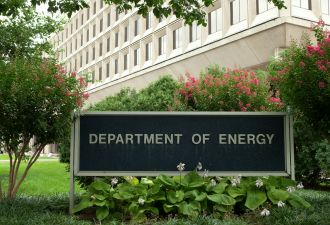
Solyndra said Friday it has received a loan guarantee offer from the U.S. Department of Energy to borrow $535 million for building a new factory.

The Fremont, Calif.-based startup, which makes thin-film solar panels, said it plans to use the loan guarantee to get the money from the U.S. Department of Treasury's Federal Financing Bank. The loan guarantee is coming from the federal Department of Energy, which has has to make sure Solyndra meets certain conditions before closing the deal. 

Solyndra made a splash last fall when it emerged from stealth mode to unveil its unusual technology (see Solyndra Rolls Out Tube-Shaped Thin Film). Each of its solar panels is made up of 40 glass cylinders lined with solar cells, which make use of copper, indium, gallium and selenium (CIGS) to convert sunlight into electricity.

Most of the solar panels on the market today have a flat surface and use crystalline silicon as the key ingredient. Those panels are different than thin-film panels, which make use of a thinner layer of silicon or other types of materials for power production. Thin-film companies say they can make panels cheaper, though their panels aren't able to convert sunlight as effectively as crystalline silicon panels.

Solyndra has a factory at its headquarters for producing the solar cell-lined tubes, and a second factory in nearby Milpitas for assembling all the components into solar panels.

With at least $1.52 billion in announced sales deals, Solyndra needs to boost its production in order to fulfill its contracts. The company said it started shipping last July, and it was reportedly trying to raise $350 million last year but didn't get the full amount.

The company has been planning to build a new factory that would be able make all the equipment and assemble the panels. The federal loan will allow Solyndra to start the construction of this new factory, which is expected to have the capacity to make 500 megawatts of solar panels per year. The company said the loan should make up 73 percent of the project costs.

Solyndra expects to start construction of the factory by the end of the year, and to start producing panels at the end of 2010 or early 2011, said Mike Grunow, a company spokesman.

The new factory construction could provide jobs to about 3,000 people, Solyndra said. The company also expects to hire more than 1,000 people to run the factory.

The company is on a short list of companies applying for loan guarantees from a DOE program that was created by the Energy Policy Act of 2005. DOE said Solyndra is the first one on the list of 16 applicants to get the loan guarantee.


Join industry leaders and influencers at Surviving the Shakeout: Greentech Media’s 2009 Solar Industry Summit in Phoenix, Ariz., April 14–15.

Comments [9]

  • Robb Henshaw 03/20/09 10:28 PM

    Hi Ucilia—Great post. This is great news for Solyndra, but also for the renewable energy market as a whole as it sees government money making its way into the industry. It?s clear that the stimulus package has put federal grant programs in the spotlight as a critical resource for rebuilding our economy due to the sheer amount being invested by our government. This increased visibility for federal grant programs increases the amount of scrutiny the various grant application processes are going to receive, to ensure that these government funds are being given to the most deserving candidates. It also increases the demand for accountability measures to be put in place to ensure that the projects that receive federal funding perform as intended and are held fiscally accountable

    This means that, not only will there be more scrutiny in the grant selection process, but there will be more scrutiny after the fact to ensure that the money is being utilized properly. Prior to awarding grants, government agencies will have more extensive internal control systems and performance measures to facilitate grant management. Agencies will then have more in-depth processes for managing performance once grants are awarded, and the ability to assess grant results and use those results when awarding future grants.

    So what does this mean for those applying for energy grants in particular?

    I would argue that these new policies and requirements will make energy monitoring and management solution a must-have in order to secure funding for energy project. How can you hold anyone accountable for a project if you have no way to monitor, measure and manage the project?s performance?

    That is precisely where open energy monitoring and management solutions like Fat Spaniel ? http://www.fatspaniel.com ? come in (disclaimer, I work with them). Our solutions provide the visibility needed to have complete, actionable insight into an entire energy system ? providing the key accountability data that government agencies will need to see in order to fund projects. Granted, I?m not claiming that energy monitoring solutions will guarantee funding for projects. But in this economic climate, it is no longer enough just to be green. You must show that your renewable energy systems can strike a balance between eco responsibility and fiscal responsibility.

    Reply
  • David Doty 03/21/09 6:51 AM

    Indeed, this is great news for Solyndra executives and some of their employees, but it is not good news for renewable energy.  It is but another example of money being thrown at a bad idea that will never compete.  Solyndra fooled a lot of investors, and now they will squander government money.  Some renewables ideas have merit.  Most don?t.  This is one that clearly doesn?t.  The best recent study on costs of PV is that from Lawrence Berkeley National Labs, Tracking the Sun, Feb 2009.  It shows thin film PV has been more expensive in residential installations than conventional PV.  Our analysis shows the Solyndra approach will be much more expensive than some other thin film options. Take a look at the analysis on the PV page under Alternatives on the windfuels site.

    Reply
  • William Hargett 03/23/09 2:54 AM

    FDDoty you are right.  I´m amazed that there are number of workable manufacturing lines with proven technologies (Optisolar) that are foreclosing.  Meanwhile the US government is underwriting a company with no track record, no substantive demonstration of energy production improvements, and a lot of hot air.

    Reply
  • Andrew Buck-Ackerson 03/23/09 6:26 AM

    Solyndra would have succeeded without this. Imagine how many startups could have been funded with this money. There are thousands of startups out there with great ideas to solve the energy crisis. By giving this money to one company, no only is the government not helping 1000+ startup companies, they could actually be hurting them by solidifying leaders in the market without giving the smaller companies a chance.

    Reply
  • Andrew Buck-Ackerson 03/23/09 6:27 AM

    Solyndra would have succeeded without this. Imagine how many startups could have been funded with this money. There are thousands of startups out there with great ideas to solve the energy crisis. By giving this money to one company, no only is the government not helping 1000+ startup companies, they could actually be hurting them by solidifying leaders in the market without giving the smaller companies a chance.

    Reply
  • Steve Pluvia 03/23/09 12:50 PM

    FDDoty;  How do you know Solyndra won’t succeed?  Do you know their production cost structure?  Do you know their power production stats from any of their multiple install?  Please share or admit you know nothing…

    Reply
  • Steve Pluvia 03/23/09 12:53 PM

    Uci, very interesting that Solyndra was the first to be offered the guarantee…  The information we don’t know about Solyndra was certainly provided to attain this guarantee.  They were competing with some big names for these dollars…

    Reply
  • David Doty 03/23/09 1:13 PM

    You?re right that Solyndra has been quite secretive. But there has been a lot published in their pending patent applications over the past two years and elsewhere.  I?ve tried to piece together what I could, from the perspective of someone with a lifetime of relevant, manufacturing and R&D experience.  Take at look under the PV page under alternatives on our windfuels website.  I don?t see any way Solyndra will come within a factor of two of competing ? probably more like a factor of 3.  I?ll quickly update my comments when they make more information publicly available.

    Reply
  • Norrin Radd 03/23/09 4:02 PM

    I’m sure the Solyndra approach has its merits.
    But if you dig a bit deeper into some of their financials you’ll find that Solyndra has spent millions on lobbyists.  And that’s a better way of getting money out of DC than conversion efficiency.

    Reply
.