
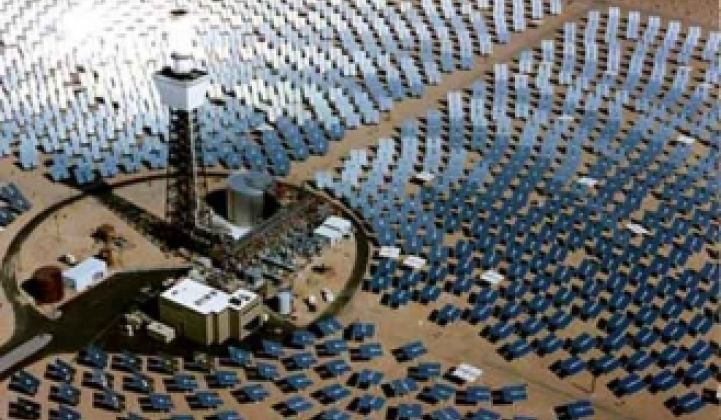
Tower, trough, dish or plate?
No, those aren't your in-flight dining options. These are the main contenders for the future of solar thermal. And the answer as to which one is best is somewhat complicated.
Solar thermal technology is the other white meat, according to Fred Morse, president of Morse and Associates and a senior advisor to Spanish power giant Abengoa. It doesn't get the same amount of attention that solar panels do, but thermal – particularly the large-scale solar thermal plants slated for North Africa or the Southwest in the U.S. – will likely become a large component of renewable portfolios in sunbelts (see No Tax Credit, No Solar Power).
In Arizona alone, there are probably 13,000 square miles of relatively level (less than 1 percent slope), dry, sunny, empty, environmentally OK land that could accommodate thermal plants, says Morse, one of the world's experts on the subject. If built out, those square miles could generate 1,742 gigawatts of power. The Southwest in total has 87,000 square miles of available land that could generate 11,200 gigawatts.
Steve Cowman, CEO of Stirling Energy Systems, puts it closer to 7,000 gigawatts, but that's still big: The worldwide installed base of renewables came to around 140 gigawatts in 2006, he pointed out, touting industry estimates, and that includes biomass and wind. Peak demand in the U.S. is growing by 20 gigawatts a year.
Solar thermal is also an incredibly reliable source of power, because the plants are put into areas that enjoy uninterrupted sunshine more than 320 days a year and can be supplemented with gas turbines.
The two decades-old solar thermal plants in California's Mojave desert "have not missed one hour of peak output in their lifetime," Morse said. "When Mt. Pinatubo blew ash into the sky, they just burned a little more gas."
Last year, California experienced six days of peak demand. The solar thermal plants produced at 110 percent capacity at that time. Wind turbines produced a measly 3 percent.
There are currently plans for 6 gigawatts worth of solar power plants in the U.S. Construction and power production will begin at various sites over the next three years. Another 6 gigawatts to 10 gigawatts could begin in 2010 through 2012 and another 12 to 20 gigawatts of projects could commence in by 2015. Potentially, that's 35 gigawatts of solar thermal by 2020 in the U.S. Typically, it takes four to six years to go from a boardroom decision to the production of power.
"[Solar thermal] will be cost competitive very soon," Morse said.
But which solar thermal system works best? Which will survive?
It all depends. Carbon policy, environmental factors, transmission lines, NIMBYism and inherent technology limitations will all play a part (see Feeding In Renewable Energy Breakthroughs). If you have more than one kid, you don't go around discussing which one will make it to adulthood, do you?
Here's the scorecard:
1. Trough: The classic solar thermal tech. Rows of curved mirrors focus heat onto a tube filled with oil. The oil, which hits 750 degrees Celsius, boils water to make steam, which turns a turbine. Excess heat can be stored in molten salt to run turbines after sundown.
Some power providers are also building trough systems to supplement gas plants. Abengoa is erecting two 20-megawatt solar farms that will connect to larger gas plants in Morocco and Algeria. "You can buy $20 megawatts for $50 million," Morse said.
Disadvantages: The mirrors can only track the sun in one direction, from east to west. The steam also has to be condensed back into water. You need about 800 gallons per megawatt hour, which is a lot of water in the desert. "Ninety-eight percent of the water is for cooling" in a solar thermal plant, he said.
Oh, and making curved mirrors is brutally expensive. What could save trough? SkyFuel, armed with $17 million in VC funding, says it has come up with a trough with a thin film reflective surface to replace mirrors. The film is far cheaper and the frame to support it requires far less metal. "We can reduce the cost by 35 percent," said CEO Arnold Leitner.
2. Heliostats: Made by BrightSource Energy, eSolar and Abengoa. Rather than pass oil over curved mirrors in a tube through a tube, water is placed in a tower in the center of a field of mirrors, or heliostats. The modular nature of the mirrors makes construction easier.
Tower and trough will compete directly against each other, said Morse, but tower/heliostats can operate at higher temperatures.
"Higher temperature will win out and that could be tower in the long run," said Morse. Another advantage for heliostats is that the field mirrors can tilt in two directions rather than just one.
Another big advantage: Heliostats can be air-cooled, or cooled by hybrid systems, which combine air and water cooling, according to John Woolard, CEO of BrightSource. That eliminates a huge part of the water problem. Utilities seem to like it. BrightSource has contracts that could lead to over 3 gigawatts of power plants in California and Nevada in the next several years (see BrightSource Locks Up Nevada Land for Solar Thermal Power and BrightSource Inks 1.3GW SoCal Edison Deal).
Disadvantages: There is limited experience and they towers could be expensive, says SkyFuel's Leitner. Abengoa has some fields in Spain and BrightSource has a demo in Israel. But the big heliostat plants in California are only going up now. Dry cooling can also potentially raise the price of power and make it tough to produce power at peak times, said Morse.
Still, heliostat advocates not that the technology isn't as new as it sounds. The idea was being toyed with back in the early '90s. The industry, however, abruptly went into a coma after the state of California refused to renew a real estate tax exemption.
3. Dish: Advocated by Stirling Energy Systems, these focus solar heat on a Stirling Engine. The differences in air temperature drive a piston. Stirling's 25 kilowatt SunCatcher dishes exhibit a 25 percent efficiency on average and once hit 31 percent, a record for solar. They need only 4.5 gallons per megawatt hour for cooling. A 1.5 megawatt trial station with 60 dishes will start running in Arizona next year. It is working on two projects in California that will total 800 megawatts with a possible expansion to 1,750 megawatts. It wants to put a gigawatt in Texas too. Construction, say advocates, is easier because it's modular.
The problem? Water. The heat transfer mechanism is all in the air. "There is no inherent storage technology," admits Steve Cowman CEO of Stirling Energy. The financial backers of Stirling, however, have taken an equity state in a European company that may have a storage solution. It is also an open question how much a large field of dishes would cost.
4. Plate: Otherwise known as Fresnel lens systems. Heat is concentrated through flat mirrors and lenses onto a pipe filled with water or oil. Like dish systems, these function at lower temperatures. Ausra was the big advocate of this approach but it is moving into providing solar steam and concentrating less on power plants. Still, Ausra recently got $25 million.
"It is really an upscale version of trough," sniffed Cowman.
Ultimately, the lower-temperature plate/Fresnel systems will compete against concentrating PV systems. That lower temperature gives them potentially a wider geographic range.


 41
41
 15
15
 9
9