Slideshow: The Economic Case for Green Building

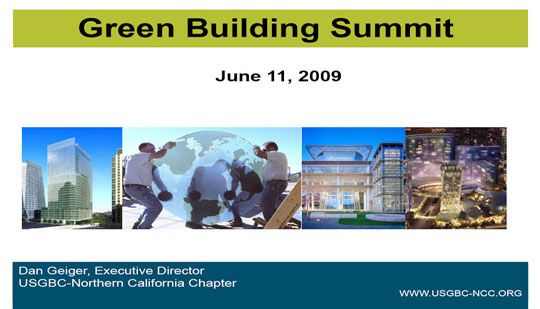
Does it pay to go green? Speaking at a Greentech Media Green Building Summit earlier this month Dan Geiger, executive director of the U.S. Green Building Council, Northern California Chapter, says yes.

Does it pay to go green? Apparently so, according to facts and figures supplied by Dan Geiger, executive director of the U.S. Green Building Council, Northern California Chapter. Geiger, who spoke at the recent Green Building Summit, notes that a LEED-certified building at 100 Pine in San Francisco – which has one of the most aggressive building policies – has saved $228,000 from "going green."

Buildings account for 72 percent of the electricity use and 14 percent of water nationally, while about 39 percent of the office buildings in San Francisco, or 49 buildings, have either started the LEED certification process or have been certified, said Geiger, citing a study by real state company CB Richard Ellis. Of those 49 buildings, 35.4 percent have registered for LEED certification and the remaining have been LEED certified (see Buildings, the Energy Gobblers).

For more check out the slide deck from Dan Geiger's presentation at Greentech Media's Green Building Summit.

Click on the slide below to launch the slideshow:
Comments [1]

  • Dr. Robert Casidy 06/29/09 9:59 AM

    Idling appliances and appliances that are not turned off when unused account for a significant electrical load. It should be possible to build “smart” appliances that turn themselves off when unused.  Alternatively, appliances could incorporate communications technology that allows the power utility to turn off the appliance (including idle power) when it is unused.  Another way to implement this technology might be in a “smart plug” or “smart extension cord” that can cut power to whatever is plugged into it as the power company’s request.  The plug or power cord could come with a customer-selected priority switch that would tell the utility (through the communications device) that the power could be interrupted “often” seldom” or “never”.  Power companies would then be able to shed load more selectively, rather than inflicting brownouts or blackouts over entire areas.  On a continuing bases, such smart appliances might save as much as 5% of the electrical load, perhaps delaying the construction of new power plants.

    Reply
.