
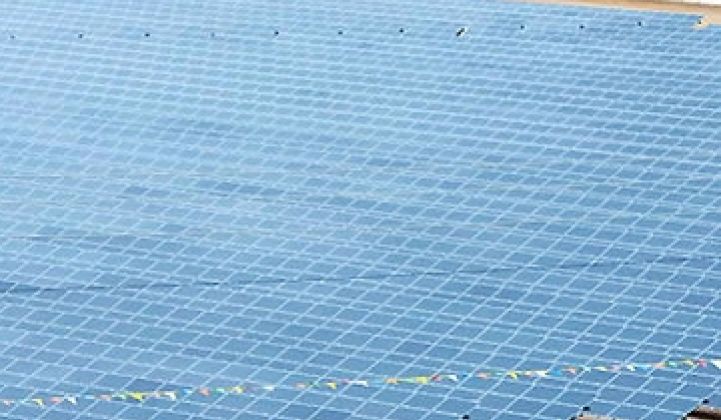
Solar energy installations in the United States are poised to grow about 50 percent annually in the next three years as the country closes in on Germany, the largest solar market in the world.
The U.S. is likely to install 400 megawatts of new solar projects in 2009, and see the growth reach 1.5 gigawatts to 2 gigawatts of new installations in 2012, according to GTM Research's new report released Tuesday.
The strong demand represents over $6.1 billion in investments per year and the creation of 50,000 jobs, GTM Research said.
The report, The United States PV Market Through 2013: Project Economics, Policy, Demand and Strategy, analyzed the scope and financing of power projects by major developers such as Sempra Generation and Renewable Ventures. It also examined policies and demand of big solar states, and detailed the impact of the American Recovery and Reinvestment Act of 2009 (ARRA).
"One of the big conclusions in our report is that the United States is really a ridiculous complex of state markets and utility markets, and each functions pretty much independently from the other, except for some relatively loose common threads," said Shayle Kann, an energy analyst at GTM and co-author of the report.
Like other hot solar markets in the world, government incentives are a big reason for fueling growth in the next few years. Last October, Congress extended a 30 percent investment tax credit for solar installations for eight years. The legislation gets rid of a $2,000 cap for residential installations and allows the utilities to take advantage of the tax credit.
Another booster shot is coming from the ARRA, which has created a host of grants, tax credits and loan guarantees for manufacturing solar energy equipment and installing it.
These federal subsidies, coupled with states' own incentives and mandates for renewable energy installations and consumption, will propel growth for residential and utility-scale projects, the report said. Projects developed to service utility customers will likely grow the fastest, from installing nearly 91 megawatts in 2009 to adding 466 megawatts in 2012, under a conservative estimate.
Twenty-nine states and the District of Columbia are requiring utilities to serve up an increasing amount of renewable electricity. Out of the 29 states, 16 of them (and D.C.) have specified the amount of solar electricity and/or distributed generation in the power mix, according to the renewable energy database DSIRE.
These state mandates have prompted utilities to sign renewable electricity power purchase agreements or start developing their own wind, solar and other renewable power plants.
California has the most aggressive goal, mandating 20 percent of renewable electricity by 2010 for its investor-owned utilities. The utilities aren't likely to meet that mandate by 2010, however (see Cal May Add 365MW in 2009, Still Short of 20% Mandate).
But half a dozen states are seeing rapid growth. GTM Research estimates that new installations in Arizona, New Jersey, New Mexico, New York, Nevada and Massachusetts will grow collectively from 54 megawatts in 2008 to 376 megawatts in 2012.
Increasingly, developers who are benefiting from these state policies are veterans of the power industry, not startup companies.
Sempra Generation, for example, belongs to Sempra Energy, which also owns the utility San Diego Gas & Electric. Sempra Generation developed a 10-megawatt solar farm next to its natural-gas power plant in Arizona and sold the resulting solar electricity to the Pacific Gas and Electric Co. starting in January this year (see PG&E to Get Solar Power For the First Time). PG&E has since agreed to buy power from another, 48-megawatt project from Sempra.
"You really have to have access to large financing channels, and Sempra is an example of that," Kann said. "The project development game is becoming more crowded quickly. Anybody who enters has to be very deliberate about how their strategies line up with the dynamics of the markets themselves."
Although a growing number of utilities are buying or developing their own solar farms, that doesn't mean they are less inclined to buy solar electricity from independent power producers, he added.
"Look at natural gas and coal, where utilities don't necessary have the capital to own every asset they get power from," he said. "You will see the same thing ultimately in solar."
Although many solar companies peg the U.S. as a reigning market one day, it remains to be seen when the country will reach that goal. Germany has become a bright spot in the otherwise gloomy market this year thanks to its generous solar incentives.
The country already has about 1.5 gigawatts of new solar projects from January through September this year, and it could add another 1 gigawatt or more by the end of the year, according to Germany's solar industry association.
Surpassing Germany might take more time than some company executives had foreseen earlier this year. For one thing, the ARRA so far hasn't given solar the boost that some had hoped for.
Although the ARRA spells out a myriad of incentives for solar, many of the programs also award money to projects for other types of renewable energy generation, electricity transmission, energy storage and even biofuels.
Competing for these federal dollars has proven difficult and more time consuming than some companies had anticipated. As a result, the Solar Energy Industries Association is now lobbying for a new legislation that would sweeten and extend some of the incentives for solar only (see Solar Industry Lobbies for Manufacturing Tax Credit, Cash Grant).
Photo via Sempra Energy.



 41
41
 15
15
 9
9