Nuclear Reactors the Lego Way

NuScale Power discusses how it can build a 1-gigawatt nuclear plant with an array of small reactors. And the power will be cheap.

In nuclear, smaller is better, argues NuScale Power.

The company – which grew out of research conducted by the Department of Energy and Oregon State – says that it can increase the safety of nuclear power plants and reduce the onerous construction jobs that go with them by building 540 megawatt to 1 gigawatt nuclear power plants with small, modular reactors that each generate 45 megawatts each instead of traditional centralized reactors that crank out hundreds of megawatts.

Experts who reviewed NuScale's passive water cooling system for the reactors declared that it was "exponentially safer" than traditional systems, said Bruce Landrey, who runs business development for NuScale.

Additionally, modular construction won't force up the price. A 540-megawatt power plant made from 12 of NuScale's 45-megawatt reactors could produce power for 6 to 9 cents a kilowatt hour on average over the plant's lifetime Landrey added.

Assuming that price – which does not include additional incentives or subsidies – can be achieved, small nuclear plants would be competitive with fossil fuel, close to wind and cost less than solar. The average blended price of electricity in the U.S. is 9.78 cents per kilowatt hour, according to the Department of Energy. Wind can cost less than 5 cents per kilowatt hour with credits but descending over time, according to the American Wind Energy Association. Others peg it slightly higher. Solar goes for 11 to 19 cents with subsidies and 25 to 35 cents without. Nuclear can also provide baseline power that isn't subject to the weather.

"Our principal market is the conventional market for providing power to the grid," he said. "We anticipate that the costs will be competitive, perhaps slightly less than the larger [nuclear] plants."

Whether or not small nuclear takes off, expect to hear more about it. Next week, Energy Northwest, a joint venture between utilities in the Pacific Northwest, will release a report about the feasibility of one day deploying modular nuclear plants.

Hyperion Power Generation and TerraPower, two other startups, have talked about installing small nuclear reactors for outlying communities or military bases. Conceivably, these small reactors could be networked into a modular array. Established nuclear companies in France, Japan and the U.S. are also examining modular construction.

It will take time. NuScale currently is preparing its application for design certification. It won't likely submit it to the U.S. Nuclear Regulatory Agency until mid-2011 and it will take about three years for the agency to review it. (There are 104 commercial nuclear reactors that exist in the U.S.)

The first plant built from NuScale's modular reactors, therefore, may not go live until 2018, he said.

Critics, no doubt, will also intensely scrutinize any plans for these reactors. Although public opinion polls show nuclear gaining favor among Americans, strong opposition remains. Investors and banks too will chime in: The nuclear industry has a long history of cost overruns and delays and steel and other raw materials have only increased in price since the 1970s. Nuclear power is one of the cheapest forms of power today, groups like the Nuclear Energy Institute like to point out, but that's because the capital costs of the decades-old plants has been amortized. The 6 to 9 cent figure to many will be like waving a red flag in front of a bull. Like conventional reactors, modular reactors produce nuclear waste too.

Like PCs, the advantages of modular nuclear power plants comes from the fact the core tools – computers or power-generating reactors – are split up. If a problem occurs in one reactor, it can't spread to the others. Ideally, the remaining 11 can continue to even provide power.

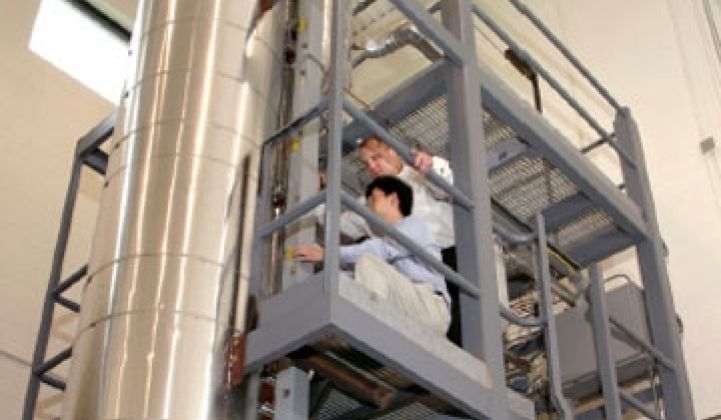
One of the main design advantages is the passive cooling system. The reactor, which measures 14 feet in diameter, effectively sits  inside of a water filled chamber that measures 60-feet long and is constructed out of three-inch thick steel walls. As water passes over the hot fuel, it heats up and rises, drawing cooler water from below. The hot water then cools off and sinks itself.

Traditional nuclear plants rely on an ornate web of pipes and pumps, which can fail. (General Electric and Westinghouse are also proponents of passive cooling.)

"It eliminates a lot of the piping," he said.

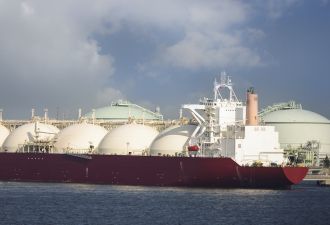
Image via NuScale Power.
Comments [12]

  • Earl Killian 08/21/09 6:17 PM

    The comment “cost less than solar” is unfair. Solar delivers power when utilities need it the most, during the afternoon peak period, when grid operators have to fire up inefficient peaking power plants. It competes quite favorably with peak power prices.

    There are only 2,600 EJ of U235 reserves listed by the IEA (the sum of their categories “Reasonably Assured”, “Inferred”, “Prognosticated”, and “Speculative” with no bound on recovery cost). For comparison, Earth receives about 3,850,000 EJ of sun energy each year.

    2,600 EJ of U235 would not last very long if it provided most of the world’s energy. There is 11,000 EJ at least of Th232, which would be better, but it pales in comparison to sunlight.

    Reply
  • russ 08/21/09 11:56 PM

    @ Earl, Two different ballgames - the reactors are baseline and until storage is practical solar can not be baseline.  Power 8, 10 or 12 hours a day on sunny days is helpful but not going to carry the day.

    With storage you are correct.

    Reply
  • Rod Adams 08/22/09 1:44 AM

    Earl - I am not sure where you live, but in many US utility systems, the peak loads do not actually match solar output. The energy intensity from the sun, no matter how sophisticated the tracking system, varies over the course of the day as a factor of the sine of the elevation angle from the horizon. It is zero at sunrise, about 500 watts per square meter when the sun reaches an elevation of 30 degrees from the horizon and peaks out at 1000 watts per square meter if the sun is directly overhead.

    Peak electrical loads happen between the hours of 4 to 8 pm. That is when the cumulative effects of warming, falling breezes near sunset, and people getting home, flipping on the big screens, the ovens, the water heaters (showering after a hard day’s work) and throwing in a load of laundry combine to spin the meters. Throughout that time, solar intensity is already fallen by about 50% of its peak and ends up at or near zero towards the end of the peak. Unless you can store the energy, you are out of luck.

    Some talk about solar thermal as if that is easy, but they fail to discuss the effects of operating an inefficient steam plant in a hot, dry place where water is very limited. All Rankine cycle steam plants need heat sinks; when the steam plant is operating at the inefficient levels driven by relatively low steam temperatures as the system uses up its stored heat, the amount of cooling required is substantial.

    Finally, your numbers about the U235 reserves are besides the point. We already know how to use both U238 and Th232 as fission fuels. Those are FAR more common, with U238 at about 140 times as much as U235 and Th232 at 4 times the amount of U238.

    Rod Adams, Publisher Atomic Insights

    Reply
  • Earl Killian 08/22/09 8:35 PM

    Rod Adams wrote, “We already know how to use both U238 and Th232 as fission fuels.” I mentioned Th232. U238 has a proliferation problem that the world appears to be unwilling to address, but if we do, it is worth 320,000 EJ, still only 10% of the annual sunshine.

    Ausra claims they have the technology to do 24x365 generation from sun using CSP+TES. Of course, a prototype would be nice (just like a prototype LFTR would be nice for Th232).

    Reply
  • Earl Killian 08/22/09 9:59 PM

    Russ wrote, “the reactors are baseline and until storage is practical solar can not be baseline

    Yes, I was trying to point that out. Peak power is much more valuable than baseline power, so I was pointing out that it was the author’s comment could be seen as misleading.

    I should have pointed out that some CSP companies are talking about prices below 10 cents per kWh which puts it in the ballpark of the 6-9 cents for nuclear. Ausra for example projects around 7-8 cents for 24x365 CSP+TES. Of course I take projections like that (and the 6-9 cents for nuclear) in the context of past projections for new technology.

    Reply
      • Michael Kanellos 08/24/09 11:32 AM

        Solar thermal can be baseline, although it is still subject to weather. (weather a big issue for PV, less for thermal.) The bigger issue is location. You can’t put solar thermal. A 250 to 500MW thermal plant can likely hit parity with fossil fuels. Ausra, though, is mostly now looking at solar thermal for making steam. They did not win the big contracts for power plants.

  • Mark 08/23/09 5:31 AM

    So more investment in 60 year old technology that produces toixic waste, great.  Why can’t we use this money in something that will produce energy where the fuel is free (Solar / Wind / Geothermal)

    Reply
  • Bob 08/24/09 7:07 AM

    “For comparison, Earth receives about 3,850,000 EJ of sun energy each year.”  Most of this energy is already in use—warming the earth; driving our weather system; feeding plants, animals, and ultimately people. 

    People think solar and wind fuel is free, but it is only free if you forget that you need some other form of power to provide backup when the sun doesn’t shine and the wind doesn’t blow.  For every kW of solar or wind you need another plant with a kW of coal, gas, or nuclear to back it up.  So when you build a solar plant plan on building a second plant too (although these backup plants are never, ever factored into the already high cost of solar and wind).

    Reply
      • Earl Killian 08/24/09 3:13 PM

        Yes, we can only use so much energy from the sun. However, what other choice is there long-term? Even fission and fusion cause global warming from simple physics (blackbody radiation).

        If you don’t believe me, check out this journal article http://www.tufts.edu/as/wright_center/eric/reprints/eos__agu_transactions_chaisson_8_july_08.pdf where the authors write, “More realistically, if world population plateaus at 9 billion inhabitants by 2100, developed (Organisation for Economic Cooperation and Development, or OECD) countries increase nonrenewable energy use at 1% annually, and developing (non-OECD) countries do so at roughly 5% annually until east-west energy equity is achieved in the mid-22nd century, after which they too will continue generating more energy at 1% annually, then a 3ºC rise will occur in about 320 years (or 10ºC in ~450 years), even if carbon dioxide emissions end.”

  • Greg 08/24/09 12:32 PM

    Echoing and building on what Bob said nothing is free especially when it comes to energy conversion.  The laws of thermodynamics dictates that there always a price.  For solar it ranges from the hazardous materials and energy used to manufacture the arrays to the shear acreage required to amass a sufficiently large enough array to produce enough power say for the Los Angeles area given that solar efficiencies are 2 to 5 percent (current nuclear power efficiency is ~31%).  That doesn’t count the facts of inability to produce power at night, decreased photovoltaic efficiencies in northern latitudes and more temperate zones beyond the desert, the inability to store large quantities of power or transmit it over large distances, the loss of habitant for the local ecosystem and (if large enough) the potential for affecting regional weather patterns by decreasing the amount of solar energy heating the soil.

    There is no one easy solution to the energy problem while still keeping green house gases in check.  All forms of energy conversion should be utilized but balanced against each in order to assure constant supply at economically viable prices (optimized).  Otherwise it becomes like the ethanol vs. oil for fuel.  We take farm land and crops that would normally be used to feed hungry people across the world and produce 1 gallon of ethanol for every 3/4 of gallon of fossil fuels used to power the tractors and produce the fertilizers in order to produce the ethanol.  It doesn’t make sense and makes us poor stewards of the land.  Personally, I like the new reactor designs and use of both fertile and fissile nuclear fuels should be done (with the right constraints) so that we start using the depleted fuel rods currently being stored at nuclear power plants across the country.

    Reply
      • Earl Killian 08/24/09 3:25 PM

        Greg, the efficiency of a Stirling SunCatcher dish is about 30%, about the same as nuclear. Where did you get a figure of 2-5%?

        The land area required to power the entire U.S. 365x24 is not as large as you seem to suggest. Read http://www.ausra.com/pdfs/ausra_usgridsupply.pdf where they estimate it at “23,418 km^2 or a square with 153 km sides.” For comparison, the Sonoran desert is 311,000 km^2, and the Mojave desert is 57,000 km^2.

        As I pointed out above, fission and fusion both cause global warming without CO2, albeit at a lower level than fossil fuels. This is simple physics. The only forms of energy that don’t cause additional warming are those from the sun and those from the heat of the Earth.

  • russ 08/24/09 1:26 PM

    @ Michael - Like I noted before - solar thermal can only be baseline with storage and no one has shown that type (amount) of storage to date. It will happen, I agree but it ain’t here yet.

    The water issue with solar CSP seems solvable with either the Heller cooling tower or air cooling. As both are more capital intensive and air cooling with a slightly higher operational cost as well the companies will not use them until they are forced to.

    ! Mark - probably baby diapers are as big of a problem as nuke waste.

    Reply
.