Khosla Calls Plug-In Cars 'Toys'

Greentech venture-capital star says meaningful climate-change solutions won't come from plugging vehicles into electric outlets.

Electric cars are not the best way for society to green transportation, famed greentech venture capitalist Vinod Khosla said Wednesday.

"Forget plug-ins," he said during a keynote address at ThinkEquity Partners' ThinkGreen conference in San Francisco. "They are nice toys. But they will not be material to climate change."

In particular, he pointed to battery problems.

Some analysts and companies have said current lead-acid and nickel-metal hydride batteries can't store enough energy for their size to drive far enough -- on electricity alone -- for mainstream drivers.

Not everyone agrees. But lithium-ion batteries, often found in consumer electronics such as cell phones, have caught the interest of the plug-in and electric-vehicle community because they are more powerful for their size.

But they are expensive and also have the problem of "thermal runaway" -- overheating and even catching fire. A number of researchers and entrepreneurs are working to try to solve those problems (see Batteries Key to Plugging in at Electric Vehicle Symposium).

Still, Khosla said the battery problems are harder to fix than those of cellulosic ethanol, which he thinks makes more sense than plug-in hybrids.

"Are we more likely to get a [fivefold] reduction in cost in cellulosic ethanol than a [fivefold] reduction in cost of batteries?" he asked in his keynote.

Cellulosic ethanol is made from nonfood biomass like switchgrass, wood chips and corncobs. Companies developing alternative fuel haven't yet been able to produce it on a mass scale, or at an affordable price.

It's no surprise that Khosla supports biofuels, of course.

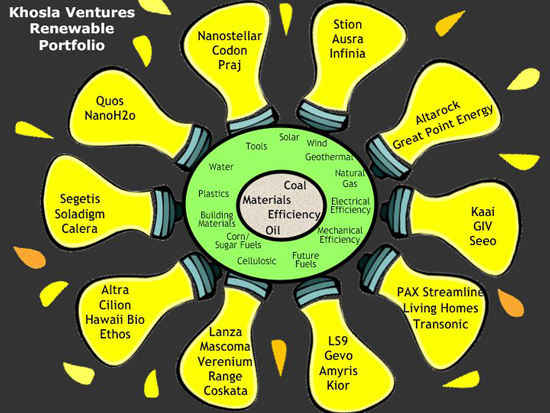
He has invested in starch-based ethanol companies such as Altra and Cilion, as well as cellulosic-ethanol companies like Range Fuels and Mascoma, among many others (see portfolio chart here). Although Khosla is not a big fan of corn-based ethanol, he said he views it as a step toward cellulosic ethanol.

He also previously said he thought plug-in hybrids were too expensive (see In Depth: Ethanol Shmethanol).

The point of view is controversial. Plenty of other entrepreneurs and analysts like the technology, including Earth Policy Institute President Lester Brown.

For example, Ford Motor Co. (NYSE: F) and Toyota Motor Corp. (NYSE: TM) are testing plug-in hybrids (see Who's Reviving the Electric Car?).

Khosla added that, although he doesn't view electric vehicles as a climate-change solution, it doesn't mean such efforts won't go unrewarded. "They will be great investments," he said.

Plug-in hybrids weren't the only transportation technology Khosla disparaged during his keynote.

He also gave biodiesel a thumbs down, saying it requires too much land.

The fuel will be permanently dependent on subsidies, and has relatively poor technical performance and prospects, he said.

"It's not such a great idea," he said.
Comments [15]

  • Daniel Englander 12/6/07 7:37 AM

    Khosla refers to everything he hasn’t invested in as a “toy”. He’s dropped a lot of money into upstream biofuel development, but without downstream distribution infrastructure, a biofuel-powered car is pretty useless. Khosla should put his money where his mouth is and started developing ethanol fueling stations.

    Reply
  • Bill Bellicheck 12/6/07 10:26 AM

    I agree with the goblin here. The cost of infrastructure for biofuel filling stations is a huge barrier to it’s adoption. Lithium Ion batteries hold a lot of promise in EV/HEV applications, and even now range is more of a perception problem than a real one.

    Reply
  • Jim Lezie 12/6/07 3:32 PM

    ”...... not be material to climate change.” Really(?); what percentage of total petroleum consumed is burned by vehicles typically traveling less than 50 miles per day (one current-technology battery charge)?  If charged each night such vehicles would rarely experience their internal combustion charging engine (or fuel cell ) coming on. - - Clearly, we need to utilize less hydrocarbon fueled generation in the power grids called upon to charge these vehicles ?? step two.

    Reply
  • Richard Wright 12/6/07 10:35 PM

    As others have mentioned, VK has a vested interest which he promotes by declaring it superior to all technologies.

    But ethanol and biofuels generally are only alternative ways of hanging onto the infernal combustion engine, which seems an unimaginative approach at this stage in history.

    This is the 21st century. Almost every other gadget we buy is solid-state or is partly so. We don’t use mechanical calculators any more, nor mechanical checkout tills. And were we starting from scratch in devising a transport vehicle, I doubt that anything as complex as a piston engine would make it beyond the drawing board - regardless of which fuel was proposed. It really is time we moved on. Compared with the ever-growing complexity of a piston engine - with all the add-ons needed to enforce eco-compliance, E drive systems are streets ahead in terms of simplicity.

    Folk can argue till the cows come home, about which fuel they should put in their mechanical engine, and how many gadgets they should employ to balance its emissions. But in the 21st century it all sounds terribly anachronistic and unnecessary. Time we moved on.

    Reply
  • Daniel Englander 12/7/07 4:45 AM

    stan - seems like you’ve got a lot of experience with EVs. do you think the adoption problem is a matter of perception - people assuming you can only drive for 45 miles, etc. - or is it really a matter of technological limitations? is the technology ready for a commercial roll-out at affordable prices without causing major disruptions to the new owners? maybe VK thinks that biofuels are the way to go because they’re most like the cars we drive today - there’s no (real or perceived) technological learning curve for early adopters.

    Reply
  • Mike Louis 12/7/07 7:18 AM

    Can Greentech Media do a story with the title “Energy Experts Call Vinod Khosla a ‘Tool’?”

    Seriously, this guy is both completely clueless about energy and unquestionably conflicted because he’s getting ready to lose a lot of money thanks to his utter cluelessness. Why does Greentech Media continue to give him a platform for his misinformed (i.e. false) views on energy? Ethanol is a joke, and Khosla is preparing to lose a lot of his LP’s money on his horrible bets. Plug-in hybrids work quite well, thanks, without a lot of improvements to batteries, and biodiesel doesn’t take any more land than ethanol - especially if you’re using waste oil, animal fats, or up-and-comers like jatropha.

    And the irony of him accusing biodiesel of requiring too many subsidies ... that’s a laughable statement. Ethanol only exists thanks to ADM and the corn lobby in DC.

    I hope that Greentech Media will find more knowledgeable investors for its future interviews.

    Reply
  • Paul Scott 12/7/07 7:29 AM

    As one who has been driving a production EV from Toyota for the past 5 years, I can attest to the viability of the technology. With a range of 120 miles+, it’s a rare day that I don’t have enough range for what I need to do.

    This vehicle (RAV4 EV) was designed in 1997 for use with a 95 amp hour Panasonic NiMH battery pack. Of the 1400 vehicles manufactured by Toyota, about 600 were detroyed before activists shamed them into stopping. Of the 800 or so left, about 300 remain in private hands with the rest in utility and municipal fleets. At least 4 of the private vehicles have exceeded 100,000 miles with virtually no maintenance required.

    SoCal Edison has the largest fleet with some 250 RAVs. They have kept meticulous records and claim over 15 million miles driven by their fleet. The vehicles have averaged a mere $200/year for maintenance, much of which was spent rotating the tires.

    Battery EVs are extremely viable as daily drivers. Over 80% of Americans could have all of their daily driving needs met with ten year old technology. While the cost of nickel and lithium is a concern, economies of scale could take care of most of the cost. Savings in energy and maintenance will remove the rest of the economic barriers.

    BTW, a survey taken last year showed that a full 48% of Californians who drive EVs power their homes and cars with solar PV. This compares quite favorably with the less than 1% of Californians as a whole who use solar.

    Reply
  • Fake Name 12/7/07 7:36 AM

    OK, so no doubt that Khosla is conflicted, but then again he never claims not to be.  He is a VC after all, and a big part of his job is to be out pimping for his companies.

    The real question with EVs and PHEVs (and every other flavor of electric vehicle) is will the existing auto industry ever get behind them.  To date most of the action has been from smaller start up companies.  The cars they produce will never reach the mass market because they don’t have the manufacturing expertise or the service and support infrastructure.

    Look at how many recalls even good (eg- non US) car companies like Toyota or BMW have.  Now think about dropping $100 grand for a Tesla roadster, and the thing inevitably breaks down within the first year… and there is no one to service it!

    Until the big car companies get on board in a meaningful way (Not just show cars and propoganda experiments) the correct focus should be on biofuels.

    Reply
  • Mike Louis 12/7/07 8:01 AM

    led1 - you’re looking in the wrong place - utilities, both traditional and distributed, will help make sure that PHEVs roll into the marketplace as they have a substantial interest in seeing them succeed; they’ll be further pushed by the growing renewables industry that views them as a way to store intermittent resources under the hood. I wouldn’t trust the American car industry with ... well, with anything.

    There are already service providers who will convert your traditional hybrid into a PHEV, and while it’s spendy, that’s just for now. The amount of modification needed to make a PHEV is very small, really.

    And if you’re placing your bets that Detroit is even going to be in the auto business in 10 years ... more power to you. Toyota, Honda and the EU manufacturers will all go PHEV in due time; they’re just waiting for Detroit to finally die its deserved death.

    Reply
  • Daniel Englander 12/7/07 8:38 AM

    I’ve said it before on these pages, but the company with the most resources to leverage into making an EV is General Electric. Forget Detroit, forget the utilities. GE has the scale, balance sheet, and engineering capabilities to get it done. Why they haven’t is beyond me.

    Reply
  • Mike Louis 12/7/07 9:17 AM

    Funny thing ... GE actually approached the Big 2 a couple years ago to offer a large sum of cash to help them make PHEVs and improve battery life.

    The geniuses of Detroit, according to my sources, looked at the boys from GE finance like they were from Mars. “What’s electricity?” was the tone of the response.

    You’re right that GE would be the natural hub for this sort of thing, but also keep in mind that they don’t make their own stuff so much as make the partnerships that make stuff and sprinkle them with cash. Check out Austin Energy’s Plug-In Hybrid Partners program as the model for what utilities will be doing in 10 years on this: http://www.pluginpartners.org/.

    Reply
  • Daniel Englander 12/7/07 9:45 AM

    Great… “Austin Energy, the City of Austin?s community owned electric utility, has set aside $1 million for PHEV rebates for Austin Energy customers when PHEVs are made available.”

    It seems like everyone involved is interested in solving one aspect of the problem. There’s no coherent action plan for (1) commercializing affordable, reliable technology, (2) creating a significant, widespread distribution infrastructure, and (3) providing incentives for early adopters.

    This is something Detroit figured out 80 years ago - scalability, financing plans (GMAC, etc.), and marketized distribution. It would be easy for GE to do all three.

    Reply
  • Tom Fulks 12/7/07 12:29 PM

    For a so-called “visionary,” Khosla is pretty ill-informed about renewable diesel fuel. His bad mouthing is based on his understanding of old, soy-based technology, the so-called FAME (fatty acid methyl ester) biodiesel fuel being promoted by the soy and farm lobby. Khosla clearly doesn’t kow about second-generation renewable diesel fuel known as NERD (non-esther renewable diesel). This is the fuel the engine manufacturers prefer over old biodiesel, and it has tremendous criteria pollutant and greenhouse gas emissions benefits. This dude needs to study up.

    Reply
  • Rachel Barron 12/26/07 3:13 PM

    Below is a comment from Vinod Khosla, founder of Khosla Ventures. Greentech Media has posted it at his request.

    From Khosla: You might refer your readers to http://www.khoslaventures.com/resources.html where almost all the questions raised here are addressed.

    ? We do invest in batteries (Seeo), not just ethanol. We also invest in engines (Transonic ? a 100mpog gasoline car is more cost effective than a 100mpg hybrid and could cut oil use by half at very little additional cost!), in butanol, cellulosic gasoline, cellulosic diesel, and cellulosic aviation fuel and more. Batteries are a great investment and hybrids will be around and big but will not be materially change carbon emissions in the next two decades. Biofuels can.

    ? I question if PHEV?s will reach 50% market penetration in China and India anytime soon where the cost of a car is approaching $2500! How do we add the cost of PHEV to that in those countries and without adoption here we are toast from a carbon emission perspective. Also in my paper I describe how hybrids and FFV?s are complementary and how market share might shift between them. I propose in fifty years we may have all electric cars through this mechanism instead of the naïve wailings of the greenie crowd that does not understand economics, adoption, and consumer and investor behavior.

    ? I critique classis diesel (FAME) but promote other ?bio? diesels in my papers. I do think cellulosic diesel made from either a fermentation process (LS9, Amyris) or various catalytic/thermochemical processes (Kior, and other undisclosed investments) will kick classic biodiesel?s butt!

    ? The only way we will solve this problem is if people can make money at it , not lash out at people on blogs while sitting on their butt or being ?pure? environmentalists with impractical (and more importantly, unlikely to be adopted or unlikely to be scalable solutions like ?lets all drive less?, ?lets reinvent cities? , ?lets get rid of western ways of life? etc etc.) ideas. We need hundreds of billions of dollars deployed in green alternatives against the might of the oil companies, oil nations and the coal lobbies. The ONLY way that happens is if people can make money at it.

    ? I don’t support areas because I have invested in them. Rather I invest because I believe they are real solutions that will work. For a blogger or university academic there is no harm if they   pontificate and are wrong. I lose all my money if I am wrong so I have to be critically objective and change my mind quickly if I am wrong. They are not putting their money where their mouth is. I am.

    ? I don’t go by press reports or published data only. We add proprietary information form inside companies and research efforts in our assessment and that data will not and should not be public as it is proprietary (should coke reveal its formulae?). As Alan Kay said, ?the best way to predict the future is to invent it? and many of our investee companies are doing just that.

    Reply
  • hazel 05/28/09 12:33 AM

    [url=“http://mls.fastrealestate.net”]
    mls[/url]

    Reply
.