Is Ivanpah the World’s Most Efficient Solar Plant?

If current calculations are correct, the 392-MW facility may edge out others for bragging rights, investment dollars.

Is Ivanpah the World’s Most Efficient Solar Plant?

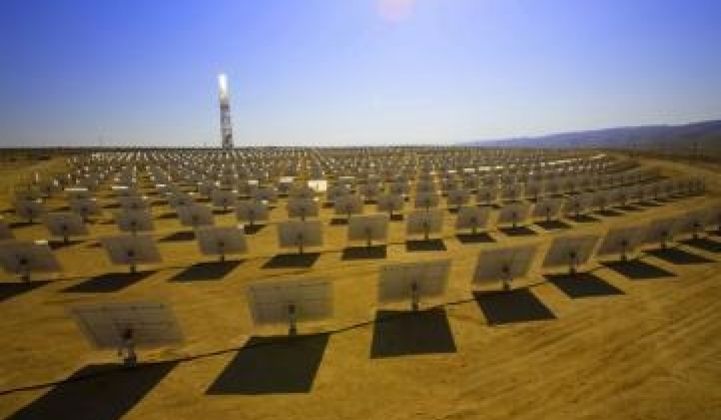
BrightSource Energy’s planned Ivanpah plant will be one of the world’s largest solar farms -- and possibly its most efficient.

When the solar-thermal plant is built on the edge of the Mojave National Preserve (construction is expected to start this year), it will operate at 18 percent efficiency and earn a capacity factor of 30 percent.

This performance should make the 392-MW facility more efficient than plants with crystalline-silicon panels, thin-film cells or rival thermal technologies using parabolic mirrors, according to analysts.

The plant is to be laid out on three nearby tracts covering 3,500 acres of desert and should run at full capacity 10 to 11 hours a day. The company says a back-up natural gas system will aid performance during its long hours of operation, easing power fluctuations on cloudy days.

This consistency of power should put electricity costs on par with natural-gas plants, something photovoltaic plants will take another two years to achieve, some analysts say. While comparing plants is complex and imperfect, the newly available figures from BrightSource make the exercise a useful chore. Sun intensity, atmospheric moisture levels and power transmission costs of course differ plant location to plant location.

But determining who holds the industry’s bragging rights -- as well as who deserves project investment dollars -- is a task utilities attempt everyday, despite the difficulties. In an interview, BrightSource Product Manager Andy Taylor described Ivanpah’s efficiency as a sunlight-to-electricity calculation based on two years of testing the company’s Luz Power Tower 550 in Israel’s Negev Desert.

At the top of the towers, boilers absorb sunlight reflected from 7-square-meter ground-mounted mirrors and heat water to more than 1,000 degrees Fahrenheit, the highest temperature in the industry. The super-heated steam drives turbines.

The company says a back-up natural gas system permits the long operating hours and the ability to run most of the day at full capacity. The gas is used to warm boilers in the morning and augment solar power on cloudy days to keep output high. “We’re pretty much a sun-up-to-sun-down resource,” Taylor says.

BrightSource, which has so far raised more than $300 million in financing, expects the plant’s efficiency to rise as the company moves beyond its first-generation technology. Higher-efficiency turbines are already in the market, and additional mirrors, or heliostats, can be deployed. Water temperatures also will rise to above 1,100 degrees.

In contrast to Ivanpah’s 18 percent efficiency, the efficiency of utility-scale crystalline silicon and thin-film plants is likely less than 12 percent. Solar-thermal plants with parabolic mirrors also have difficulties keeping up. Ivanpah’s higher boiler temperatures give it an advantage, and dual-axis tracking can more accurately follow the sun through the seasons. The average efficiency of other solar thermal plants is 13 to 15 percent, says Cara Libby, project manager at the Electric Power Research Institute.

That doesn’t mean Ivanpah won’t have competition. One crystalline-silicon vendor, SunPower, with industry-leading 18-percent-efficient solar cells, could give BrightSource a run for its money, says Travis Bradford, president of the public-policy think tank, Prometheus Institute. A SunPower farm with a single-axis tracking system could have an efficiency of 15 percent, or maybe slightly higher depending on the location, he says.

Broader competition will come with falling solar-panels prices, unless a stronger Chinese currency slows the trend. Panel prices tumbled about 40 percent last year and, while they are more stable this year, they continue to decline more rapidly than solar thermal efficiency is improving.

BrightSource responds that plant efficiency is only one measure of performance, and not necessarily the best. Capacity factor, a calculation of a farm’s ability to deliver full power over time, may be more important, the company says. Ivanpah’s capacity factor (including the use of natural gas) should be 30 percent, Taylor claims. A wind farm in an ideal location (think Tehachapi) can have a factor of 40 percent. Photovoltaic plants generally are lower. A Carnegie Mellon Electricity Industry Center study estimates a PV plant in Arizona should be closer to 20 percent.

Another useful metric is the delivered cost of electricity. BrightSource claims this measure makes Ivanpah “extremely competitive,” but declines to release figures to back up the claim. The calculation looks at plant output versus costs and factors in development and financing charges. An examination of California Public Utilities Commission documents shows only that expected delivered costs are to be less than 12.5 cents a kWh. It doesn’t state how much less.

Nevertheless, Nathaniel Bullard, a solar analyst at Bloomberg New Energy Finance, calculates that the cost of Ivanpah’s electricity will be lower than photovoltaic power and about the same as natural gas. Of course no one knows for sure until the plant is built. “We’ll see if they can meet the targets they have in place,” Bullard says.

13 Comments

  • Tom 06/24/10 1:52 PM

    CPV plants operate at well over 20% efficiency.

    Reply
      • Bill 06/24/10 4:09 PM

        It seems each approach has it’s bragging points.  For ground mounted projects the efficiency and capacity factor are important, but intermediate, parameters that feed into the key metrics of LCOE and AC MWh output (from solar input) per acre of land used.  It would be interesting to compare the technologies along these metrics - how much does each solar generated MWh cost, and how much land is needed for each solar MWh/year?  The fact that various technologies are all winning projects in CA says they all must be competitive depending on site specifics and owner/investor preferences.

      • Falstaff 07/11/10 8:06 PM

        But concentrators require expensive two-axis trackers, as the lenses only work well with radiation normal to PV plane and lens.

  • PV PhD 06/24/10 4:46 PM

    How do you define “efficiency” for large scale solar installations? We usually assume that 100% of the light is illuminated on the device when discussing the power conversion efficiency of solar cells and modules. However, for large scale projects there is a lot of empty space (i.e. spots between heliostats and spaces between PV module rows) that is illuminated but does not contribute to power generation. I would guess that the 18% efficiency you quoted is based on the total surface area of the heliostats and not the total area of the farm.

    From a technical perspective, talking about the conventional power conversion efficiencies might be less relevant than talking about power output per meter squared at full sun over the entire area of the installation. Economically this might be less relevant because we do not currently pay a premium for desert land, but before talking about bragging rights we should set up some ground rules for competition.

    P.S. I really like GTM articles and look forward to receiving them every week.

    Reply
  • Carl Hage 06/24/10 5:56 PM

    How is efficiency measured? kW/mirror-m2? What might be more relevant is MW/hectare and $/MW, multiplied by the capacity factor. The 392MW/3500ac is .276 MW/ha, or 2.76 MWh/day/ha at a 10 (!) hour capacity factor. In Mojave, insolation is 58 MWh/day/ha (0 tilt collector), so efficiency of the site is really 4.8%. Relatively low efficiency 11% CdTe fixed panels with complete coverage would yield twice the energy/acre.

    What really matters is $/W and $/Wh. Efficiency might matter when adding installation and mounting equipment costs, but 2D mirror trackers don’t compare directly with panel brackets.

    Also, note that the area for a solar PV plant isn’t that large compared to traditional plant including cooling ponds. For example the 2800MW FPL Martin power plant is on 11,000 acres, and running 20 hours/day full capacity, is only 2X the kWh/day/acre of a 10% efficient solar plant. If you include the area for strip mines, coal plants take up much more area.

    But ideally, PV panels should be put over parking lots and large roofs, so won’t need any dedicated area, and would be closer to it’s users.

    Reply
  • Larry G. Stewart 06/24/10 8:14 PM

    Does anyone here follow Solarreserve? How do Brightsource and Solarreserve compare? People are throwing out alot of numbers and I don’t know how applicable this info is.

    Reply
  • solarguy 06/25/10 2:31 AM

    Ugh another GTM puff piece on BS. So boring and tiresome…

    BS and Solar Reserve have very similar steam cycles and so should have similar if not the same solar to electric conversion efficiencies. Solar Reserves CEC filing for their proposed 150 MWe project in Rice, CA shows a molten salt temperature of 1050F which would give a main steam temperature of 1000F just like BS.

    Another poster mentioned CPV systems as having higher solar to electric efficiencies so it should also be mentioned that dish stirling systems have high solar to electric efficiencies too.  At ~ 25% solar to AC electric efficiency Stirling Energy Systems and their proposed projects are the most efficient solar plants in the world.  Not BS and Ivanpah.  This doesn’t really mattter as another poster noted since the cost of the electricity from a large scale dish stirling plant remains to be seen and it is $/MWh not solar to electric efficiency that ultimately matters.

    There is no way power from BS’ Ivanpah project will cost less that $125/MWh. It will be closer to $180/MWh if the project can secure financing and actually gets built. Their small heliostats are stupid and will cost a small fortune to install once the blood sucking parasites at CURE are done with them.  BS has already lost to First Solar but they do not yet know it. It’s really too bad that it is us rate and tax payers who are going to pay for BS to learn that lesson.  The only hope for rate and tax payers is that the project will tank before BS draws much or any of the $1.4B DOE loan guarantee they got…

    BS still has not generated one single kWh of electricity. It remains to be seen if they ever will.

    Reply
  • Grandpa 06/25/10 3:07 AM

    I tend to agree with solarguy: why is BS getting all this coverage when operations are 3 years out?  This industry is transforming so quickly there might be something better coming along in that time frame.  I’m a believer in CPV.  The people who work on projects in the desert all have the same problem: 1) transmission congestion all around Southern California, and 2) building the plants in the first place.

    Is this an article written on behalf of BS?  Or is it that BS feels the need to maintain project viability and do that by feeding the media an interesting tidbit.  And lumping the efficiency of crystalline silicon panels and thin-film together as if they are one and the same is like saying an apple is like an orange.  Suntech and Sunpower panels are more efficient than thin-film.  As PV PhD said, lets set some ground rules for the competition before the conjecture begins.

    Reply
  • Larry G. Stewart 06/25/10 9:52 AM

    Both Solar Reserve and BS are Solar Thermal solutions. BS does not utilize any form of Energy Storage while Solar Reserve indicates that it can store solar energy in the form of molten salt very efficiently. The BS solution requires backup by a natural gas power plant. I don’t see that this discussion includes the cost of this natural gas backup in the analysis. Isn’‘t it possible that SolarReserve is providing a more practical and cost effective solution?
    CPV would require some form of Energy Storage or Backup by Natural Gas power plant so that would add to the projectd costs.
    It will take awhile for the Markets to sort all this out.

    Reply
      • Haerdt 07/4/10 2:30 AM

        Let’s keep in mind that the acronym BS has alternate meanings…

  • pROB 06/28/10 6:04 PM

    Envision Solar (EVSI.OB) converts parking lots and structures into Solar Groves with vehicle charging stations for hybrids and electric cars. Envision Solar Stockholder here who believes that Solar Trees are going to be BIG moneymakers!


    check out some of their plans at…...

    http://www.envisionsolar.com/video/

    Reply
  • Telemann 06/29/10 3:52 PM

    I was extremely gratified by the knowledgeable commentators on the Ivanpah article. Their analyses and mention of competing systems were as interesting as the description of BS’s Ivanpah - which by the nature of things features positive projections. From my perspective as an energy policy researcher the highlight of the report was the creative use by BS of backup generation by natural gas, not just to compensate for the intermittent nature of solar energy, but to preheat the boiler system for optimum performance. The realistic and synergistic combination of established technologies and equipment with renewable technologies to achieve stability and efficiency in electrical power generation often gets less attention that the “gee whiz” attraction of new innovative systems. The trouble is that before such systems get real-world testing, there are few limits on optimistic projections that media and ideological advocates for renewables may welcome. If projections take the place of more realistic assessment in governmental planning or Congressional legislation,  then the results can lead to double disaster: 1) failed programs; and 2) disillusionment and cynicism on the part of the most able industrial companies and private investors about future involvement in stigmatized development areas. Senator Jeff Bingaman pointed out in his presentation for the unveiling of the NAS Energy report of 2008 that every administration since Richard Nixon had proposed renewable energy vehicles and other solar energy projects that eventually foundered. The failures were particularly egregious in the late 1970s because there was such a large ideological motivation behind Jimmy Carter’s visions. He didn’t want to include in planning people who might throw cold water on his cherished projects.

    The German and Scandinavian approach emphasizing realistic assessment for implementing new technologies, including public acceptance, longer-term financing, policy innovation to minimize distortions and adverse impacts on private industry, etc. is exemplified by the German feed-in tariff. Successive German governments with different political persuasions supported the program for its committed life length of 20 years, assuring that technological firms would be able to recover their expenses and more. That program will not be extended in its present form in the future, in part, apparently, because Chinese PV suppliers have taken over much of the market originally anticipated to be served by German PV suppliers. But, because of the way realistic assessment is brought into the picture, there will be no traumatic disruptions.

    The big question is when the U.S.‘s manic depressive, serendipitous, short-range approach to policymaking will begin to be replaced by realistic analysis, cooperation, and learning from other nations.

    Reply
  • JoeJoe 06/29/10 6:25 PM

    Here’s a write up by Vaclav Smil that compares the power density of coal, natgas, wind and solar.

    http://www.vaclavsmil.com/wp-content/uploads/docs/smil-article-power-density-primer.pdf

    Smil likes to compare technologies by power density. This metric provides a good framework for comparison in most circumstances but its application to PV is questionable. The fact that you can tilt panels or build them into a facade spoils the comparison. It’s questionable whether you should even compare PV on roofs to other technologies because, in the case of PV, you are reusing a space that might not otherwise be used. Smil is an awesome writer so I’m not trying to call him out or anything. Just pointing out the obvious difficulties that arise when we compare energy technologies using physical metrics.

    I’m a fan of the levelized cost of electricity metric. It factors for installed cost and performance and boils things down to a $/kWh value. It seems as though this is the metric we should be concerned with. Is it perfect? No… I’m afraid not… But it’s getting there.

    Does anyone know of a good Levelized Electricity Cost Calculator?

    Reply
Need an avatar? Get one here: Gravatar