How Solar Thermal Could Move Into Homes

It's only a matter of time before devices and appliances used to capture the sun's heat will begin to perform a wider variety of tasks.

Water heaters are only the beginning for residential solar thermal.

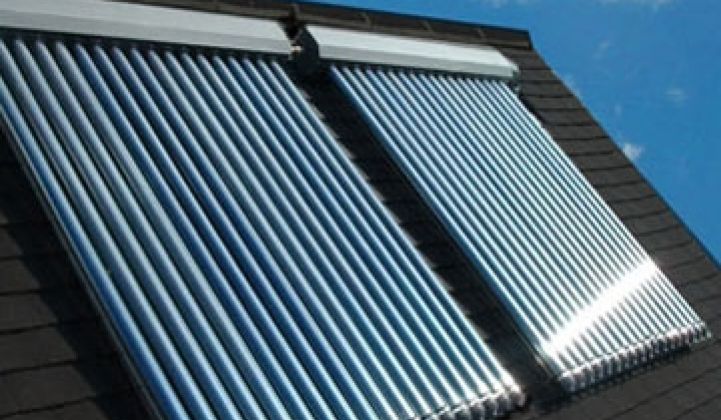
Devices and appliances for capturing the sun's heat are going to likely start performing more and varied tasks, according to solar advocates at the Fifth Annual German California Solar day that took place in San Francisco yesterday. Right now, solar thermal is primarily deployed to heat water for pools, showers or household appliances, but in the future expect to see it used to heat rooms, purify water or other things.

In part, the increased experimentation with solar thermal technology derives from the fact that, compared to photovoltaic panels, solar thermal has been overlooked. Only about 180,000 solar water heaters and other solar thermal devices exist in the U.S., according to Ed Murray, CEO of Aztec Solar. Only 1,000 get installed yearly in California, although many homes in Los Angeles and Berkeley were equipped with solar water heaters in the 1920s, before a large network of natural gas pipelines existed.

Approximately 75 percent of the homes in the U.S. could take advantage of solar technology, said Jane Davidson, a professor at the University of Minnesota and the director of the Solar Energy Laboratory.

But, oops, there's the price. Solar thermal systems in the U.S. cost about $150 a square foot, she said. Without subsides, they are only currently economical in parts of the Southwestern U.S., Alaska and Hawaii.

"In most of the U.S. it is less expensive to use natural gas or electric," she said. Piling on the chores, therefore, can help spread the costs. 

But a growing number of consumers in Germany and Austria are beginning to buy combi systems, said Werner Koldehoff, a board member of the German Solar Industry Association. In these, hot water goes to the heater, and some of it goes through pipes in the floor to provide space heating. A conventional solar water heater might cost €6,000 to €8,000 while a combi system can run €10,000 to €15,000.

Some customers have also begun to harness heat to run solar air conditioners. The Hotel Belroy Palace in Spain has a floor heater/water heater/solar air conditioner, he noted. Air conditioning is in the early stages, but manufacturers are already popping up.

"That is the future of solar thermal. It is not only water," he said.

European communities have additionally started to deploy solar thermal water/heating systems for multifamily buildings and communities. Marstal, Denmark has erected 18,000 square meters of solar collectors which provide 30 percent of the town's heating, he said. In all, the system can provide the equivalent of 12.8 megawatts of power in terms of heat. (Warm wastewater from the shower, whether solar heated or not, can also be used to warm incoming water – Zeta Communities has a pre-warmer like this in its beta home.) Like solar air conditioning, community systems are in the early stages.

Later, solar thermal could be used to purify and/or desalinate water, he noted. Industrial equipment for hot water and steam is also coming from Ausra and eSolar.

One issue that will need to be ironed out, however, is storage. PV panels can just shuttle power to the grid. There is no heat grid. Heat also needs to be stored seasonally – harvested in summer and consumed in winter. One solution may be chemical storage, i.e., fuel cells, said Davidson. 


Join experts and influencers at Greentech Media's Growth Opportunities in the New PV Market: Projects, Finance and Policy in San Francisco on July 13.

18 Comments

  • Bilsko 06/17/09 11:53 AM

    I’d be curious to see the source for the $150/sqft figure.  I’ve been reading up on solar thermal and have come across much more reasonable figures (around the $40/sqft mark- **installed**)  Google: TECHNICAL AND ECONOMIC ASSESSMENT OF SOLAR THERMAL ABSORPTION COOLING
    SYSTEMS IN SMALL COMMERCIAL BUILDINGS

    A 4x price difference is a bit hard to sort out.

    Reply
      • Michael Kanellos 06/17/09 12:07 PM

        That would be Jane Davidson herself. She’s been researching this for years.

  • Bilsko 06/17/09 1:36 PM

    Thanks - So by those figures, a solar thermal installation costs about half as much (on a energy output basis) as PV panels.  Again, I find that a bit hard to reconcile with lots of other sources out there. 

    10ïf aSI PV panels installed go for about $6/W - at that efficiency output is about 100W/m2
    Evacuated tube solar thermal has efficiency ratings somewhere in the 50%-60% range. So output/m2 is around 550W (1877BTU).  At $1,614/m2, that makes the price just about $3/W

    Then again, here’s a recent NREL case study showing a price of $1,074 (just under $100/sqft) http://www.nrel.gov/docs/fy04osti/36149.pdf

    So, while I suspect there’s a lot of tacit knowledge behind that $150/sqft estimate, you can see responses like: “She’s been researching this for years.”  are really not that helpful.

    Reply
      • Steve Pluvia 06/17/09 1:56 PM

        Solar thermal for residential is just not economical.  Regardless of the application, you always need to install a backup system for sunless days.  It makes much more sense to just install the primary for example mechanical system (e.g. geothermal heat pump) that requires no backup and dedicate the savings to a larger PV system which can power the mechanical system and thereby achieve a net zero emission HVAC.

        Anyone installing PV @$6/watt is an idiot.  Site and run conduit to your proposed PV location, then wait for $3ish/watt installed PV prices if you don’t have the resources to install at those prices today.

  • Tyler Hamilton 06/17/09 3:50 PM

    Solar thermal isn’t economical? It’s a hell of a lot more economical than solar PV. It’s economical in Canada, where we have several months of cold and cloudy weather, so certainly in the U.S. south it makes sense. Especially economical in the U.S., where more homes per capita have swimming pools that need heating than in Canada. The reason why residential solar thermal hasn’t taken off in the U.S. is because it’s not as sexy as PV and because the government hasn’t given it much thought when it comes to incentives/rebates. It’s a shame—a far better way to reduce CO2 than using PV.

    Reply
      • jeff 06/18/09 7:30 PM

        We found in 3 installs, thermal to be more financially appealing than current PV. All were radiant floor mountain homes. 2 are weekend retreats, 1 full time. The numbers never worked for PV even though we have a very high solar index. PV is still too much of a science experiment and needs to go back to the lab and be developed to efficiencies of 25% or greater before we can move any of it on the market. Solar thermal is simple and more cost effective if you just hit the H in Hvac and leave the appliances and CFL’s to the utilities. No energy conversion. Straight heat energy.

        PV is sexier but unrealistic. Let’s face it, unless we get efficiencies up we are just creating the largest EPA dump site the world has ever seen. Who is going to recycle this stuff in 20 yrs?

        I am not a real fan of subsidies. Sorry. The auto was not subsidized in the US when introduced. It beat the next best alternative hands down. I believe that solar/alternative energy needs to do the same before we can take it seriously.

  • Bilsko 06/18/09 10:07 AM

    @ Steve Pluvia - Most people who are installing solar thermal systems (and PV for that matter)  are smart enough to know that they serve as peak shaving measures - not baseload-must-run systems.  Your solar thermal system is just going to offset the amount of hot water that your boiler is going to produce (and for an existing system, the boiler is already going to be sized to meet the full load of the bldg) Same with PV - you’re just decreasing the amount of power that you draw from the utility.

    And $6/W doesn’t count any of the up-front grants/tax incentives or SRECs that are available in most states:
    30% Federal ITC,  Commercial Bldg Energy Efficiency tax breaks @ $1.,80/sqft, SRECs pulling in anywhere from 20c - 40c / kWh in East Coast states… Not to mention net metering and feed-in tariffs…

    Of course for most places outside the US Southwest PV isn’t as economically viable as plopping down a recip engine or turbine and running it near full capacity factor… the point is that both solar thermal and PV are (with a great deal of help from federal and state governments) proving to be attractive investments.

    Reply
  • rooferguy 06/21/09 7:46 PM

    I find it very difficult to agree with Steve Pluvia, but I have to….this time.

    The industry has lots of experience with solar thermal systemss.  You need to consider the maintenance costs for moving fluids, pumps, pipes, valves, motors, etc.  They break and leak.  Full stop.  So the operating and maintenance costs are much higher than for PV—which has essentially zero O&M costs.

    The good thing about PV is that the prices are on a fast decline.  Solar thermal does not benefit from manufacturing economies of scale like PV electronics.

    In a few short years it will be way cheaper to heat water with rooftop PV systems (essentially a resistance coil in your hot water tank) than with a solar hot water system.

    Reply
      • Logic 06/22/09 10:00 AM

        The maintenance cost of solar thermal is considerable less than PV. Generally pumps are the first item that will need replacement (10 years into operation), and a pump tends to cost around $100 or less. Compare that with the cost of replacing an inverter at the same interval ($1500-$15,000).

        Pipes never need replacement, valves never need replacement, and the panels do not degrade over time.

        There are literally thousands of solar thermal manufactueres. There are already economies of scale, and prices are declining just as fast, if not faster, than PV.

  • factbased 06/23/09 11:31 AM

    in reply to rooferguy, you need to pencil out your idea for a pv energized hot water resistance coil to see that’s not be a practical nor affordable option for a long time.

    My solar thermal hot water system can deliver peak 100,000BTU net per day to my storage tanks, or 29kWh energy peak per day.  That’s enough energy to raise approx 1000lbs (~120gal) of water 100 degrees, enough to keep 4-5 persons happy. I installed this system on my own for $9k, before state and federal tax credits.

    Now, consider the size and cost of a self-installed pv array to equal this peak energy output, as well as the conversion inefficiencies, and i hope you’ll quickly see the folly in your suggestion.

    Reply
  • russ 06/23/09 1:11 PM

    My system - new this year for a new home - with 3 Schuco panels, control system & hot water tank with electric backup cost about 4000 euros - say 6000 USD, now, in June, the 350 liter tank temp is 90 degrees C plus - I really need to cover one of the panels for summer but the extra panel will be useful in the winter. The prices are with no subsidies, incentive or other cost cutting feature.

    I turn off electrical power to the water tank before 1 April and will only turn it back on in November.

    At present we are receiving about 7.5 kW per m2 per day according to my weather station.

    Reply
  • rooferguy 06/23/09 8:20 PM

    Here’s what home builders are doing in California to get to a zero energy home.  They put a PV system on the roof and use a flash electric heater for hot water.  The house is on a Time of Day rate, which means they get credited for electricity at about 60 cents/kwh at peak, and buy power back at about 12 cents off peak.  Now here’s the fun part when it comes to domestic hot water.  The usage profile for water is in the early AM and evening when they buy cheap electricity.  They run their meter backwards at the 60 cent rage—it’s a 4x multiplier.  Think about it:  no storage tank, no water circulating to the roof, no pumps to fail — all electronic.

    From an incident energy/square foot standpoint I agree it’s better to heat water with a solar thermal system.  But from an economic standpoint it’s better to install solar PV and use a flash heater in certain locations.  This advantage gets even greater for PV when you consider the very rapid installed cost reductions from lower price PV panels and streamlined installations.  The number of locations in which these economics make sense will only increase as PV prices drop and rates increase.

    Reply
      • Steve Pluvia 07/1/09 10:00 PM

        Guys but you’re still using the wrong design.  One geothermal heat pump replaces costs for 1.  an Air conditioner; 2.  a Heating system; 3.  a Domestic hot water heater.  1 waterfurnace geothermal heat pump replaces all these and does so with a cheaper capex than solar thermal that won’t provide you a cooling system.  Add PV with installed cost of $3.50 or less and you run the heat pump for free.  Size your PV properly and you run the entire house and your plug-in hybrid off of 15-1800sq ft of PV. Do more research before throwing your money away with a much more complicated, expensive and failure prone solar thermal system.  If you want to use solar thermal use it to boost your heat heat pump by running a loop of both your heat pump and solar thermal thru an insulated heat sink [think insulated sand filled box].  Use another loop for ice melt if needed in your area.  Solar thermal works and is cost effective in very select applications only.

  • factbased 06/24/09 6:44 AM

    rooferguy,

    wow, i had no idea, thanks for the education.

    any idea what the “average” daily gallons of hot water usage is for households using this setup?

    i would also assume the electric utility is giving incentives to replace storage tanks with flash heaters as well?

    i’m in the northeast with no tiered electric rates, and the choice of either diesel or propane for most heat, so we have ways to go.  i could flash electric heat hot water also with pv, but don’t have the multiplier on the net metering as you do.

    Reply
  • Whetstone Green 06/29/09 11:53 PM

    Factbased asked the important question. In doing research for a net-zero community I’m developing in SE AZ, I discovered likely buyers for high performance homes use less water than average. Case in point: My wife and I only use about 90 gallons per day. Although I can’t measure how much of that is heated, our summer gas bills are only about $12 when meter charge is removed. If a solar water heater saves 75%, it will only reduce our gas bill by about $120 per year. I’m not saying that’s typical, but in my experience, most folks who sell solar systems (and just about any other energy conservation product) way overestimate base loads when doing savings calculations.

    The March 08 issue of Energy Design Update had an excellent article on this (page 12). A solar thermal system installed on the subject home turned out to have a payback of 489 years. The article makes the case that investing the same $$ in PV would have provided more benefit to the homeowners of this particular house. NREL researchers presented the paper at the January 08 ASHRAE Conference.

    The biggest fallacy when doing cost-performance calculations is failure to estimate how much of the solar energy captured by the water heater is actually used. Clearly, a system sized for space heating is going to operate at far lower than capacity in the summer. You’re paying a huge premium to buy capacity that will only be needed a few months of the year. The same issue applies to PV in markets without net metering.

    Having said all of that, our local utility recently introduced an incentive program for solar thermal. When combined with the Federal incentive, I believe I can now cost-justify a 32 sf panel on the 2-person homes I’m developing, assuming my own personal usage patterns are atypical. (My target market is early retires and empty nesters). Whether you like the incentives or not, they play a key role in any cost-performance analysis.

    BTW to the OP, I received 3 quotes on 32SF solar thermal systems with 80 gallon storage tank and electric backup (one tank). All were higher than $150/sf. Your reference has no relevance to this thread.

    Reply
  • zinfool 10/24/09 12:18 AM

    Back in the sixties, I was part of a research effort to see if thermal solar was a practical and economic venture. We made several assumptions about what types of applications would have to be included. 1. It would have to generate electricity. 2. It would have to heat the house. 3. It would have to heat all the water the housed used. 4. It would be the source of heat for cooking, and other related tasks. 5. It would have to work for air conditioning. So our goal was to make a system that would run the energy need of the house in total.

    We used a parabolic reflective tunnel and concentrated the energy on a pipe suspended at the hottest point. Water did not work because it got too hot. We experimented with oils, and came up with cottonseed oil as the best because of it’s high temperature flash point, over 1500 degrees F. We were able to show that all the tasks listed could be done, but the efficiencies were not really good. Modern heat pumps, coupled with some of the geothermal 2 stage systems make it easy now. The costs?? Someone would have to design and build a modular system that was a drop in unit to make it work and be cost efficient. No one that I know of is doing it. If I build another house, it will have all these items. Please, someone do it, make allot of money too!

    Hope my experiences from the past can get all you smart guys and gals thinking outside the box I see/read above that you seem to be locked in….

    zinfool

    Reply
      • stevepluvia 10/24/09 11:35 AM

        @zinfool:  You are correct re: heat pumps.  Tyler Hamilton et al are dead wrong re: their use and application of solar thermal.  Best evidence to date is the recently completed Solar Decathalon.  You will note the winning entry from Germany came to the exact conclusion I noted in my post above.  Specifically, use heat pumps as primary heat/hot water/cooling and run everything possible on electricity produced by PV. 

        You will note none of the Decathalon contenders used solar thermal as a primary for hot water or heat.  The winners of the hot water and comfort (heating & cooling) used heat pumps for heating and hot water.  One used a very kewl ERV equipped with a heat pump.  Several used stand alone heat-pumps for domestic hot water heaters (these will become the new “hot” green renovation product). Pay attention Mike K—there’s a story there…

        Solar thermal was only used by the top contenders for preheating a tank that boosted performance of the heat pumps.  Exactly as I described in my post above, written weeks before the Solar Decathlon =).

  • Ade Adeshina 11/3/09 1:36 PM

    We are interested in your solar products as a wholeseller and installer in the UK and West Africa, hence this email. we are willing and able to visit your site upon your invitation/acknowledgement of this email, therefore we will appreciate swift acknowledgement from your team to ensure our travel plan for group coming programme/project

    Kind regards
    Ade Adeshina CEO
    Adex Ventures Uk
    Ade Adeshina UK Limited
    Broad House
    205 Fore Street
    Upper Edmonton
    London
    N18 2TZ
    Phone: +44 208 807 6252
    Fax : + 44 208 803 2729
    CEO - Direct mobile Line: 07950616696

    Reply
.